
Photo: Moonik · CC BY-SA 3.0 · Wikimedia Commons
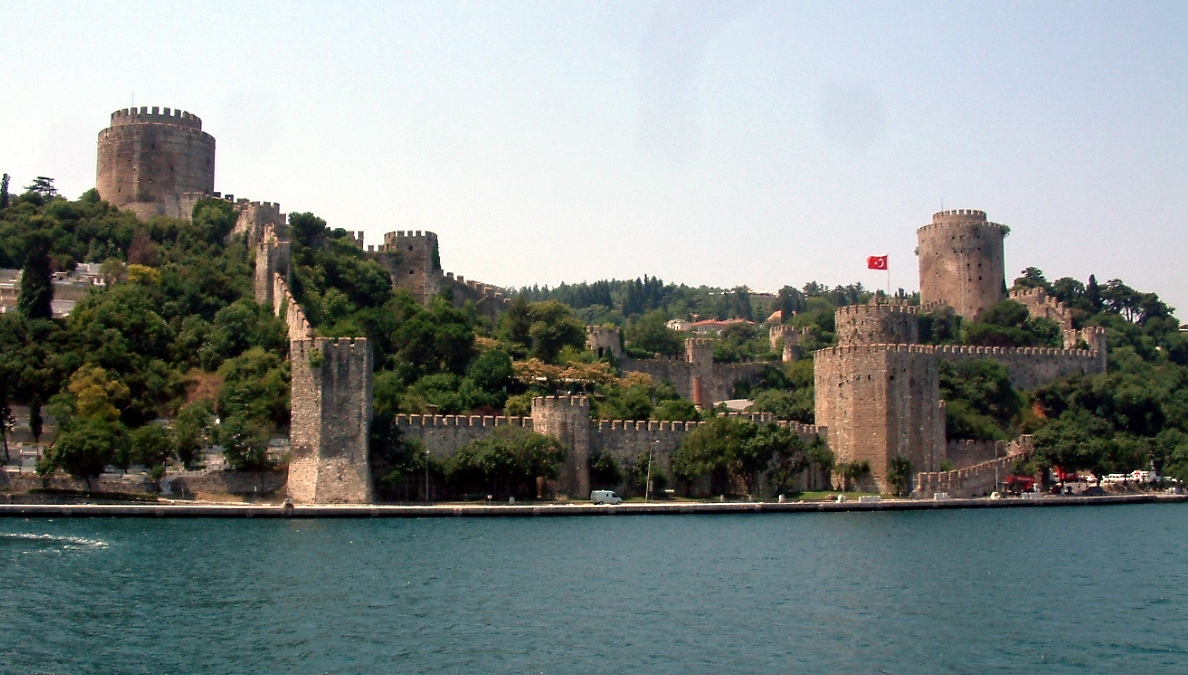
Yoros Castle is a castle near Istanbul/Tyrkey. Guards the northern mouth of the Bosphorus strait. The free Lokali audio guide runs 7 minutes.
✓ Published October 2026 · how we write these guides
Visitor facts
| Lokali audio guide | 7 min · free |
|---|---|
| Type | Castle |
| Location | Sarıyer, Türkiye |
| Coordinates | 41.1786, 29.0944 |
| Languages | 50+, in the Lokali app |
The story
The path climbs steeply from the fishing village below. Underfoot, the cobbles give way to packed earth and loose stone. Wind comes off the water, and it smells of salt and something colder, the open sea to the north. Gulls call from somewhere below you. Then the walls appear: ragged towers of grey stone, banded with thin red brick, standing on the crest of the hill like broken teeth. Welcome to Yoros Castle.
First, a small note about where you are standing. Yoros sits on the Asian shore of the Bosphorus, above the village of Anadolu Kavağı. Many visitors come from the Sarıyer side, on the European shore, and see the castle across the water before they ever reach it. Ferries link the two shores and the villages along the strait. So this is a place you often meet twice: first as a silhouette on a hill, then up close.
Turn north and look. This is the reason the castle exists. Here the Bosphorus begins to widen and open into the Black Sea. Every ship moving between the Black Sea and Istanbul must pass below this hill. For centuries, whoever held this ridge could watch that traffic, and could try to control it. A fortress here was less about defending a town, and more about guarding a door.
Long before the walls, this headland was a sacred place. Ancient writers describe a sanctuary near the mouth of the strait, often called the Hieron, linked to Zeus as the giver of fair winds. Sailors stopped to make offerings before they faced the open sea. Some scholars believe the name Yoros comes, through many centuries of speech, from that old Greek word. That idea is widely repeated, but it is a theory, not a certainty.
The story reaches back even further in legend. According to Greek myth, Jason and the Argonauts sailed through these waters in search of the Golden Fleece. The myth tells of clashing rocks at the entrance to the Black Sea, which smashed ships that tried to pass. Locals and travel writers like to place that tale here, at the mouth of the strait. Nobody can prove it. But stand in the wind and watch the current, and you understand why sailors feared this passage.
The walls you see belong to the medieval centuries. The castle was a Byzantine fortress. The Byzantine Empire was the Greek-speaking eastern Roman Empire, ruled from Constantinople, the city we now call Istanbul. Look at how the walls are built. Rough stone is laid in courses, with rows of flat red brick running between them. This banding is a typical Byzantine method. It made walls more flexible and helped them survive earthquakes, which this region knows well.
In the fourteenth century, the castle passed into the hands of the Genoese. Genoa was a powerful trading republic in northern Italy, and its merchants had a strong colony across the Golden Horn, at Galata. Their ships traded deep into the Black Sea. Holding a fortress at its entrance made good business sense. Because of this period, you will sometimes hear the place called the Genoese Castle. Historians also describe tolls collected from ships passing through the strait in these centuries.
Then came the Ottomans. As Ottoman power grew around Constantinople, castles along the Bosphorus changed hands. Yoros eventually came under Ottoman control in the late medieval period. After the conquest of the city in 1453, the strait was fully inside one empire. Over time, newer defences were built closer to the water, and this hilltop fortress slowly lost its military role. Grass and wild fig trees moved into the towers. The castle became a ruin, and a viewpoint.
Here is something many visitors miss. Look closely at the stonework near the main towers. In several places, builders reused older carved blocks, and some stones carry crosses or other marks. Reused stones like these are common in Byzantine walls. Builders took material from older buildings nearby. So a single wall can hold pieces from very different centuries, stacked together like pages from different books.
And here is a second surprise. This is not a forgotten ruin. In recent years, archaeologists have carried out excavations inside and around the castle. They have studied the walls, the layout of the inner area, and the layers of use beneath the surface. Parts of the site have been fenced or restored as this work continues. So the castle you visit today may look a little different from the one visitors saw just a few years ago. The hill is still telling its story.
Now look east and west along the strait. On the far side, on the European shore, you can see the hills of Sarıyer and the village of Rumeli Kavağı. Its name is a mirror of the village below you. Rumeli means the European side, and Anadolu means the Asian side. Further north, a large modern suspension bridge crosses the water. It carries traffic between two continents, at the very place where ancient sailors once prayed for good winds.
When you walk back down, take your time in the village. Anadolu Kavağı has long been known for its fish restaurants, and the smell of grilling fish often drifts up the hill. Small cafés sell tea in tulip-shaped glasses. You may notice that some land around the castle is a military area, with signs and fences. Respect those boundaries. The strait is still strategic, just as it was in the days of the Byzantines and the Genoese.
Before you go, stand for one more moment between the towers. Watch a cargo ship move slowly south toward Istanbul. Listen to the wind in the dry grass, and the faint sound of an engine on the water. Feel the rough brick under your hand. People have stood on this hill for thousands of years, watching the same door between two seas. Now, for a few minutes, you are the one keeping watch.
Key facts
What to look for
Practical tips
Common questions
Is there a free audio guide to Yoros Castle?
Yes — the Lokali app narrates Yoros Castle free of charge in 50+ languages. The guide runs about 7 minutes, covers the history, what to look for on site and practical tips, and works offline once downloaded.
Where is Yoros Castle?
Yoros Castle is near Sarıyer, Türkiye, at 41.1786, 29.0944. Tap the map link on this page for directions from where you are.
What is Yoros Castle known for?
Guards the northern mouth of the Bosphorus strait. Built as a Byzantine fortress in medieval times.
What should you look for at Yoros Castle?
Red brick bands running through the grey stone walls. Reused carved blocks with crosses in the towers. Black Sea opening beyond the northern end of the strait.
What should you know before visiting Yoros Castle?
Wear sturdy shoes for the steep climb from the village. Reach Anadolu Kavağı by ferry along the Bosphorus.
On the map
Opens directions to Yoros Castle from your location.
More to see near Yoros Castle



Hear Yoros Castle in your language
The full story, narrated, in 50+ languages. Download it before you go and it plays offline, at your own pace, with no ticket and no tour group.