
Beng Mealea
13.4764° N · 104.2383° E · Archaeological Site
Photo: 松岡明芳 · CC BY-SA 3.0 · Wikimedia Commons
Beng Mealea is a Hindu temple in Siem Reap, Cambodia. Name is usually translated as lotus pond. The free Lokali audio guide runs 7 minutes.
✓ Published October 2026 · how we write these guides
Visitor facts
| Lokali audio guide | 7 min · free |
|---|---|
| Type | Archaeological Site |
| Location | Siem Reap, Cambodia |
| Coordinates | 13.4764, 104.2383 |
| Languages | 50+, in the Lokali app |
The story
Listen for a moment. Somewhere above you, a bird calls from the canopy. Water drips from a leaf onto stone. Under your feet, the wooden boardwalk creaks a little with each step. All around you, grey sandstone blocks lie in great tumbled heaps, green with moss and wrapped in roots. This is Beng Mealea, a temple that the forest was allowed to keep.
You are a long way from the crowds of central Angkor. The temple sits east of Siem Reap, near the southeastern foot of the Kulen hills. The drive out passes rice fields, palm trees and small villages. Many visitors come here after Angkor Wat and Ta Prohm. They often say this is the place where they finally felt like explorers. That feeling is not an accident of marketing. It comes from what you see in front of you: a temple that was never put back together.
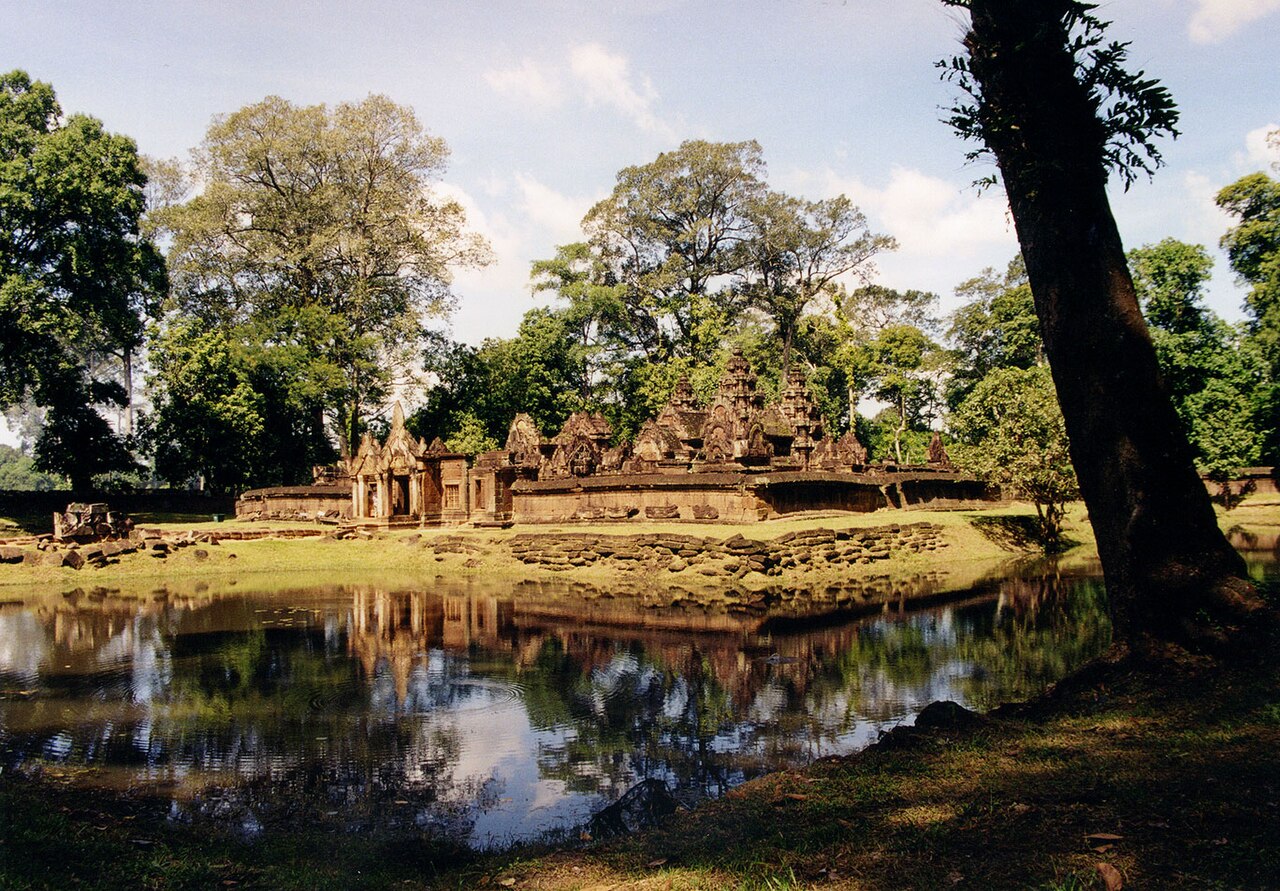
The name is usually translated as lotus pond. Look out beyond the walls and you can understand why. A wide moat once surrounded the whole complex, and in the wet season parts of it still fill with water. The builders of the Khmer Empire thought carefully about water. For them, a temple surrounded by a moat was a model of the universe. The central towers stood for the sacred mountain at the centre of the world, and the water stood for the oceans around it.
So who built it? Here, honesty matters. No founding inscription has been found that names a king or gives a date. Scholars date the temple to the early twelfth century, based on its style and its carving. That style is very close to Angkor Wat. For this reason, many historians link Beng Mealea to the reign of King Suryavarman the Second, the ruler who built Angkor Wat. But that link is a careful judgement, not a written record.
Here is the first surprise. Look closely at the layout as you walk. Beng Mealea follows a plan similar to Angkor Wat, with galleries, enclosures and courtyards arranged around a central sanctuary. Some writers have even called it a kind of rehearsal for the larger temple. Whether or not that is true, the similarity is real. Imagine Angkor Wat, but flattened by time and swallowed by trees. That is a useful picture to carry with you through these ruins.
Now look at the stone itself. Almost everything here is sandstone, cut into heavy blocks and fitted together without mortar. The Khmer builders relied on weight and precise cutting to hold the walls in place. Much of this stone is thought to have come from the Kulen hills nearby, which supplied sandstone for many Angkorian temples. When roots push between the blocks, or when the ground shifts, the walls have nothing to hold them. That is why you see whole galleries lying where they fell.
As you came in, you may have passed guardian figures at the entrance. These are nagas, sacred serpents with several heads raised like a fan. In Khmer belief, the naga links the human world to the world of the gods. Their bodies once formed long balustrades along the causeways. Some still stand, worn smooth by rain. Others lie broken in the grass. Pause beside one and look at the scales carved along the body.
The second surprise is about the boardwalk you are standing on. It is often said that parts of these walkways were first built for the film crew of Two Brothers, a French film about tigers shot here in the early 2000s. Whatever their origin, the boardwalks now do an important job. They let you move through the ruins without climbing on fragile stone. They also give you a raised view into courtyards that would otherwise be hidden behind rubble.
There is a harder story here too. For years, this area was not safe to visit. Like much of rural Cambodia, the land around the temple was affected by landmines left from decades of conflict. Clearance teams worked to make the site and its paths safe before visitors began arriving in larger numbers. Today the danger is gone from the walkways. Still, it is worth remembering that the quiet you hear now was once a quiet of fear.
As you move deeper inside, watch for carved lintels. A lintel is the horizontal stone block above a doorway. Khmer carvers covered them with scenes from Hindu stories and with rich floral patterns. Many have fallen and now lie face up or face down among the rubble. Look carefully and you may find a deity, a dancing figure or a curling vine, half covered in moss. Finding these carvings yourself is part of the pleasure here.
The temple was not built alone. It stood on an ancient royal road that ran east from the Angkor region toward other great Khmer sites. Travellers, soldiers and pilgrims would have passed this way. Along these roads the empire also built rest houses and stone bridges. Beng Mealea was a stop on a network that tied a large kingdom together. You are standing at one of its old crossroads.
Notice the light as you walk. The trees filter the sun into patches that move across the stone. After rain, the sandstone turns darker, and the green of the moss becomes deep and bright. In the dry season, dust settles on the leaves and the air feels warmer and still. The temple looks different almost every hour. Take your time in one courtyard and simply watch how the shadows change.
Before you leave, stop in one quiet corner. Put your hand on a block of stone, cool even in the heat. Look up at the roots that hold the wall, and at the gaps where the roof once was. Listen again for the birds and the dripping water. As you walk back along the boardwalk, notice how the forest closes in behind you... and how the temple goes back to the trees.
Key facts
What to look for
Practical tips
Common questions
Is there a free audio guide to Beng Mealea?
Yes — the Lokali app narrates Beng Mealea free of charge in 50+ languages. The guide runs about 7 minutes, covers the history, what to look for on site and practical tips, and works offline once downloaded.
Where is Beng Mealea?
Beng Mealea is in Siem Reap, Cambodia, at 13.4764, 104.2383. Tap the map link on this page for directions from where you are.
What is Beng Mealea known for?
Name is usually translated as lotus pond. Dated by style to the early twelfth century.
What should you look for at Beng Mealea?
Multi-headed naga serpents guarding the entrance causeway. Fallen carved lintels lying among the moss-covered rubble. Tree roots gripping and splitting the sandstone walls.
What should you know before visiting Beng Mealea?
A separate ticket is needed beyond the main Angkor pass. Wear shoes with good grip for damp, mossy walkways.
On the map
Opens directions to Beng Mealea from your location.
More to see in Siem Reap



Hear Beng Mealea in your language
The full story, narrated, in 50+ languages. Download it before you go and it plays offline, at your own pace, with no ticket and no tour group.