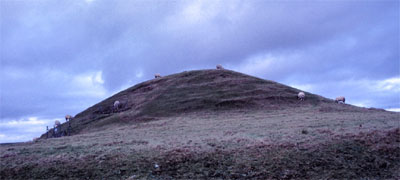
Photo: Otter at Dutch Wikipedia (Original text: Hopmans) · CC BY-SA 3.0 · Wikimedia Commons
Maeshowe is a neolithic chambered cairn and passage grave situated on Mainland Orkney, Scotland. Built by Neolithic farmers about five thousand years ago. The free Lokali audio guide runs 7 minutes.
✓ Published October 2026 · how we write these guides
Visitor facts
| Lokali audio guide | 7 min · free |
|---|---|
| Type | Archaeological Site |
| Location | Stromness, United Kingdom |
| Coordinates | 58.9966, -3.1882 |
| Languages | 50+, in the Lokali app |
The story
Bend low. The passage ahead is barely the height of your waist, and the stone walls press in close on either side. The air turns cool and still. Outside, the Orkney wind moves across the open fields without rest. A few steps into this tunnel, that sound falls away. What is left is the soft echo of your own breathing, and the faint smell of damp earth and very old stone.
You are entering Maeshowe, a chambered tomb built by Neolithic farmers about five thousand years ago. From the road it looks like a simple grassy mound, rounded and green, set inside a wide ditch. Many drivers pass it without a second look. But under that turf sits one of the finest pieces of prehistoric stone building in northern Europe. It is older than the pyramids of Giza, and its builders worked without metal tools.
The mound stands a short drive east of Stromness, in the low country between the lochs of Stenness and Harray. This is the heart of a remarkable prehistoric landscape. The Stones of Stenness and the great stone circle called the Ring of Brodgar stand only a few minutes away. Together with the village of Skara Brae, they form a World Heritage Site known as the Heart of Neolithic Orkney. Maeshowe was built as part of this wider world of ritual and gathering.
Now look at the passage walls as you move through. Some of them are made from single slabs of flagstone, enormous and flat, running for metres along the side of the tunnel. Orkney flagstone splits naturally into clean sheets, and the builders used this to remarkable effect. The joints are so tight that a knife blade would struggle to enter them. Moving these slabs into place, by hand and with ropes and rollers, took organised effort and real skill.
The passage opens into the central chamber, and you can stand up again. It is a square room, a few paces across. The walls rise in careful layers of flat stone. Each course sits slightly further inward than the one below, so the walls lean toward each other as they climb. This method is called corbelling. It allowed the builders to close a roof without arches or mortar. At each corner, a tall upright slab stands like a buttress.
Look around the walls and you will see three openings, set a little above the floor. Each one leads into a small side cell, roughly the size of a large cupboard. Their entrances were once closed with blocking stones, and some of those stones still lie on the floor nearby. Archaeologists think these cells held the remains of the dead, though very little was found inside them. The tomb had been entered and disturbed long before modern excavation began.
Here is the first surprise. Maeshowe was designed to work with the sun. The passage faces roughly south-west. In the weeks around the winter solstice, the shortest day of the year, the setting sun shines straight down the passage. A narrow band of golden light crosses the floor and touches the back wall of the chamber. For a people who lived by the seasons, this moment may have marked the turn of the year, when light begins to return.
In the middle of the passage, look for a recess cut into the wall. A large stone sits there. It was probably used to seal the tomb from the inside. Notice something odd about it, though. When the stone is pushed into place, it does not quite reach the top of the doorway. A small gap remains. Some people suggest that this gap let the midwinter light enter even when the tomb was closed. It is a lovely idea, but it remains a theory.
Now for the second surprise. Look closely at the stone walls of the chamber, and you will see scratched lines. These are runes, the writing of the Norse world. In the twelfth century, Norse visitors broke into the tomb through the roof. They left behind one of the largest collections of runic inscriptions known anywhere outside Scandinavia. The tomb was already thousands of years old when they arrived. To them, it was an ancient mound full of mystery.
The carvings are not sacred texts. Many read like graffiti on a modern wall. Several are boasts about the carvers themselves. One praises a woman named Ingigerth as the most beautiful of women. Others are crude jokes. A few speak of treasure, and claim that great wealth was carried away from the mound. Nobody knows if any treasure existed. One inscription even brags that it was carved by the best rune carver in the west.
The Orkneyinga saga, a medieval history of the earls of Orkney, may also mention this place. It tells of men who sheltered in a mound called Orkahaugr during a snowstorm, and says that two of them went mad. Many historians think Orkahaugr is Maeshowe. Treat the tale of madness as a saga story rather than a documented fact. Still, standing in the dim chamber, it is easy to see why the place unsettled winter travellers.
Among the runes, look for a small carved animal. It is often called the Maeshowe dragon, though some see a lion or another beast. Its body curls, its head turns back, and a long tongue stretches out. It is a fine piece of Norse art, cut with confidence into hard stone. In the nineteenth century, excavators cleared the chamber and recorded the inscriptions. Parts of the roof you see above you are a later rebuild, replacing the section the Norse broke through.
When you walk back out, stoop low once more and move slowly. Let your eyes adjust to the daylight. Then stand on the grass and look across the land. You can see the water of the lochs, the long low hills, and perhaps the stones of Stenness and Brodgar. Five thousand years ago, people stood near this spot and watched the same sun set. Look back at the mound as you leave... a quiet green shape that has held the dark, and the light, for a very long time.
Key facts
What to look for
Practical tips
Common questions
Is there a free audio guide to Maeshowe?
Yes — the Lokali app narrates Maeshowe free of charge in 50+ languages. The guide runs about 7 minutes, covers the history, what to look for on site and practical tips, and works offline once downloaded.
Where is Maeshowe?
Maeshowe is near Stromness, United Kingdom, at 58.9966, -3.1882. Tap the map link on this page for directions from where you are.
What is Maeshowe known for?
Built by Neolithic farmers about five thousand years ago. Norse visitors carved runes here in the twelfth century.
What should you look for at Maeshowe?
The huge single flagstone slabs lining the passage walls. The blocking stone resting in its recess by the passage. Corbelled walls leaning inward as they rise toward the roof.
What should you know before visiting Maeshowe?
Book a guided tour in advance; visits are guided only. Wear sturdy shoes for the walk across the field.
On the map
Opens directions to Maeshowe from your location.
More to see in Stromness


Hear Maeshowe in your language
The full story, narrated, in 50+ languages. Download it before you go and it plays offline, at your own pace, with no ticket and no tour group.