
Standing Stones of Stenness
58.9939° N · 3.2081° W · Archaeological Site
Photo: Wilson44691 · CC0 · Wikimedia Commons
Standing Stones of Stenness is a henge in Orkney Islands, Scotland, UK. Built in the late fourth millennium before Christ. The free Lokali audio guide runs 7 minutes.
✓ Published October 2026 · how we write these guides
Visitor facts
| Lokali audio guide | 7 min · free |
|---|---|
| Type | Archaeological Site |
| Location | Stromness, United Kingdom |
| Coordinates | 58.9939, -3.2081 |
| Languages | 50+, in the Lokali app |
The story
Listen first. The wind comes off the water from two directions here, and it rarely stops. Grass hisses around your boots. Somewhere close, a curlew calls, or a sheep complains. And in front of you, four thin grey slabs rise out of the turf. They are tall and sharp, and they lean slightly against the light. They are some of the oldest standing stones in Britain, and they have been here for roughly five thousand years.
You are standing on a narrow neck of land between two lochs. To one side lies the Loch of Stenness, which is brackish, because the sea leaks into it. To the other lies the Loch of Harray, which is fresh water. Water, sky and low green hills surround you. The builders chose this spot with care. From here, the land opens outward in every direction, like the inside of a wide stone bowl.
The Stones of Stenness date to the late fourth millennium before Christ. That is the Neolithic, the New Stone Age, when farming communities lived across Orkney. That makes this monument older than the great pyramids of Egypt. It is also older than the familiar circle of Stonehenge as it stands today. Here, at the edge of northern Scotland, people were already building on a monumental scale. Orkney was not a remote outpost. For a time, it may have been one of the creative centres of Neolithic Britain.
Look at the shape of the stones. They are not rough boulders. They are flat slabs of local flagstone, the same layered rock that splits cleanly along the shores of Orkney. The tops are cut at a slant, so each stone ends in a sharp angle. The tallest stands at around six metres. Imagine lifting a slab like that into place without metal tools, without wheels, and with ropes made from plant fibre or leather.
Today you see only four stones. Archaeologists think the monument once held around eleven or twelve, set in a wide ring. Around them ran a deep ditch, cut down into the bedrock, with a bank of earth outside it. Monuments of this type are called henges, which simply means a circular earthwork with a bank and a ditch. Over time, the ditch filled with silt and the bank wore away. If you look closely at the ground, you can still trace a faint ring in the grass.
Now look at the centre of the circle. There is a low, square setting of flat stones, set into the turf. Excavations found that this was a hearth — a place for fire. It looks very much like the hearths found inside Neolithic houses nearby. So the monument may echo the home. People may have gathered here around a fire, on a much larger scale than a family kitchen. Burnt bone and pieces of decorated pottery were found during digs.
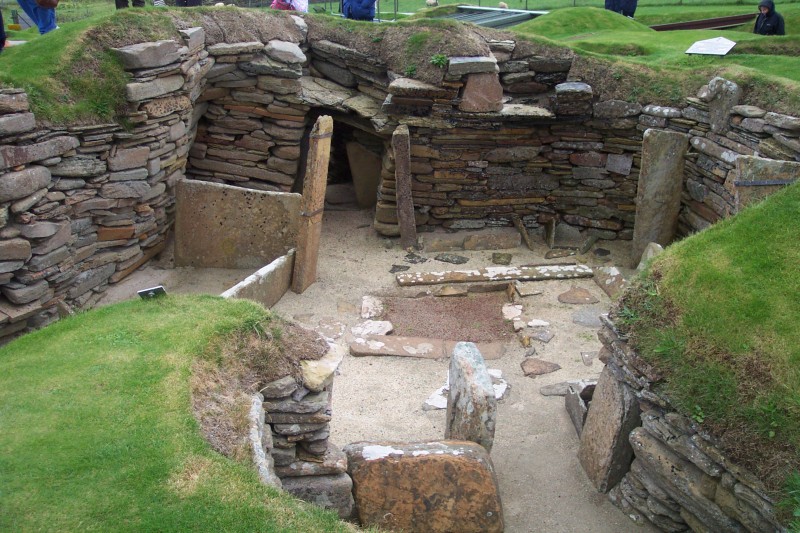
Here is something many visitors miss. The single entrance through the old ditch faced north, toward the shore of the loch. Just a short walk in that direction lie the remains of a Neolithic settlement called Barnhouse. Its people lived in stone houses with central hearths and stone furniture. The village and the circle were in use at around the same time. So this was not a lonely ritual site. It stood beside a living community, close enough to hear voices across the grass.
Turn north-west and look along the road. Between the two lochs, across a narrow causeway, a single tall stone stands alone. This is the Watch Stone. Beyond it, about a mile away, lies the much larger Ring of Brodgar. Between the two circles, archaeologists have uncovered the Ness of Brodgar, a complex of large Neolithic stone buildings. Together with the chambered tomb of Maeshowe nearby, these places form part of the Heart of Neolithic Orkney, a UNESCO World Heritage Site.
Not every story here is about the deep past. One stone that once stood in the fields nearby is now gone. It was called the Odin Stone, and it had a hole cut right through it. According to local tradition, couples clasped hands through the hole to make a solemn promise. Locals say a promise made at the Odin Stone could not be broken. Visitors also came to the stone hoping for luck or healing. The name comes much later than the stone itself, from Orkney's Norse centuries.
Then, in the early nineteenth century, a tenant farmer who was new to the area grew tired of people crossing his land. He began to break up the stones. He destroyed the Odin Stone and toppled others in the circle. The local community was furious. According to accounts of the time, angry neighbours tried to set fire to his property. The damage was stopped before he could finish. Part of what you see today survives because local people refused to let it disappear.
The monument has also been changed by well-meaning hands. In the early twentieth century, one fallen stone was set upright again. Restorers also built a small stone table near the hearth, imagining an ancient altar. Later research showed that this structure had no ancient basis, and it was taken down. It is a useful reminder. Every age looks at these stones and sees its own ideas in them. Even the archaeologists of today work with careful guesses, not certainties.
So what was this place for? Honestly, no one knows for sure. It may have marked seasons, gatherings, the dead, or the bonds between families. The surrounding hills form a natural ring around the lochs, and the stones may have been placed to work with that landscape. What is clear is the effort. Quarrying, moving and raising these slabs took many people working together, probably over many seasons. This was a shared project, built by a community that planned for the long term.
Before you leave, stand still for a moment near the hearth. Look up at the tallest stone and follow its slanted edge against the sky. Notice the lichen on its surface, pale green and orange, and the way the light changes as clouds move over the lochs. Listen to the wind again. People stood on this same ground and felt this same weather five thousand years ago. As you walk back to the road, glance over your shoulder. The stones look different from every angle, and they will still be here long after you go.
Key facts
What to look for
Practical tips
Common questions
Is there a free audio guide to Standing Stones of Stenness?
Yes — the Lokali app narrates Standing Stones of Stenness free of charge in 50+ languages. The guide runs about 7 minutes, covers the history, what to look for on site and practical tips, and works offline once downloaded.
Where is Standing Stones of Stenness?
Standing Stones of Stenness is near Stromness, United Kingdom, at 58.9939, -3.2081. Tap the map link on this page for directions from where you are.
What is Standing Stones of Stenness known for?
Built in the late fourth millennium before Christ. Among the oldest henge monuments in Britain.
What should you look for at Standing Stones of Stenness?
The slanted, sharply angled tops of the slabs. The square stone hearth set in the centre. The faint ring of the old ditch in the grass.
What should you know before visiting Standing Stones of Stenness?
Bring a windproof layer; the site is exposed on all sides. Walk to Barnhouse village, just a short stroll north.
On the map
Opens directions to Standing Stones of Stenness from your location.
More to see in Stromness


Hear Standing Stones of Stenness in your language
The full story, narrated, in 50+ languages. Download it before you go and it plays offline, at your own pace, with no ticket and no tour group.