
Ness of Brodgar
58.9972° N · 3.2156° W · Archaeological Site
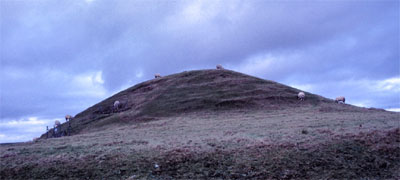
Photo: genevieveromier profile · CC BY 2.0 · Wikimedia Commons
Ness of Brodgar is an archaeological site. It is near Stromness, United Kingdom. Discovered in the early 2000s after a plough struck a notched slab. The free Lokali audio guide runs 7 minutes.
✓ Published October 2026 · how we write these guides
Visitor facts
| Lokali audio guide | 7 min · free |
|---|---|
| Type | Archaeological Site |
| Location | Stromness, United Kingdom |
| Coordinates | 58.9972, -3.2156 |
| Official website | nessofbrodgar.co.uk |
| Languages | 50+, in the Lokali app |
The story
Listen first. Wind moves across the water on both sides of you, and somewhere close a curlew calls over the reeds. You are standing on a narrow neck of land, barely wider than a road in places. To one side lies a broad, salty loch. To the other, a loch of fresh water. The grass at your feet is ordinary Orkney pasture... and under it lies one of the most remarkable Stone Age sites ever found in Europe.
This is the Ness of Brodgar, a short drive east of Stromness on Mainland, the largest island of Orkney. The word ness means a headland or point of land. Look along the isthmus and you will see why the name fits. The Loch of Stenness, which connects to the sea, sits on one side. The Loch of Harray, fed by streams, sits on the other. People of the Neolithic, the late Stone Age, chose this exact strip of ground with great care.
Now turn and look for the standing stones. To the northwest rises the Ring of Brodgar, a great circle of tall, thin slabs on a gentle rise. To the southeast stand the Stones of Stenness, fewer in number but taller still. The Ness sits between them, almost exactly in the middle. For a long time, archaeologists studied the two stone circles as separate monuments. Nobody guessed that a vast complex of buildings lay buried on the land in between.
The discovery came by chance, in the early 2000s. A plough turned up a large stone slab with a notch cut into it. Local people and archaeologists looked more closely, and geophysical surveys followed. The results showed something huge under the field — walls, buildings, and enclosures spread across the whole isthmus. Excavation began soon after, and it continued season after season for about two decades. The lead archaeologist for much of that time was Nick Card, of the Archaeology Institute at the University of the Highlands and Islands.
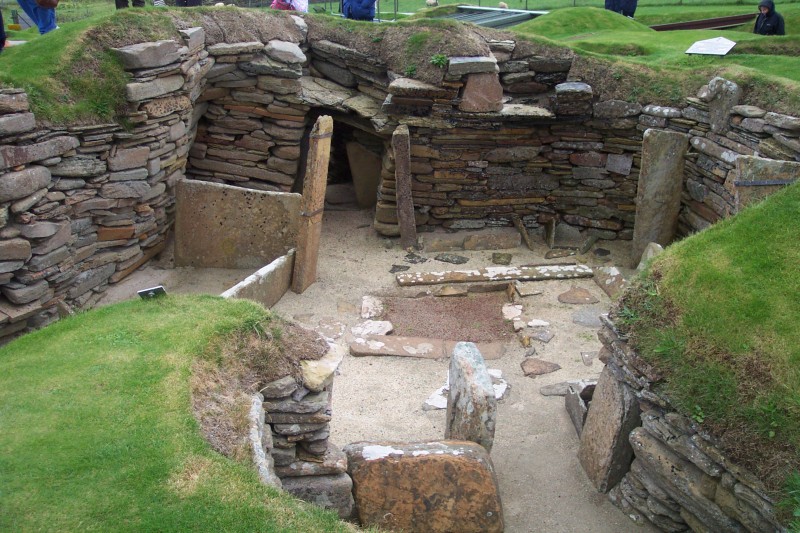
So what exactly did they find? Not a village in the usual sense. The buildings here are larger and more carefully built than the homes at Skara Brae, the famous Stone Age village on the west coast. The stonework is precise. Flagstones were split and laid in neat, even courses. Some walls stood remarkably thick. Most archaeologists now see the Ness as a ceremonial centre — a place for gathering, feasting, and ritual, rather than a place where ordinary families simply lived.
The complex was in use for a very long time. Radiocarbon dates suggest people were building here from around 3300 BCE, and activity continued for roughly a thousand years. That is older than the great pyramids of Egypt. Buildings were put up, used, altered, knocked down, and rebuilt on top of earlier ones. The result is a deep layer cake of stone, one structure resting on the remains of another, generation after generation.
Here is a detail that surprises most visitors. These Stone Age walls were not always grey. Excavators found stones carrying traces of pigment — reds, yellows, and darker tones made from natural minerals. Some surfaces had been painted. Imagine walking into one of these halls by firelight, with colour on the stone around you. It changes the picture of the Neolithic as a world of plain, bare rock.
The stones also carry carving. Hundreds of decorated pieces came out of the trenches, many incised with lines, zigzags, triangles, and crosshatching. Some patterns are bold. Others are so faint they only show when light falls across them at a low angle. Some decoration sat in places nobody would easily see, inside walls or on hidden faces. Why carve something meant to stay out of sight? Nobody knows for certain, and that question is part of the fascination.
The second surprise concerns the roofs. Archaeologists found thin stone slates, some still lying where they fell. That suggests at least some buildings had slate roofs, a sophisticated choice for the time. Pottery turned up too, in the style called Grooved Ware, a type of flat-based Neolithic pottery decorated with grooves. The style seems to appear early in Orkney before spreading across Britain. This tiny island group may have been a source of new ideas, not a distant edge.
One building, known to the excavators as Structure Ten, tells a dramatic closing story. It was among the largest buildings on the site. When it went out of use, people held what looks like a great final event. They left behind a large deposit of cattle bones, especially leg bones, from hundreds of animals. It may have been a farewell feast on an enormous scale. Soon after, the long life of the complex came to an end.
What you see today depends on the moment of your visit. For years, the open trenches drew crowds each summer, with guides explaining the work as it happened. The main excavation programme has now come to a close, and the trenches have been covered over to protect the fragile stone. Covering a site is a normal step in archaeology. The soil keeps the walls safe from frost, rain, and wind until future researchers return with new questions.
That makes this a place for imagination as much as for looking. Stand still for a moment and picture the scene. Smoke from fires inside the great halls. People arriving from across the islands, perhaps carrying food and animals for a gathering. The two stone circles rising on either side, linked by this strip of land between the waters. The Ness, the Ring of Brodgar, and the Stones of Stenness all sit within the area known as the Heart of Neolithic Orkney, a UNESCO World Heritage Site.
Before you leave, look once more along the isthmus. Notice how the light shifts on the two lochs, one slightly rougher than the other. Notice how low and open the land is, with the hills of Hoy rising beyond. The people who built here saw much the same shapes of water and sky. As you walk back toward the road, the ground under your feet holds five thousand years of stone... quiet now, and waiting.
Key facts
What to look for
Practical tips
Common questions
Is there a free audio guide to Ness of Brodgar?
Yes — the Lokali app narrates Ness of Brodgar free of charge in 50+ languages. The guide runs about 7 minutes, covers the history, what to look for on site and practical tips, and works offline once downloaded.
Where is Ness of Brodgar?
Ness of Brodgar is near Stromness, United Kingdom, at 58.9972, -3.2156. Tap the map link on this page for directions from where you are.
What is Ness of Brodgar known for?
Discovered in the early 2000s after a plough struck a notched slab. Building activity here began around 3300 BCE.
What should you look for at Ness of Brodgar?
The salty Loch of Stenness on one side of the isthmus. The freshwater Loch of Harray on the other side. The Ring of Brodgar's tall slabs to the northwest.
What should you know before visiting Ness of Brodgar?
Visit the Ring of Brodgar and Stones of Stenness alongside. Bring a windproof layer; the isthmus is very exposed.
On the map
Opens directions to Ness of Brodgar from your location.
More to see in Stromness


Hear Ness of Brodgar in your language
The full story, narrated, in 50+ languages. Download it before you go and it plays offline, at your own pace, with no ticket and no tour group.