
Photo: NASA · Public domain · Wikimedia Commons
Arwad is an island in Syria. Arwad was the ancient Phoenician city of Arados. The free Lokali audio guide runs 6 minutes.
✓ Published October 2026 · how we write these guides
Visitor facts
| Lokali audio guide | 6 min · free |
|---|---|
| Type | Archaeological Site |
| Location | Tartus, Syria |
| Coordinates | 34.8561, 35.8583 |
| Languages | 50+, in the Lokali app |
The story
Listen first. Gulls call over the harbour, diesel engines knock against the quay, and somewhere behind the boats a hammer strikes wood in a slow, steady beat. The air smells of salt, tar, and frying fish. Under your feet, the stone of the waterfront is smooth and pale from centuries of wear. You have crossed a short stretch of sea from Tartus, and now you stand on Arwad, the only inhabited island along the Syrian coast.
The crossing itself is part of the story. From the mainland port, small motorboats carry passengers over open water in roughly a quarter of an hour. As you approach, the island rises low and compact from the sea. Houses crowd right to the edge of the water. A fortress shows above the rooftops. There are no bridges and no cars here. Everything arrives by boat, just as it has for thousands of years.
That long past is real. In the ancient world, this rock was a Phoenician city called Arados. The Phoenicians were a seafaring people of the eastern Mediterranean, famous traders who spread an early alphabet across the region. Arados stood alongside better-known cities such as Tyre and Sidon. The Bible mentions it too, under the name Arvad. The Book of Ezekiel speaks of the men of Arvad as skilled rowers and defenders on the walls of Tyre.
Here is the first surprise. Arados did not stay on its island. The city controlled a strip of the mainland opposite, and one of its towns there was called Antaradus — literally, the place facing Arados. Over time, that name changed and shortened. It became Tartus, the city you just left. So the mainland port takes its very name from this small island. For a long time, the island was the senior partner.
Walk to the western edge of the island and look closely at the shoreline. In places, you can still see enormous stone blocks set into the base of the old sea wall. These are some of the oldest surviving pieces of Arados. The blocks are massive and roughly squared, laid without the neat regularity of later work. Waves have rounded their edges and filled their cracks with salt and green weed. Modern houses sit on top of ancient foundations.
An island this crowded faces one obvious problem — fresh water. The ancient Greek geographer Strabo described a remarkable solution. According to his account, divers went down to a freshwater spring on the sea floor near the island. They lowered a funnel and a leather pipe over it and drew sweet water up through the salt sea. Whether every detail is exact, the story shows how inventive island life had to be.
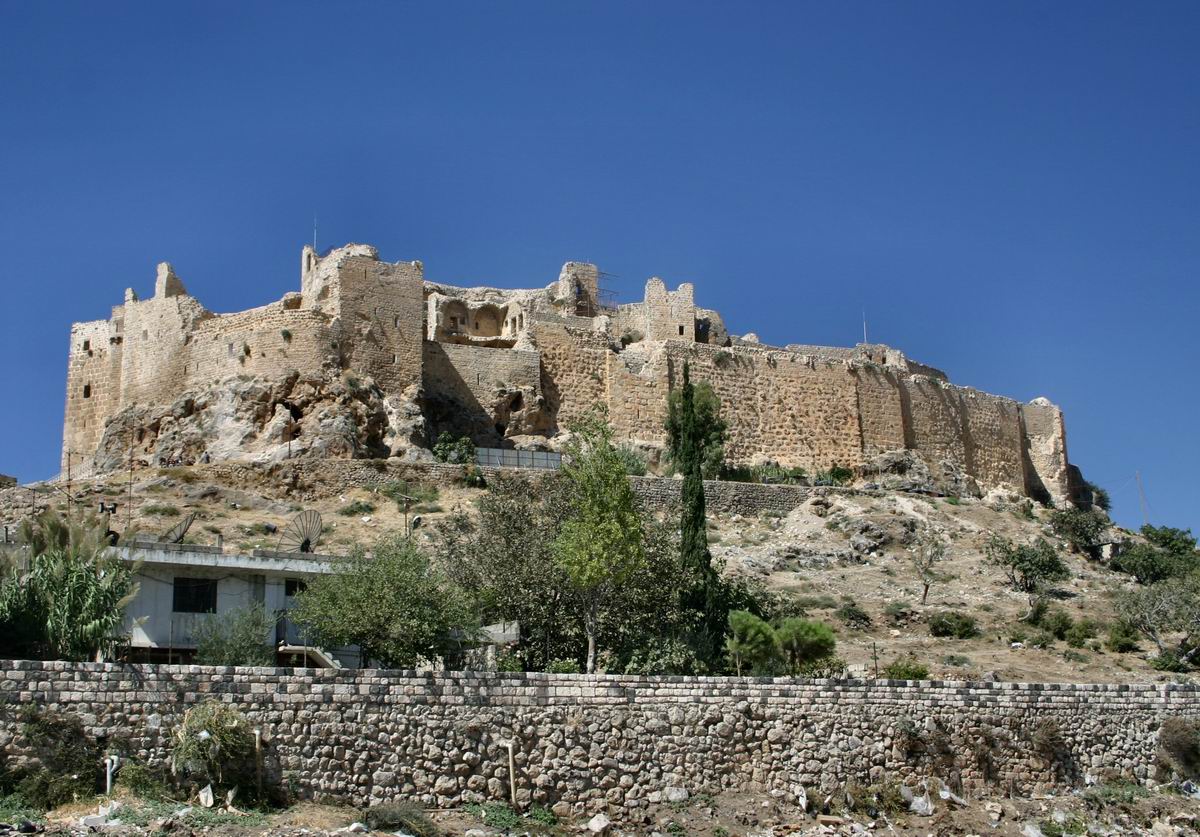
Now turn inland, toward the fortress. Its thick walls and narrow openings belong to the medieval period, when the eastern Mediterranean was contested ground. The castle stands near the centre of the island, built from heavy, weathered stone the colour of sand and old bone. Inside, a modest museum displays finds connected to Arwad's long past. The building feels solid and low, designed to resist attack rather than to impress.
The second surprise comes from the age of the Crusades. These were the military campaigns launched by western European Christians to control the Holy Land. By the end of the thirteenth century, the Crusaders had lost almost every stronghold on the mainland. Yet the Knights Templar, a powerful military order, held on to Arwad. The island became the last Crusader foothold on this coast. It finally fell to the Mamluks, the rulers of Egypt and Syria, in 1302.
The fortress has a more recent history as well. During the French Mandate, the period between the two world wars when France governed Syria, the castle is said to have served as a prison. Local accounts describe Syrian nationalists held inside its walls. Today, the same stones that once confined people stand open to visitors, and children run along the lanes outside.
Leave the fortress and let the streets lead you. Arwad is a maze of narrow alleys, many barely wide enough for two people to pass. Walls are washed in pale colours, with blue doors and green shutters faded by sun and salt. Laundry hangs between windows. Cats sleep on doorsteps. Because there is no traffic, you hear voices, radios, the scrape of chairs, and the constant movement of the sea at the end of every lane.
The sound of hammering you heard at the harbour leads to one of Arwad's oldest crafts — boatbuilding. Islanders have built wooden boats here for generations, often by hand and on the open shore. If you are lucky, you will see a hull taking shape on the waterfront, its curved ribs exposed like the frame of a giant basket. Fishing remains central to daily life. Nets are mended in the shade, and the catch comes in fresh each day.
Back along the harbour, small cafés and fish restaurants face the water. This is a good place to sit and watch the rhythm of the island. Boats arrive from Tartus, unload families and crates, then turn around again. Sellers offer shells, model boats, and small souvenirs. Across the water, the mainland skyline seems close enough to touch, yet the island feels like its own separate world.
Before you board the boat back, pause at the edge of the quay. Look down at the old stones beneath the newer pavement. Look out at the line of the coast where Antaradus once stood. People have lived, traded, fought, and fished on this small rock for thousands of years. As the engine starts and the island shrinks behind you, listen once more — for the gulls, the voices, and that steady hammer on wood.
Key facts
What to look for
Practical tips
Common questions
Is there a free audio guide to Arwad?
Yes — the Lokali app narrates Arwad free of charge in 50+ languages. The guide runs about 6 minutes, covers the history, what to look for on site and practical tips, and works offline once downloaded.
Where is Arwad?
Arwad is near Tartus, Syria, at 34.8561, 35.8583. Tap the map link on this page for directions from where you are.
What is Arwad known for?
Arwad was the ancient Phoenician city of Arados. Tartus takes its name from Antaradus, facing Arados.
What should you look for at Arwad?
Huge rough-cut Phoenician blocks at the western sea wall. Wooden boat hulls under construction on the shore. Narrow arrow slits in the medieval fortress walls.
What should you know before visiting Arwad?
Take a small passenger boat from Tartus port. Wear comfortable shoes for narrow, uneven island lanes.
When is the best time to visit Arwad?
Visit early to avoid crowded midday boats in summer.
On the map
Opens directions to Arwad from your location.
More to see near Arwad


Hear Arwad in your language
The full story, narrated, in 50+ languages. Download it before you go and it plays offline, at your own pace, with no ticket and no tour group.