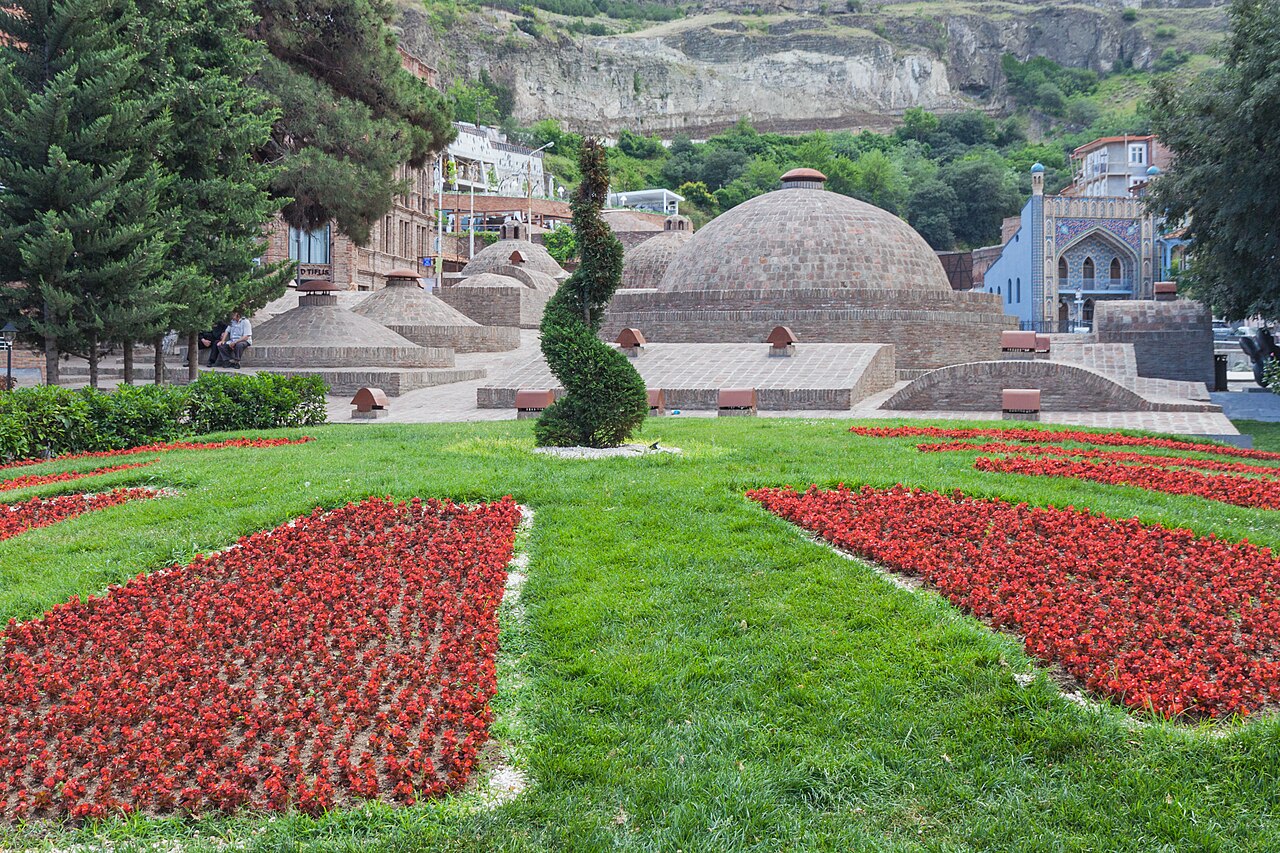
Abanotubani (Sulphur Baths)
41.7196° N · 44.8085° E · Bathhouse
Abanotubani (Sulphur Baths) is a bathhouse in Tbilisi, Georgia. Historic thermal baths built into the hillside below Narikala, fed by natural sulphur springs. Most visitors spend 1–2 hours here. The free Lokali audio guide runs 6 minutes.
✓ Verified August 2026 · how we write these guides
Visitor facts
| Time needed | 1–2 hours |
|---|---|
| Lokali audio guide | 6 min · free |
| Type | Bathhouse |
| Best for | Local life |
| Location | Tbilisi, Georgia |
| Coordinates | 41.7196, 44.8085 |
| Languages | 45, in the Lokali app |
The story
The smell reaches you before anything else. It is faint and mineral, a thread of sulfur in the warm air. You are standing in the oldest part of Tbilisi, in a low pocket of the city where the ground itself seems to breathe. Around you, round brick domes rise from the earth, smooth and grey, like bubbles caught and frozen in stone. Steam drifts from small openings at their tops, curls once in the air, and disappears into the sky.
These domes are not buildings you enter from above. They are the roofs of the bathhouses, and the rooms themselves lie below. They are dug into the slope, set deep into the earth to hold their heat through the day and night. Beneath your feet, hot water moves through old stone channels. It rises on its own, with no pump and no fire, from deep springs under the city. It has done so for a very long time, longer than anyone can clearly say.
The name of this district tells you its purpose plainly. Abanotubani means the bath quarter. For many centuries this was the place people came to wash, to rest, to heal sore bodies, and to talk for hours. It sits at the foot of the Narikala fortress, in the heart of the old town, where the streets stay narrow and the walls are worn soft by time and many hands.
There is a story about how the whole city began right here. People tell it as legend, not as fact. A king named Vakhtang Gorgasali was hunting in these wooded hills. His bird struck down its prey, and both fell into a hot spring and vanished in the rising steam. The king found the warm water where they had fallen, and he ordered a city built upon the spot. The name Tbilisi is said to come from the old word tbili, which means warm.
Whether the tale is true or not, the springs themselves are real. The water comes out of the ground already hot, carrying the minerals that give it both its smell and its soft, slightly oily feel. People have bathed in it across many centuries, through war and through peace, under different rulers and different flags. Empires rose and fell on the hills above. The water below did not stop for any of them.
One bathhouse stands apart from all the others. It is covered in patterned blue tiles, with two slim towers and a tall, arched front. Its name is the Orbeliani Bath, though many people simply call it the blue one. The design looks more like a small mosque than a place to wash, a touch of Persian style left in the stone. It is the building most visitors stop to photograph first.
Step inside any of the baths and the air itself changes. It grows thick, wet, and warm, and it presses gently on your skin. Stone arches curve low overhead. Pools of hot water sit in quiet, shadowed rooms, and the sound of slow dripping echoes off the walls. An attendant may offer to scrub you with a rough cloth mitt, a local tradition that is firm and quick and leaves the skin feeling new.
Travelers have written about these baths for a very long time. The poet Alexander Pushkin came through in 1829 and wrote about them with real admiration. The French writer Alexandre Dumas visited some years later and set down the scene as well. Both men found something here worth remembering, a plain comfort that stayed with them long after they had left the city behind.
When you step back outside, look up from the domes. The fortress walls climb the steep hill above you. The Metekhi church stands on a tall cliff across the water, small and dark against the open sky. The Mtkvari River runs close by, just beyond the rooftops. This one small corner gathers many of the city's oldest sights together within a single short walk.
Behind the baths, a narrow gorge cuts back into the rock. A path follows it inward, passing old stone walls and wooden balconies that lean out over the stream. Walk it for only a few minutes and you reach a small waterfall, set quietly between the cliffs. There the sound of falling water slowly replaces the noise of the streets you left behind.
This is still a working part of the living city, not a museum. Local people come on ordinary days, the way they always have, carrying small bags and towels. Tourists come too, curious and a little unsure of how it all works. The baths do not perform for anyone or pretend to be more than they are. They simply open their doors each morning, as they have for generation after generation.
Stand still for a moment and feel the warmth rising up through the worn stone underfoot. The same water that once drew a king's eye, that eased a tired poet's body, is moving below you right now, in this very moment. Cities rise and change above the ground. Down here, something quiet and warm keeps flowing, asking nothing of you, offering only the same simple rest it always has.
Key facts
What to look for
Practical tips
Common questions
How long do you need at Abanotubani (Sulphur Baths)?
Plan 1–2 hours. That is the time most visitors spend at Abanotubani (Sulphur Baths). The free Lokali audio guide adds about 6 minutes of narration you can listen to as you walk, so it fits inside your visit rather than adding to it.
Is there a free audio guide to Abanotubani (Sulphur Baths)?
Yes — the Lokali app narrates Abanotubani (Sulphur Baths) free of charge in 50+ languages. It covers the history, what to look for on site and practical tips, and it works offline once downloaded.
Where is Abanotubani (Sulphur Baths)?
Abanotubani (Sulphur Baths) is in Tbilisi, Georgia, at 41.7196, 44.8085. Tap the map link on this page for directions from where you are.
What should you know before visiting Abanotubani (Sulphur Baths)?
Bring a towel and sandals, or rent them onsite.
What is Abanotubani (Sulphur Baths) known for?
Abanotubani means the bath quarter in Georgian.
What is the best time to visit Abanotubani (Sulphur Baths)?
The oldest baths have low stone entrances and round domes puncturing the street level.
On the map
Opens directions to Abanotubani (Sulphur Baths) from your location.
More to see in Tbilisi

Hear Abanotubani (Sulphur Baths) in your language
The full story, narrated, in 50+ languages. Download it before you go and it plays offline, at your own pace, with no ticket and no tour group.