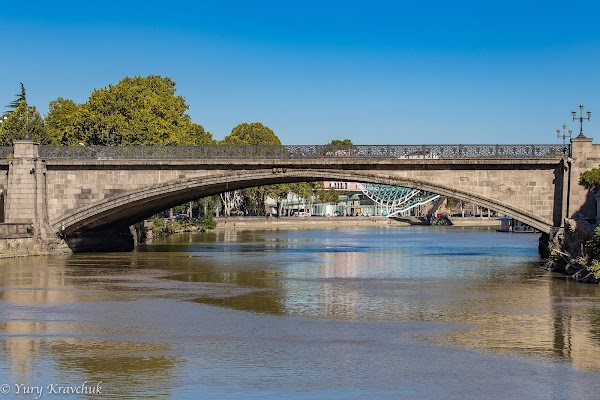
Metekhi Bridge is a bridge in Tbilisi, Georgia. Sits at one of the city's oldest river crossings. Links the old-town Maidan with Avlabari. Most visitors spend 15-20 min here. The free Lokali audio guide runs 5 minutes.
✓ Verified October 2026 · how we write these guides
Visitor facts
| Time needed | 15-20 min |
|---|---|
| Lokali audio guide | 5 min · free |
| Type | Bridge |
| Best for | Photography |
| Location | Tbilisi, Georgia |
| Coordinates | 41.7163, 44.7974 |
| Languages | 45, in the Lokali app |
The story
At the foot of the cliff that carries the Metekhi church, the old town meets the river, and a bridge takes you across the green water to the far bank. This is the Metekhi Bridge, set at one of the oldest crossing points in Tbilisi, where people have forded or bridged the Mtkvari for many centuries. It is a plain structure in an extraordinary position.
The bridge links two halves of the historic city. On one side lies the Maidan, the old market square and the tangle of old-town lanes; on the other rises Avlabari, historically home to Armenian and other communities. The two banks have always needed joining here, and a crossing of some kind has stood at this pinch in the river for a very long time.
The spot is older than any bridge you can see. This narrow point of the Mtkvari has been a strategic crossing since the early days of the city, fought over, washed away, and rebuilt many times along with everything else in Tbilisi. The structure underfoot is modern, but you are standing on a line of travel almost as old as the capital itself.
What lifts the crossing above the ordinary is what hangs over it. Directly above rises the Metekhi cliff, crowned by the old church and the bronze equestrian statue of the city's founder. From the bridge you get one of the cleanest head-on views of that group, the church and the rider standing together against the sky on their rock.
Look the other way and the scene is just as good. The old town climbs toward the Narikala fortress on its ridge, the river slides beneath you between stone embankments, and the cliffside houses lean out over the water. Mid-span is a natural place to stop, get your bearings, and take in the geography of the old city in a single turn.
The Metekhi church on the cliff deserves a glance of its own. A church has stood on that rock for many centuries, tied to the early Christian history of the city, rebuilt repeatedly after the same invasions and fires that shaped everything around it. The bridge is, in effect, the front approach to that whole historic group.
In daily life the bridge is a busy link rather than a destination, carrying traffic and pedestrians between the two banks at all hours. But because of where it sits, almost everyone exploring the old town crosses over or passes under it at some point, usually without realising they are following such an old route into the city.
Cross it on foot to get the most from it. Pause halfway for photographs of the Metekhi cliff, which catches warm light in the late afternoon and is floodlit after dark. The walk across takes only a couple of minutes, but the views in both directions reward a slower pace than the traffic around you suggests.
The far bank opens onto more of the city. From the Avlabari side you are within easy reach of the valley where the cable car climbs to the fortress, and of the long stair and slopes that lead up toward the large modern cathedral on its hill. The bridge is often the first step in a longer climb away from the river.
Timing rewards you here as elsewhere in the old town. Early morning is quiet and good for clear photographs; late afternoon brings the warm light on the cliff; evening lights the church and statue against the dark. The river itself changes colour and mood through the day, from grey to deep green.
The bridge is also one of the better places to watch the river itself. The Mtkvari runs fast and green through the centre, swollen and muddy after spring rain, lower and clearer in late summer, and from mid-span you see it framed by the cliffs and embankments that channel it through the city.
On the old-town side, the Maidan square at the bridge's foot is a hub in its own right, ringed with cafes and lanes running off in every direction. The bridge, the square, and the cliff above form a tight knot of sights within a few minutes of each other.
Stand for a moment over the water and consider how many travellers, traders, pilgrims, and armies have used this same crossing to enter the old town across the centuries. The bridge is modest, but its position is not. When you step off onto the far bank, you are joining a procession of arrivals that stretches back almost to the founding of the city.
Key facts
What to look for
Practical tips
Common questions
How long do you need at Metekhi Bridge?
Plan 15-20 min. That is the time most visitors spend at Metekhi Bridge. The free Lokali audio guide runs 5 minutes and is made to listen to while you walk.
Is there a free audio guide to Metekhi Bridge?
Yes — the Lokali app narrates Metekhi Bridge free of charge in 50+ languages. No ticket, tour group or subscription, and it works offline once downloaded.
Where is Metekhi Bridge?
Metekhi Bridge is in Tbilisi, Georgia, at 41.7163, 44.7974. Tap the map link on this page for directions.
What should you know before visiting Metekhi Bridge?
Pause halfway for photos of the Metekhi cliff.
What is Metekhi Bridge known for?
Sits at one of the city's oldest river crossings.
What is the best time to visit Metekhi Bridge?
Cross in late afternoon for the warmest light.
On the map
Opens directions to Metekhi Bridge from your location.
More to see in Tbilisi




Hear Metekhi Bridge in your language
The full story, narrated, in 50+ languages. Download it before you go and it plays offline, at your own pace, with no ticket and no tour group.