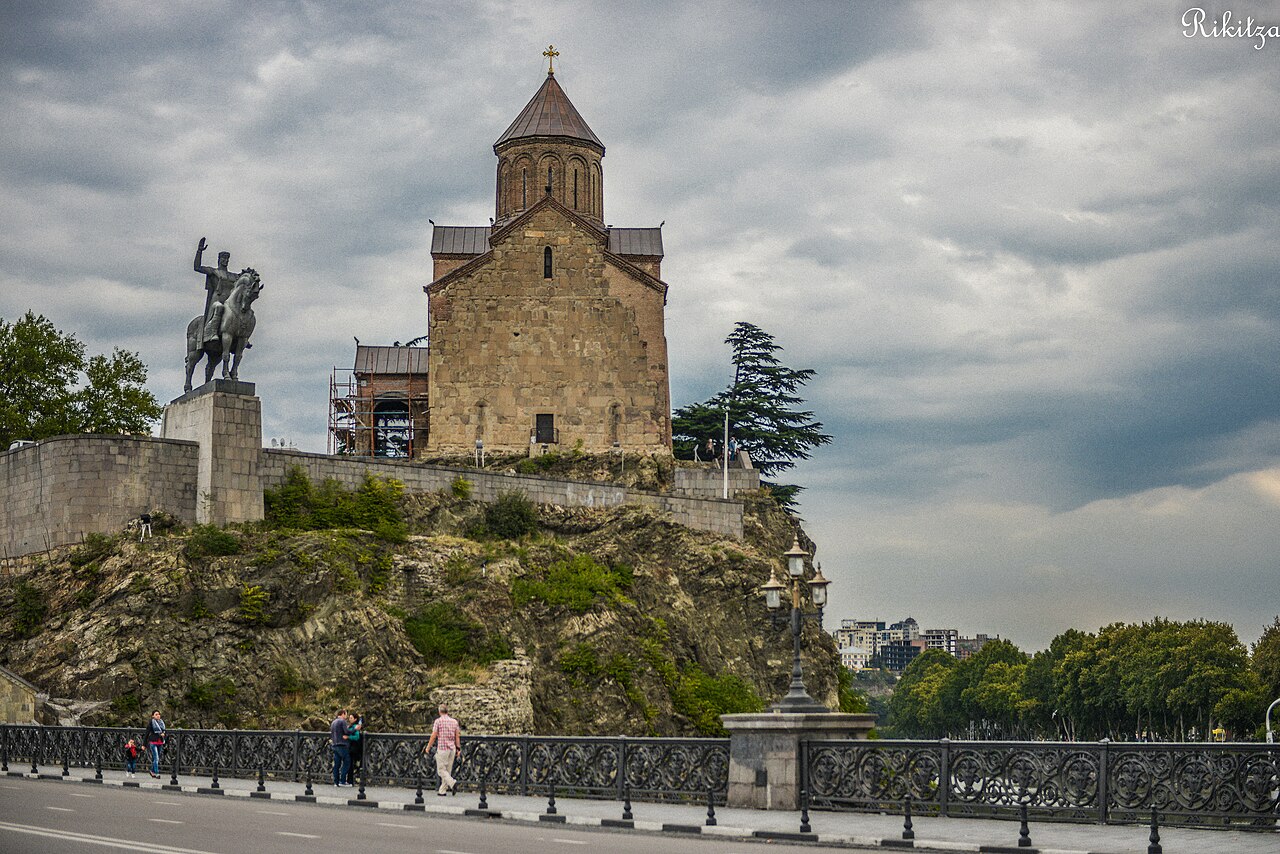
Metekhi Equestrian Statue
41.7152° N · 44.7928° E · Monument
Metekhi Equestrian Statue is a monument in Tbilisi, Georgia. Depicts King Vakhtang Gorgasali, founder of Tbilisi. The king is dated to the fifth century. Most visitors spend 10-15 min here. The free Lokali audio guide runs 5 minutes.
✓ Verified October 2026 · how we write these guides
Visitor facts
| Time needed | 10-15 min |
|---|---|
| Lokali audio guide | 5 min · free |
| Type | Monument |
| Best for | History |
| Location | Tbilisi, Georgia |
| Coordinates | 41.7152, 44.7928 |
| Languages | 45, in the Lokali app |
The story
On the edge of the cliff above the river, beside the Metekhi church, a bronze king sits on a bronze horse, looking out over the old town he is said to have founded. This is the equestrian statue of Vakhtang Gorgasali, and its position on the rock makes it one of the most recognisable silhouettes in Tbilisi, picked out on postcards and from half the bridges in the centre.
The king it honours stands at the start of the city's story. Vakhtang Gorgasali was a ruler of the fifth century, remembered as the founder of Tbilisi. The old account credits him with discovering the valley's hot springs while hunting and choosing to move his capital here. Whatever the precise history, he is woven deeply into how the city explains its own beginning.
The statue itself is much younger than the king. It is a twentieth-century work by the Georgian sculptor Elguja Amashukeli, the same artist behind several of the city's large monuments, including the towering Mother of Georgia on the fortress ridge. Knowing the two share a maker helps you read the city's modern monumental style.
Notice how the king is shown. He sits in armour, calm and upright, the horse standing still rather than rearing — a steady, watchful pose rather than a dramatic charge. It reads as a guardian keeping watch over the city rather than a warrior in mid-battle, which suits a figure remembered as a founder.
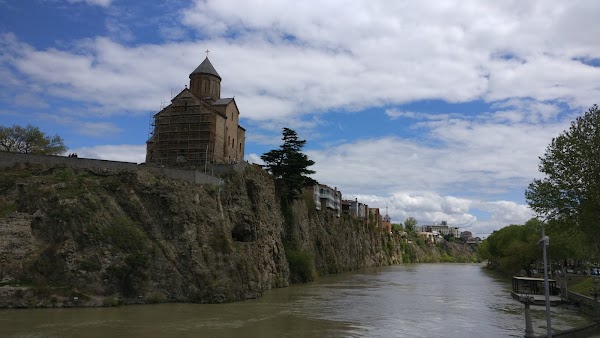
Placement is everything here, and it is no accident. The statue stands on the Metekhi cliff, right beside the church, at the exact spot where the old town first grew up above the river. From below — from the water, the embankment, or the bridge — the rider and the church read as a single group standing on their rock against the sky.
The church beside it carries its own long history. A place of worship has stood on this cliff for many centuries, bound up with the early Christian life of the city and rebuilt repeatedly after invasions and fires. Statue and church together make the cliff one of the most concentrated historic spots in Tbilisi.
Walk up to the base of the statue and you share the king's vantage. The river bends below, the brick domes of the bathhouse quarter cluster downstream, the fortress sits on the opposite ridge, and the roofs of the old town spread out between. It is a compact, free viewpoint that many visitors reach almost by accident.
The monument changes with the light. It is floodlit after dark, when the rider stands out sharply against the night sky, and it catches warm colour in the late afternoon. For photographs, the clearest angle is often from across the river or from the bridge below, where you can frame the king and the church together as one image.
It is easy to fold into a wider walk. The statue sits directly above the Metekhi Bridge and within minutes of the old-town lanes, the river paths, and the climb toward Avlabari. Most people pass it on the way to somewhere else, but it rewards a deliberate stop rather than a glance from the car window.
Take a moment to think about what the monument is doing. A modern state put up a medieval king on the spot where legend says the city began, choosing the most visible cliff in the centre to do it. The statue is as much a statement about how Tbilisi wants to remember itself as it is a likeness of any one man.
The cliff has carried meaning for the city far longer than the statue has. It was a seat of royal and religious power in the early city, a place of churches and, at times, of prisons, so setting the founder's monument here ties him to one of the oldest charged spots in Tbilisi rather than to a neutral square.
Seen from the water at night, the lit church and rider together make one of the defining images of the city. Many of the photographs that stand for Tbilisi are taken from this angle, looking up at the cliff, which is why the spot can feel familiar even on a first visit.
Stand beside the horse for a while and look where the king is looking, out over the city. He is placed exactly where the story says it all started, watching the place grow that he is said to have founded. When you walk back down toward the river, you leave him there on his cliff, keeping the same watch the city has counted on for generations.
Key facts
What to look for
Practical tips
Common questions
How long do you need at Metekhi Equestrian Statue?
Plan 10-15 min. That is the time most visitors spend at Metekhi Equestrian Statue. The free Lokali audio guide runs 5 minutes and is made to listen to while you walk.
Is there a free audio guide to Metekhi Equestrian Statue?
Yes — the Lokali app narrates Metekhi Equestrian Statue free of charge in 50+ languages. No ticket, tour group or subscription, and it works offline once downloaded.
Where is Metekhi Equestrian Statue?
Metekhi Equestrian Statue is in Tbilisi, Georgia, at 41.7152, 44.7928. Tap the map link on this page for directions.
What should you know before visiting Metekhi Equestrian Statue?
Photograph it from the bridge or the far bank.
What is Metekhi Equestrian Statue known for?
Depicts King Vakhtang Gorgasali, founder of Tbilisi.
On the map
Opens directions to Metekhi Equestrian Statue from your location.
More to see in Tbilisi



Hear Metekhi Equestrian Statue in your language
The full story, narrated, in 50+ languages. Download it before you go and it plays offline, at your own pace, with no ticket and no tour group.