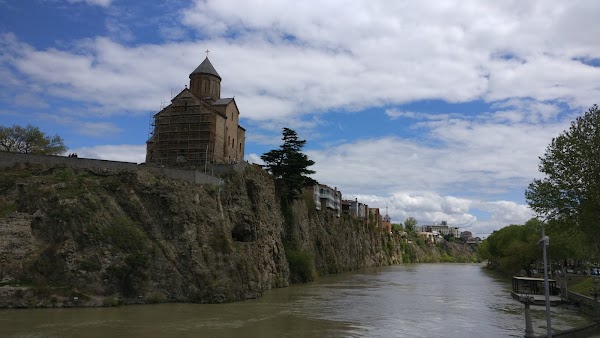
Metekhi Square is a square in Tbilisi, Georgia. Church dates from the thirteenth century. Vakhtang Gorgasali founded Tbilisi in the fifth century. Most visitors spend 20-30 min here. The free Lokali audio guide runs 5 minutes.
✓ Verified October 2026 · how we write these guides
Visitor facts
| Time needed | 20-30 min |
|---|---|
| Lokali audio guide | 5 min · free |
| Type | Square |
| Best for | Photography |
| Location | Tbilisi, Georgia |
| Coordinates | 41.7168, 44.7893 |
| Languages | 45, in the Lokali app |
The story
Stand here on the cobbles and look across the Mtkvari River. The cliffs drop steeply beneath your feet, and the current runs fast below. This is Metekhi, where Tbilisi's oldest fortress once stood — a place of power, prayer, and punishment that has watched over the city for more than fifteen hundred years.
The church you see perched on the cliff edge is Metekhi Church of the Assumption. The current structure dates from the thirteenth century, though chronicles tell us a church stood here as early as the fifth century, built by King Vakhtang Gorgasali himself — the legendary founder of Tbilisi. For centuries, this was the private chapel of Georgian kings, who built their palace on this rocky outcrop. The cliffs made it a natural fortress, defensible on three sides by the river's steep banks.
The equestrian statue in front of the church shows Vakhtang Gorgasali on horseback, erected in the nineteen sixties. He sits high in the saddle, gazing out over the city he is said to have founded after his falcon led him to these warm sulfur springs. Whether the story is legend or history, the statue has become the symbol of Tbilisi's origins — a king who chose this strategic crossing point on the Silk Road and changed the course of the Caucasus.
Metekhi's history turned dark in later centuries. After the Russian Empire annexed Georgia in the early eighteen hundreds, the palace complex was demolished and a prison built in its place. The fortress became one of the most notorious jails in the Caucasus. Political prisoners, revolutionaries, and common criminals were held in its cells. Maxim Gorky, the Russian writer, was imprisoned here briefly in the eighteen nineties. The prison operated until the early twentieth century, and locals still remember Metekhi as a place of suffering as much as sovereignty.
Look closely at the church itself. The brick is honey-colored tufa stone, quarried from nearby hills, and the dome follows the classic Georgian cross-in-square plan. The exterior is austere, almost fortress-like — no elaborate carvings, no grand portals. This simplicity reflects both the medieval Georgian aesthetic and the church's role as a royal stronghold. It was built to endure sieges, not to impress pilgrims.
The church was damaged repeatedly over the centuries — by Mongol invasions, Persian raids, Ottoman sieges, and earthquakes. Soviet authorities closed it in the nineteen thirties and considered demolishing it entirely to make way for a bridge. Local architects and historians fought to save it, and the church survived. It was restored in the late twentieth century and returned to the Georgian Orthodox Church.
From this square, you can see the entire sweep of Old Tbilisi — the sulfur bath district of Abanotubani below, the Narikala Fortress on the opposite hill, the tangle of wooden balconies climbing the slopes. This vantage point shows you why Metekhi mattered. Whoever controlled this cliff controlled the river crossing, the trade routes, the city itself. Kings knew it. Conquerors knew it. The Soviets knew it.
Walk to the edge of the square and look down at the river. The water is cloudy with sediment, fed by mountain streams that cut through the Caucasus range. In spring, the current runs even faster, swollen with snowmelt. Fishermen used to work these banks, and traders forded the river here before the bridges came. The cliffs made this a natural chokepoint, and Metekhi became the gatekeeper.
The square itself is often quiet in the early morning, before tour groups arrive. Locals walk their dogs here, and old men sit on benches watching the river. In the evening, the church and statue are lit from below, and the whole cliff glows amber against the darkening sky. Couples come here at sunset to watch the light fade over the city.
Metekhi has been a throne room, a monastery, a prison, and now a public square. Each layer of history is still visible if you know where to look — in the church's thick walls, in the foundations beneath the cobbles, in the cliff itself. Stand here long enough, and you can almost hear the centuries folding over one another, each age leaving its mark on the stone.
Key facts
What to look for
Practical tips
Common questions
How long do you need at Metekhi Square?
Plan 20-30 min. That is the time most visitors spend at Metekhi Square. The free Lokali audio guide runs 5 minutes and is made to listen to while you walk.
Is there a free audio guide to Metekhi Square?
Yes — the Lokali app narrates Metekhi Square free of charge in 50+ languages. No ticket, tour group or subscription, and it works offline once downloaded.
Where is Metekhi Square?
Metekhi Square is in Tbilisi, Georgia, at 41.7168, 44.7893. Tap the map link on this page for directions.
What should you know before visiting Metekhi Square?
Visit at sunrise for quiet and soft light
What is Metekhi Square known for?
Church dates from the thirteenth century
What is the best time to visit Metekhi Square?
Visit at sunrise for quiet and soft light
On the map
Opens directions to Metekhi Square from your location.
More to see in Tbilisi



Hear Metekhi Square in your language
The full story, narrated, in 50+ languages. Download it before you go and it plays offline, at your own pace, with no ticket and no tour group.