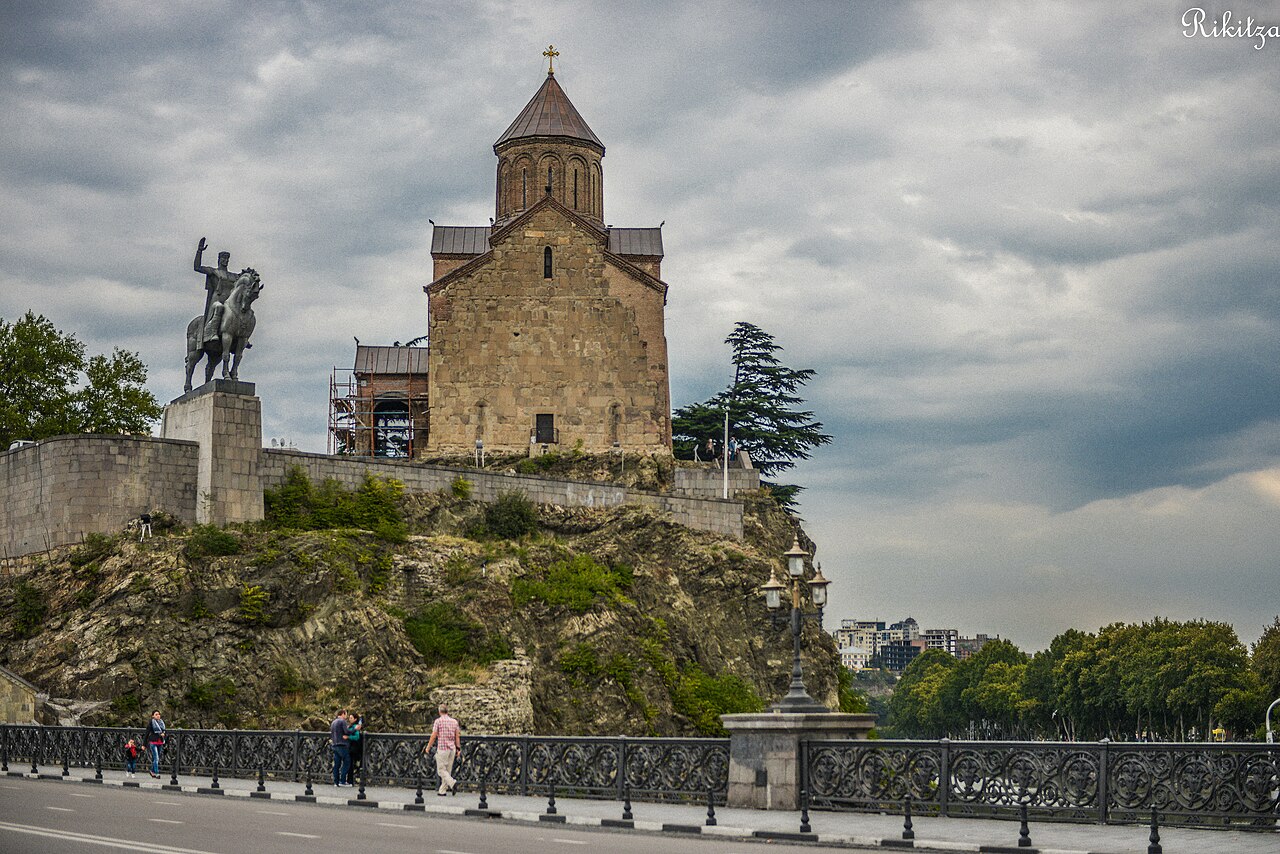
Metekhi Palace is a palace in Tbilisi, Georgia. Name references Metekhi cliffs in Tbilisi, Georgia. Built during Bangkok's cosmopolitan expansion era. Most visitors spend 20-40 min here. The free Lokali audio guide runs 4 minutes.
✓ Verified October 2026 · how we write these guides
Visitor facts
| Time needed | 20-40 min |
|---|---|
| Lokali audio guide | 4 min · free |
| Type | Palace |
| Best for | History |
| Location | Tbilisi, Georgia |
| Coordinates | 41.7151, 44.791 |
| Languages | 45, in the Lokali app |
The story
The air here carries the faint hum of traffic from the Chao Phraya River, mingling with the rustle of palm fronds overhead. You are standing before a structure that does not quite fit the rhythm of Bangkok's historic core — a building whose name suggests distant origins, yet whose presence here tells a story of cultural exchange and twentieth-century ambition.
Metekhi Palace emerged during a period when Bangkok's elite looked beyond Siam's borders for architectural inspiration. The name itself evokes the cliffs of Tbilisi, where the original Metekhi once stood overlooking the Mtkvari River. Here, thousands of kilometres from Georgia, the reference is less about direct imitation and more about the cosmopolitan aspirations of a city opening to the world. The palace was conceived as a residence, a statement of modernity wrapped in European forms.
The facade presents a blend of neoclassical symmetry and tropical adaptation. Notice the high ceilings implied by the tall windows — a design choice driven by Bangkok's heat and humidity. The arches and columns echo European precedents, yet the proportions feel lighter, the ornamentation sparser, as if the building acknowledges the weight of the monsoon rains and the need for air to move freely through its halls.
Inside, the palace once housed rooms arranged in the formal European manner, with reception halls and private chambers segregated by function. The floors were likely polished teak or marble, materials that could withstand the damp and be cleaned easily in a climate where mildew is a constant adversary. The walls would have been painted in pale tones to reflect light, reducing the need for lamps in the equatorial glare.
By the mid-twentieth century, the palace had shifted hands and purposes. Like many grand residences in Bangkok, it adapted to the city's rapid modernization — becoming offices, hosting institutions, or standing quietly as the urban fabric grew denser around it. The surrounding neighbourhood transformed from low-rise compounds and gardens into a patchwork of shophouses and mid-rise commercial blocks.
Today, the building occupies a quieter role. It is not a museum with ticketed entry, nor a monument with plaques and guided tours. Instead, it functions as a marker of a particular moment in Bangkok's history — a time when the city's architects and patrons drew freely from global vocabularies, creating hybrid forms that belonged fully neither to Europe nor to traditional Siamese aesthetics, but to the specific conditions of this place.
Stand back and observe the relationship between the palace and its immediate context. The street level may be occupied by small businesses or administrative offices, the kind of adaptive reuse that keeps old buildings alive in a city where land values constantly pressure owners to demolish and rebuild. The roofline, visible from certain angles, shows the influence of European gables softened by the tropical need for overhangs and ventilation.
The palace does not shout for attention. It sits within the urban grain, a testament to the quieter layers of Bangkok's architectural history — the experiments, the borrowings, the moments when distant influences landed here and were transformed by local climate, materials, and use. It is a building that rewards the attentive walker, the visitor willing to pause and read the city's palimpsest of styles and eras.
As you move on, notice how the surrounding streets carry traces of the same cosmopolitan impulse — a Chinese shophouse next to a modernist block, a spirit house beside a concrete parking garage. Metekhi Palace is one thread in that larger weave, a building that speaks not of grandeur but of adaptation, not of monuments but of the everyday work of making a global city feel like home.
Key facts
What to look for
Practical tips
Common questions
How long do you need at Metekhi Palace?
Plan 20-40 min. That is the time most visitors spend at Metekhi Palace. The free Lokali audio guide runs 4 minutes and is made to listen to while you walk.
Is there a free audio guide to Metekhi Palace?
Yes — the Lokali app narrates Metekhi Palace free of charge in 50+ languages. No ticket, tour group or subscription, and it works offline once downloaded.
Where is Metekhi Palace?
Metekhi Palace is in Tbilisi, Georgia, at 41.7151, 44.791. Tap the map link on this page for directions.
What should you know before visiting Metekhi Palace?
Walk the surrounding streets to see architectural layering
What is Metekhi Palace known for?
Name references Metekhi cliffs in Tbilisi, Georgia
What is the best time to visit Metekhi Palace?
Visit in morning light for clearer facade details
On the map
Opens directions to Metekhi Palace from your location.
More to see in Tbilisi



Hear Metekhi Palace in your language
The full story, narrated, in 50+ languages. Download it before you go and it plays offline, at your own pace, with no ticket and no tour group.