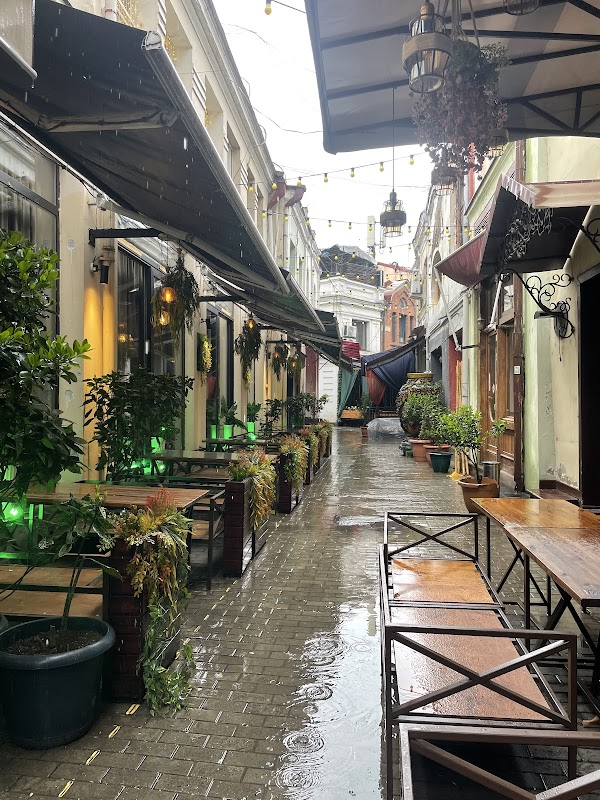
Shardeni Street is the cobblestones beneath your feet are worn smooth by centuries of footsteps — merchants, soldiers, poets, and now you. It is in Tbilisi, Georgia. The free Lokali audio guide runs 9 minutes.
✓ Verified August 2026 · how we write these guides
Visitor facts
| Lokali audio guide | 9 min · free |
|---|---|
| Location | Tbilisi, Georgia |
| Coordinates | 41.7155, 44.7895 |
| Languages | 45, in the Lokali app |
The story
The cobblestones beneath your feet are worn smooth by centuries of footsteps — merchants, soldiers, poets, and now you. Shardeni Street curves gently through the heart of Tbilisi's old town, a narrow lane where the buildings lean close enough that neighbours could pass a cup of sugar from balcony to balcony. The name honours Jean Chardin, a seventeenth-century French traveler who chronicled the Silk Road cities of Persia and the Caucasus. His journals captured Tbilisi in vivid detail — the sulfur baths, the bazaars, the mingling of faiths — and the city repaid him with this street.
Look up at the balconies. They jut from every facade, carved wooden frames painted in faded blues and greens, some sagging under their own weight. These are not decorative — they were essential to life here. In the heat of summer, families moved their entire day outdoors onto these platforms, cooking, eating, sleeping above the street. The lattice screens gave privacy while letting the breeze through. You will notice some balconies are newer, their wood pale and straight, rebuilt after the Soviet years when much of the old town fell into disrepair.
The street was once a quiet residential lane, home to Armenian and Georgian merchants whose wealth came from the caravanserais a few blocks away. By the late twentieth century, it had become shabby, almost forgotten. Then in the early two thousands, Tbilisi began to wake up to its own architectural heritage. Shardeni was one of the first streets to be restored, its cobbles relaid, its buildings shored up. Cafes and wine bars moved into the ground floors, and suddenly this forgotten alley became the beating heart of Tbilisi's nightlife.
Today, the street hums with a particular energy — part tourist boulevard, part local gathering place. On warm evenings, tables spill onto the cobbles, and the air fills with the clink of wine glasses and the murmur of Georgian, Russian, English, Turkish. You will hear live music drifting from doorways — a guitarist playing old Soviet ballads, a trio singing Georgian polyphony in tight, eerie harmonies that seem to rise from the stones themselves.
But step into Shardeni during the day, especially in the morning, and you catch a different rhythm. Shop owners sweep their stoops, delivery trucks inch down the narrow lane, and the light slants low through the gaps between buildings, turning the pastel facades gold. The tourist crowds have not yet arrived, and for a few hours, the street belongs to the people who live and work here.
Notice the ironwork — the curling balcony railings, the lanterns bolted to the walls, the heavy rings set into the stone where horses were once tethered. Much of this metalwork dates from the nineteenth century, forged in workshops that lined the Mtkvari River below. The iron has rusted to a deep orange-brown, and in places, you can see where modern welders have patched breaks with cleaner, shinier metal.
At the street's southern end, you will find a small square where Shardeni meets Erekle II Street. A bronze statue stands here — a man in a long coat, his face thoughtful. This is Sayat-Nova, the eighteenth-century poet and musician who sang in Armenian, Georgian, and Persian, moving between the courts and taverns of the Caucasus. His songs were love poems, drinking songs, laments for lost kingdoms. He was murdered during a Persian invasion, but his melodies survived, passed down through generations of ashughs — wandering bards — and you still hear them in Tbilisi's wine cellars today.
The buildings along Shardeni are a patchwork of eras. Some have thick stone walls from the eighteenth century, others are nineteenth-century brick with stucco facades. A few show the scars of the eighteen hundred and ninety-five earthquake — cracks that were never fully repaired, walls that lean slightly out of plumb. The city has layered itself here, each generation building on the ruins of the last, and the street has absorbed it all.
Peer into the courtyards as you walk. Many are open to the street, and you will glimpse vine-covered pergolas, washing lines strung between balconies, cats sleeping on warm stone. These inner spaces were the true heart of the old town — semi-public zones where neighbours gathered, children played, and the life of the street turned inward, away from the noise and dust.
Shardeni is louder now than it was a generation ago, more commercial, more polished. Some locals grumble that it has lost its soul, that the wine bars have driven out the old families. But walk it at the right hour — early morning, late autumn, when the tourists are few — and you can still feel the weight of the place, the centuries compressed into these stones. The balconies still sag, the cobbles still shine where they have been worn smooth, and the street still curves the way it did when Chardin walked it, three hundred years ago.
Stand still for a moment. Listen past the cafe music and the chatter. You might catch the echo of what this street was — a lane where empires met, where languages tangled, where the road to Persia began. And then, when you are ready, walk on. The old town is full of streets like this, each with its own story, each waiting to be noticed.
Key facts
What to look for
Practical tips
Common questions
How long is the audio guide for Shardeni Street?
The free Lokali audio guide for Shardeni Street runs about 9 minutes. Allow extra time beyond that to look around at your own pace.
Is there a free audio guide to Shardeni Street?
Yes — the Lokali app narrates Shardeni Street free of charge in 50+ languages. It covers the history, what to look for on site and practical tips, and it works offline once downloaded.
Where is Shardeni Street?
Shardeni Street is in Tbilisi, Georgia, at 41.7155, 44.7895. Tap the map link on this page for directions from where you are.
What should you know before visiting Shardeni Street?
Visit early morning for quieter atmosphere and better light.
What is Shardeni Street known for?
Named after Jean Chardin, seventeenth-century French traveler.
On the map
Opens directions to Shardeni Street from your location.
More to see in Tbilisi



Hear Shardeni Street in your language
The full story, narrated, in 50+ languages. Download it before you go and it plays offline, at your own pace, with no ticket and no tour group.