
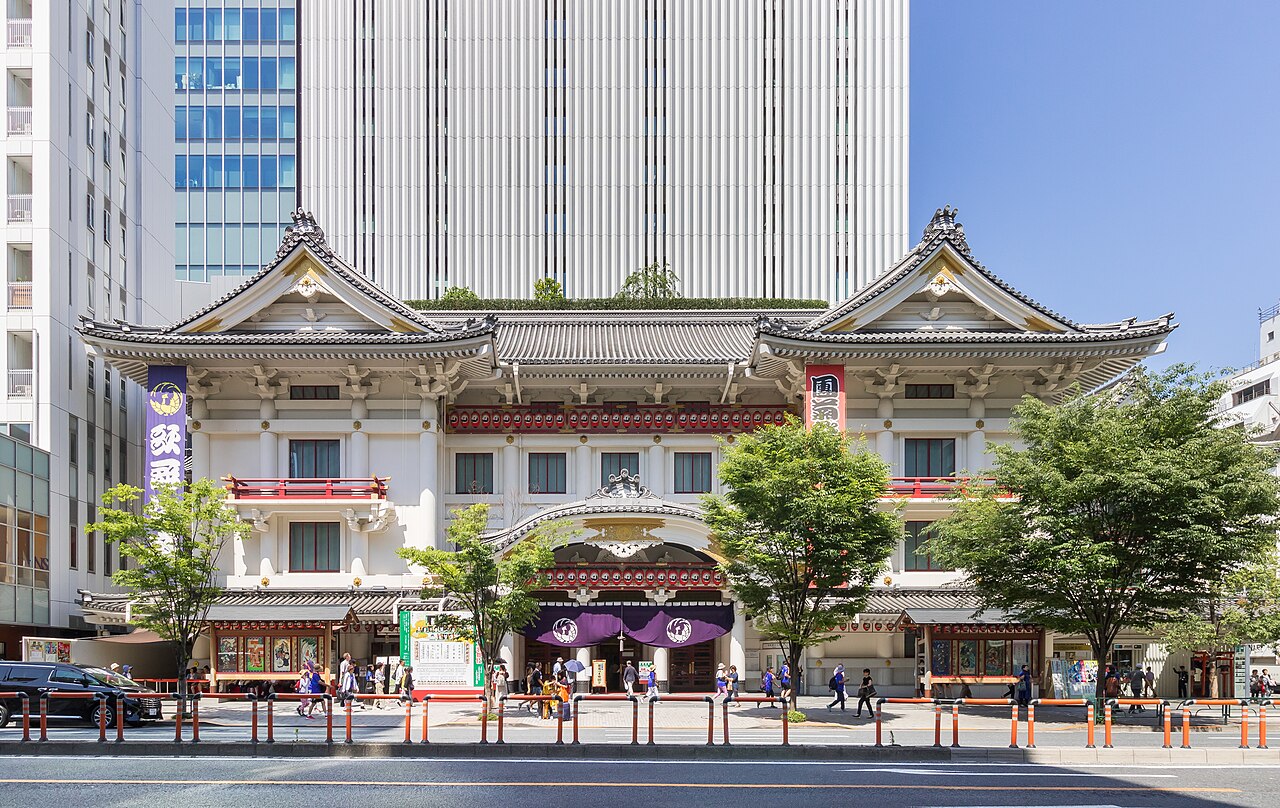
Photo: Kakidai · CC BY-SA 4.0 · Wikimedia Commons
Kabuki-za is a Kabuki theatre in Tokyo. The first Kabuki-za theatre opened on this site in 1889. The free Lokali audio guide runs 7 minutes.
✓ Published October 2026 · how we write these guides
Visitor facts
| Lokali audio guide | 7 min · free |
|---|---|
| Type | Theatre |
| Location | Tokyo, Japan |
| Coordinates | 35.6697, 139.7681 |
| Official website | kabuki-za.co.jp |
| Languages | 50+, in the Lokali app |
The story
Stand on the pavement across the road and look up. A row of red paper lanterns hangs along the front of the building and sways a little in the wind off Harumi-dori. Above them, a heavy tiled roof curves upward at the edges, and its gables are painted a soft, chalky white. Taxis hiss past. Somewhere behind you, a crossing signal chirps. And in the middle of all that glass and steel, this theatre looks like it belongs to another century.
This is Kabuki-za, the main home of kabuki in Tokyo. Kabuki is a form of Japanese theatre known for bold makeup, rich costumes, live music, and stylised movement. The name of the building simply means the kabuki theatre. For many Japanese people, it is the place where this art form is kept alive in its fullest, most traditional shape. It sits in Higashi-Ginza, the eastern edge of Ginza, one of the city's oldest shopping districts.
The first theatre on this site opened in 1889, in the Meiji era. That was a period when Japan was changing very fast and looking hard at Western ideas. Some of the early backers wanted kabuki to feel respectable and modern, a theatre that could stand beside the opera houses of Europe. Since then, the building has been destroyed, rebuilt, and redesigned several times. Fire, earthquake, and war have all taken their turn here.
The Great Kanto Earthquake of 1923 struck Tokyo before a rebuilt theatre could even open. The new building that finally rose in the 1920s used traditional Japanese forms, but it was made with modern materials. Then, in 1945, air raids on Tokyo badly damaged it. After the war, the theatre was restored and reopened in the early 1950s. That postwar building served audiences for more than half a century. Many older Tokyoites still remember it with real affection.
What you see today is the fifth version of Kabuki-za. It opened in 2013, and the architect Kengo Kuma led the design. Here is the first thing many visitors miss. Kuma did not try to invent something new. He kept the familiar face of the postwar theatre — the curved gables, the lanterns, the long, low front — almost exactly as people remembered it. The change is hidden in plain sight. Look up and behind the roof, and you will see a tall office tower rising above it.
That tower is called Kabuki-za Tower, and it climbs to twenty-nine floors. The theatre and the tower are one project. The rent from the offices helps support the theatre below. It is a very Tokyo solution: tradition at street level, business in the sky. From many angles, the two seem to belong to different worlds. Stand on the far corner and you can frame both in a single photograph.
Inside, the auditorium seats close to two thousand people. The stage is very wide and shallow, much wider than most Western stages. It is built for long, flat pictures, like a painted scroll unrolling sideways. Under the stage, there is machinery that kabuki pioneered centuries ago. There is a revolving stage that can turn a whole scene around in front of you. There are also trapdoors, called seri, that lift actors up from below.
Now, look for the hanamichi, which means flower path. It is a raised walkway that runs from the stage straight through the audience to the back of the hall. Actors make dramatic entrances and exits along it. At one key spot, an actor will often stop, strike a frozen pose, and glare. That pose is called a mie. If you sit near the hanamichi, a performer in full makeup may pass close enough to hear the silk of his costume.
And yes — his costume. In traditional Grand Kabuki, all the roles are played by men. Actors who specialise in female roles are called onnagata. Many famous actors come from long family lines, and their stage names pass down through generations. During a performance, you may hear a sudden shout from the upper seats. It is not a heckler. Devoted fans call out the actor's guild name at exactly the right moment, as a form of praise. This tradition is called kakegoe.
Kabuki itself is much older than this building. It grew up in the early seventeenth century. According to tradition, a woman named Izumo no Okuni started it by performing dances in Kyoto, by the banks of a river. Women were later banned from the stage, and the art passed fully to male actors. Over time, kabuki became the popular theatre of the merchant class in the city then called Edo — the old name of Tokyo.
Here is a second small surprise, and it is about food. A full kabuki programme can last most of a day, with long breaks between acts. People eat during those breaks, and the boxed meal known as makunouchi bento takes its name from them. Makunouchi roughly means between the curtains. Today you can still buy bento and snacks inside the theatre, and many people eat at their seats during the intermissions.
If a full programme feels like too much, there is another way in. Kabuki-za sells single-act tickets, called hitomakumi, for seats high up at the back. They are sold on the day, so you can drop in for one act and leave. English-language guides are also offered, which explain the plot and the music as the play unfolds. Even if you do not go inside, the basement and the tower have places worth exploring. Below ground, a small plaza links to Higashi-Ginza Station and sells theatre souvenirs and sweets.
Up on the tower, there is also a small rooftop garden. It sits above the theatre roof, among the modern buildings of Ginza. From there, you can look down at the old curved tiles from above — a view most people never see. A quiet path leads past a stone lantern and some trees. It is a good place to sit for a moment between the noise of the street and the noise of the stage.
Before you walk on, look once more at the front of the theatre. Notice the lanterns, the white gables, and the people waiting by the doors in kimono or office suits. This building has burned, shaken, and fallen, and each time Tokyo has rebuilt it. Listen for the traffic, the crossing signal, and perhaps the faint sound of a drum from inside. Then step back into Ginza and carry that sound with you down the street.
Key facts
What to look for
Practical tips
Common questions
Is there a free audio guide to Kabuki-za?
Yes — the Lokali app narrates Kabuki-za free of charge in 50+ languages. The guide runs about 7 minutes, covers the history, what to look for on site and practical tips, and works offline once downloaded.
Where is Kabuki-za?
Kabuki-za is in Tokyo, Japan, at 35.6697, 139.7681. Tap the map link on this page for directions from where you are.
What is Kabuki-za known for?
The first Kabuki-za theatre opened on this site in 1889. The current theatre opened in 2013, designed by Kengo Kuma.
What should you look for at Kabuki-za?
Red paper lanterns hanging along the theatre's front. Curved white gables on the heavy tiled roof. The hanamichi walkway running through the audience to the stage.
What should you know before visiting Kabuki-za?
Buy single-act hitomakumi tickets on the day for a short visit. Rent the English-language guide to follow the plot and music.
On the map
Opens directions to Kabuki-za from your location.
More to see in Tokyo

Hear Kabuki-za in your language
The full story, narrated, in 50+ languages. Download it before you go and it plays offline, at your own pace, with no ticket and no tour group.