
Photo: Akonnchiroll · CC0 · Wikimedia Commons
Tokyo Skytree is a tower in Tokyo, Japan. Height is 634 metres, the world's tallest tower. The free Lokali audio guide runs 7 minutes.
✓ Published October 2026 · how we write these guides
Visitor facts
| Lokali audio guide | 7 min · free |
|---|---|
| Type | Tower |
| Location | Tokyo, Japan |
| Coordinates | 35.7101, 139.8107 |
| Official website | tokyo-skytree.jp |
| Languages | 50+, in the Lokali app |
The story
Stand close to the base and tilt your head back. The steel lattice rises above you in a pale, almost milky white, and the top seems to disappear into the sky. Around you, trains rumble into the stations below. Shoppers drift past with paper bags. Somewhere nearby a crossing signal chirps. This is Tokyo Skytree, and from down here it is hard to believe that anything built by people could climb this high.
The tower stands 634 metres tall. That makes it the tallest tower in the world, and the tallest structure in Japan. The number was chosen with care. In Japanese, the digits six, three and four can be read as mu, sa and shi, which sounds like Musashi. Musashi was the old name of the province that once covered Tokyo and the land around it. So the height itself is a small piece of wordplay, and a nod to the region's past.
Skytree opened to the public in 2012. Its main job is practical, not decorative. It is a broadcasting tower. As Tokyo filled with skyscrapers, the older Tokyo Tower was no longer tall enough to send digital television signals cleanly across the city. Signals bounced off the high buildings. A taller mast was needed, one that could reach over the whole Kanto plain. The answer was this tower, rising from a former freight yard in the east of the city.
Now look at the shape of the legs. At ground level, the tower stands on a triangle. As it climbs, the cross-section slowly changes, and near the top it becomes a circle. Most visitors miss this. Walk around the base, and the outline shifts as you move. From one side the tower seems to curve inward, a gentle concave line. From another it seems to swell outward. Japanese builders have traditional names for these two curves, used for centuries in temple roofs and the blades of swords.
The colour has a story too. It is called Skytree White. The designers based it on aijiro, the palest shade of traditional indigo dye — a blue so light it reads almost as white. Indigo was the everyday colour of the Edo period, the era when Tokyo was still called Edo, from the early seventeenth to the mid nineteenth century. Workers, merchants and craftsmen wore it. So this very modern tower is painted in a colour that ordinary people of old Edo would have recognised.
Here is the surprise hidden inside. Tokyo sits in one of the most earthquake-prone regions on Earth. To keep the tower steady, the engineers borrowed an idea from the wooden pagodas of Japanese temples. Those pagodas have a central pillar, called a shinbashira, that runs up through the middle. Many of them have survived centuries of earthquakes. Skytree has its own central column of reinforced concrete, standing apart from the outer steel frame. When the ground shakes, the two parts move differently, and that difference helps calm the sway.
That idea was tested early. In March 2011, while the tower was still under construction and nearly at its full height, the great earthquake struck eastern Japan. Cranes were perched near the top. The tower came through. For many people in Tokyo, that moment changed how they saw the structure. It was no longer just a television mast going up in the east. It became a quiet symbol of a city that bends but does not break.
When you go up, the high-speed elevators carry you to the first observation level, called the Tembo Deck, at 350 metres. The ride is fast and smooth, and your ears may pop. Watch the elevator interiors as well — each set is decorated with a different seasonal theme drawn from Japanese art. Once you step out, the whole city spreads in every direction through tall glass windows. Look for the section of glass floor. Standing on it, you can stare straight down the steel frame to the streets far below.
A separate ticket takes you higher, to the Tembo Galleria at 450 metres. Here the experience changes. Instead of a flat deck, you walk up a long, gently sloping ramp of glass and steel that spirals around the tower. It feels a little like walking on air. The highest point of the ramp is the highest place you can stand in the tower. Above you, out of reach, the antenna mast continues upward to the full 634 metres.
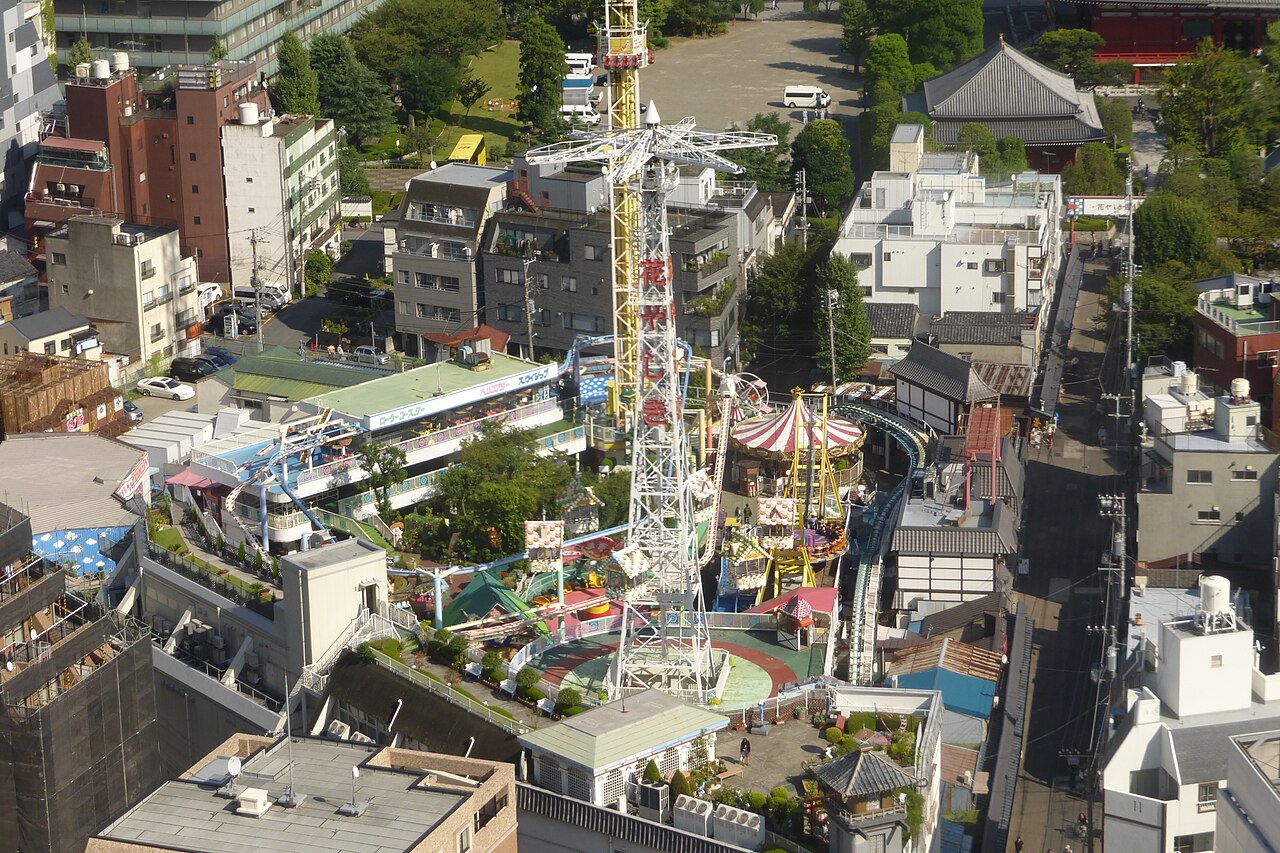
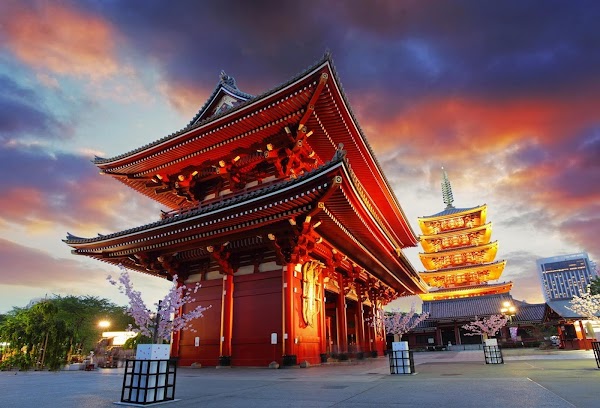
On a clear day the view stretches far beyond the city. Tokyo has no obvious edge. Rooftops run on and on, cut by rivers, rail lines and elevated highways. Look west on a crisp winter morning, and you may see the snowy cone of Mount Fuji on the horizon. Look down closer, and you will see the Sumida River curving below. Just across it lies Asakusa, the old temple district, where the red gate and pagoda of Senso-ji draw crowds every day.
At night the tower becomes a different object. It is lit in patterns that change through the year. Two of the main styles have names taken from old Japanese ideas of beauty. One is Iki, a pale blue that suggests the cool, stylish spirit of Edo townspeople. The other is Miyabi, a purple tone linked with courtly elegance. The colours glow against the dark sky, and from many parts of eastern Tokyo you can see the tower shining above the rooftops.
Down at the base, the tower is part of a larger complex called Tokyo Skytree Town. It includes a large shopping centre, Tokyo Solamachi, full of restaurants, food stalls and small shops selling snacks and souvenirs. There is also an aquarium and a planetarium. Many local families come here without going up the tower at all. They eat, shop and walk the riverside paths. The neighbourhood around it, Oshiage and Narihirabashi, still has small streets, older houses and quiet canals.
Before you leave, step back to one of the bridges over the canal near the base. From there, the whole tower fits into view, with the water in front of it. Notice how the white steel picks up the colour of the sky — warm at sunset, grey in rain, pale blue on a bright afternoon. Listen to the trains again, the voices, the bicycles passing. The tower is enormous, but life around it carries on at street level. Take one last look up, and then let the city pull you back in.
Key facts
What to look for
Practical tips
Common questions
Is there a free audio guide to Tokyo Skytree?
Yes — the Lokali app narrates Tokyo Skytree free of charge in 50+ languages. The guide runs about 7 minutes, covers the history, what to look for on site and practical tips, and works offline once downloaded.
Where is Tokyo Skytree?
Tokyo Skytree is in Tokyo, Japan, at 35.7101, 139.8107. Tap the map link on this page for directions from where you are.
What is Tokyo Skytree known for?
Height is 634 metres, the world's tallest tower. Opened to the public in 2012.
What should you look for at Tokyo Skytree?
Triangular base turning into a circle near the top. Pale Skytree White paint based on traditional indigo. Glass floor panel on the Tembo Deck.
What should you know before visiting Tokyo Skytree?
Go up on a clear winter morning for Fuji views. Book the Tembo Galleria ticket separately if wanted.
When is the best time to visit Tokyo Skytree?
Go up on a clear winter morning for Fuji views.
On the map
Opens directions to Tokyo Skytree from your location.
More to see in Tokyo

Hear Tokyo Skytree in your language
The full story, narrated, in 50+ languages. Download it before you go and it plays offline, at your own pace, with no ticket and no tour group.