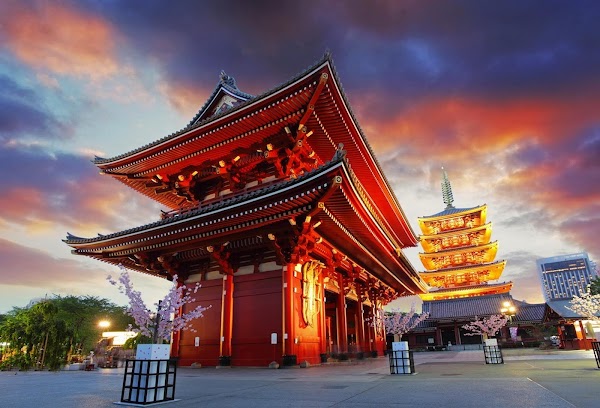
Senso-ji Temple is a temple in Taito, Japan. Tokyo's oldest temple, founded in 645 and rebuilt after wartime destruction. Most visitors spend 45–90 min here. The free Lokali audio guide runs 9 minutes.
✓ Verified August 2026 · how we write these guides
Visitor facts
| Time needed | 45–90 min |
|---|---|
| Lokali audio guide | 9 min · free |
| Type | Temple |
| Best for | Editors' pick |
| Location | Taito, Japan |
| Coordinates | 35.7148, 139.7967 |
| Languages | 45, in the Lokali app |
The story
The first thing you notice is the smoke. Thick, sweet, curling upward from the bronze incense cauldron in front of you — pilgrims waft it over their heads, their shoulders, their hands, believing it carries prayers and heals the body. The smell of sandalwood and camphor fills the air, mingling with the chatter of visitors and the snap of camera shutters. This is Senso-ji, Tokyo's oldest Buddhist temple, and you are standing in a current of devotion that has flowed here for nearly fourteen centuries.
Legend says it began with two fishermen in the year 628. They hauled their nets from the Sumida River one morning and found a small golden statue of Kannon, the bodhisattva of compassion, tangled in the mesh. They tried to throw it back — the story goes — but it returned to them again and again. Eventually the village chief recognized the statue as sacred, converted his own home into a shrine, and Senso-ji was born. Whether the story is folklore or fact, the temple has occupied this ground ever since, surviving fires, earthquakes, and war.
You entered through the Kaminarimon, the Thunder Gate, with its enormous red lantern hanging like a suspended drum. That gate was a gift in 1960 from the founder of Panasonic, rebuilt after the Second World War leveled much of the temple complex. The original structures stood for centuries, but American firebombing in 1945 reduced the main hall, the pagoda, and most of the surrounding buildings to ash. What you see today is a postwar reconstruction, completed in the nineteen-fifties and sixties, built from reinforced concrete rather than wood — a pragmatic choice for a city that had burned too many times.
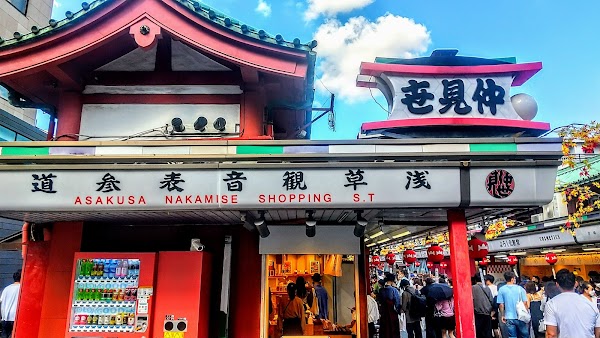
The approach to the main hall runs through Nakamise-dori, a shopping arcade that has served pilgrims since the Edo period. Two hundred metres of stalls sell everything from folding fans and wooden combs to grilled rice crackers and sweet red-bean cakes. The street hums with transaction and appetite, a reminder that temples in Japan have always been social centres, not just places of quiet prayer. Merchants set up here as early as the seventeenth century, when Senso-ji drew millions of visitors each year, making it one of the busiest pilgrimage sites in the country.
Ahead of you, the five-storey pagoda rises fifty-three metres into the sky, its tiered roofs stacked in perfect symmetry. Inside the base, sealed away from public view, are said to be sacred relics brought from Sri Lanka — fragments of bone believed to belong to the Buddha himself. The pagoda you see is the 1973 reconstruction, but it follows the design of earlier versions that stood here since the tenth century, each one destroyed by fire or earthquake, each one rebuilt in the same form.
The main hall, the Hondo, is where most visitors gather. You will see people tossing coins into the offering box, clapping twice, bowing, pressing their palms together. Some shake wooden sticks from a metal canister until one falls out — these are omikuji, fortune slips. If the fortune is bad, they tie it to a rack nearby, leaving the ill luck behind. If it is good, they fold it carefully and tuck it into a pocket. The ritual is simple, tactile, and you will see it repeated dozens of times while you stand here.
Inside the hall, behind clouds of incense smoke and dim golden light, sits the statue of Kannon — or at least the space where it is believed to reside. The statue itself has not been seen in centuries. It is a hibutsu, a hidden Buddha, never displayed, never photographed, its existence a matter of faith rather than evidence. Some scholars doubt it survived the fires of the Edo period. Others believe it remains sealed in the inner sanctuary, untouched, unseen, a mystery at the heart of Tokyo's most visited temple.
Walk to the left of the main hall and you will find a smaller shrine, Asakusa Jinja, dedicated not to Buddhist deities but to Shinto kami — the two fishermen and the village chief from the founding legend. This blending of Buddhism and Shinto, once common across Japan, was officially discouraged after the Meiji Restoration in 1868, but here the two traditions still share the same ground. The shrine is quieter, less crowded, its wooden beams dark with age and weather.
Senso-ji receives around thirty million visitors each year, making it one of the most visited religious sites on earth. On New Year's Eve, the crowd swells to hundreds of thousands, pressing toward the main hall to pray for good fortune in the coming year. But even on an ordinary afternoon, the temple hums with life — tourists, pilgrims, schoolchildren on field trips, elderly women lighting incense, young couples shaking fortune sticks, a monk in black robes sweeping the courtyard stones.
The temple sits in Asakusa, a neighbourhood that was once the entertainment heart of Edo-period Tokyo, filled with kabuki theatres, teahouses, and pleasure districts. Much of that world is gone now, replaced by office towers and train stations, but Senso-ji remains, a fixed point in a city that has rebuilt itself over and over. The smoke rises, the bells ring, the visitors come and go, and the temple holds its ground.
Stand here a moment longer. Watch the way the light catches the gold leaf on the main hall's roof. Listen to the low hum of chanted sutras drifting from inside, the rustle of omikuji paper, the shuffle of feet on stone. This is a place that has been prayed in, rebuilt, and prayed in again for fourteen hundred years. The city around it has changed beyond recognition, but the rhythm here — the smoke, the bells, the bowing heads — remains.
Key facts
What to look for
Practical tips
Common questions
How long do you need at Senso-ji Temple?
Plan 45–90 min. That is the time most visitors spend at Senso-ji Temple. The free Lokali audio guide adds about 9 minutes of narration you can listen to as you walk, so it fits inside your visit rather than adding to it.
Is there a free audio guide to Senso-ji Temple?
Yes — the Lokali app narrates Senso-ji Temple free of charge in 50+ languages. It covers the history, what to look for on site and practical tips, and it works offline once downloaded.
Where is Senso-ji Temple?
Senso-ji Temple is in Taito, Japan, at 35.7148, 139.7967. Tap the map link on this page for directions from where you are.
What should you know before visiting Senso-ji Temple?
Waft incense smoke over yourself at the cauldron.
What is Senso-ji Temple known for?
Tokyo's oldest temple, founded in 628.
What is the best time to visit Senso-ji Temple?
Visit early morning or after 6 PM to avoid peak crowds.
On the map
Opens directions to Senso-ji Temple from your location.
Reference
More to see in Taito




Hear Senso-ji Temple in your language
The full story, narrated, in 50+ languages. Download it before you go and it plays offline, at your own pace, with no ticket and no tour group.