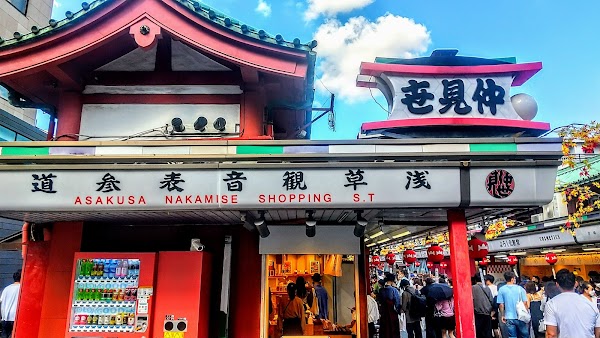
Nakamise Shopping Street
35.7141° N · 139.7968° E · Street Market
Nakamise Shopping Street is a 250-meter pedestrian alley between Senso-ji's main gate and temple entrance, lined with roughly 90 small shops selling traditional souvenirs, snacks, and crafts. It is in Taito, Japan. Most visitors spend 30–60 min here. The free Lokali audio guide runs 5 minutes.
✓ Verified August 2026 · how we write these guides
Visitor facts
| Time needed | 30–60 min |
|---|---|
| Lokali audio guide | 5 min · free |
| Type | Street Market |
| Best for | Local life |
| Location | Taito, Japan |
| Coordinates | 35.7141, 139.7968 |
| Languages | 45, in the Lokali app |
The story
The smell reaches you first. Warm dough on a hot iron. Sweet bean paste. Something frying in oil just steps away. Then the color hits your eyes. Red lanterns in a row. Painted shutters. Rows of small shops pressed close together, left and right. The crowd carries you forward. You have stepped onto Nakamise.
This is the path to the temple. It runs straight from the great red gate to the inner gate of Senso-ji. The walk is about 250 meters long. It is narrow. It is crowded almost every day of the year. And it has looked something like this for a very long time. You are walking a route that millions have walked before you.
Start at the first gate. It is called Kaminarimon, the Thunder Gate. A huge paper lantern hangs in the middle of it. It is red and black and far taller than a person. At the bottom you can see a carved wooden base. Below it, people stop and raise their cameras. Almost no one passes without a photo. Walk under the lantern, and the shopping street begins.
There are around ninety shops along this lane. They line both sides, shoulder to shoulder. Each one is small, often just a single open front. Many are run by families who have held the same spot for generations. They do not sell to locals doing their daily shopping. They sell to pilgrims and travelers, as they have for ages.
The story of this street goes back to the late seventeenth century. Back then, the people who lived near the temple were given a special right. They were allowed to open shops along this path. In return, they helped clean and care for the temple grounds. That simple deal created the street you walk today. It is one of the oldest shopping streets in the whole country.
Look at what they sell. Much of it is food you eat while standing still. There are ningyo-yaki, small cakes shaped like dolls and filled with sweet bean paste. They are pressed hot from metal molds, right in front of you. There are senbei, rice crackers grilled over heat until they turn crisp and brown. There are age-manju, soft buns fried until golden. The smells pull you from one shop to the next.
Other shops sell things to keep. Folding fans painted with flowers. Paper umbrellas. Small cotton towels with bold patterns. Wooden hair combs. Soft cloth shoes. Many of these objects follow old designs. They are made to look much the way they did a hundred years ago. You could carry a piece of that older world home with you.
Try to look up as you walk. It is easy to forget, with so much at eye level. Above the shutters, you may see painted panels. They show the four seasons of the city. Cherry blossoms for spring. Green leaves for summer. Red maples for autumn. These paintings turn the whole street into one long decoration above your head.
The crowd moves slowly. Do not fight it. This street is not made for speed. It is made for stopping. People pause to buy a warm snack. They pause to take a photo. They drift from one window to the next. Let yourself move at the same gentle pace. There is no prize for reaching the end first. Half the joy of Nakamise is the slow walk itself.
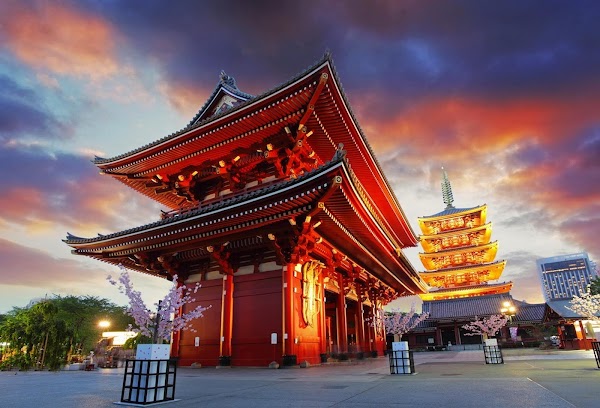
At the far end stands a second gate, larger than the first. It is called Hozomon. Look at its back wall as you pass beneath it. Two giant straw sandals hang there, each one taller than a grown person. They were woven by hand in a town far to the north. Pass through this gate, and you reach the open temple yard. The shops end. The sacred ground begins.
It helps to know that this short walk is a kind of crossing. You begin in the world of buying and selling. You move through the noise, the smells, the bright colors. Step by step, you draw closer to the temple. The street does not only sell you things. It slowly prepares you for the quiet that waits at the end.
So take your time here. Buy something warm and hold it in your hands. Watch the crowd flow toward the gate ahead. People have made this same short walk for hundreds of years. Hungry and curious. Carrying coins and small wishes. Each of them on the way to say a prayer, just like you.
Key facts
What to look for
Practical tips
Common questions
How long do you need at Nakamise Shopping Street?
Plan 30–60 min. That is the time most visitors spend at Nakamise Shopping Street. The free Lokali audio guide adds about 5 minutes of narration you can listen to as you walk, so it fits inside your visit rather than adding to it.
Is there a free audio guide to Nakamise Shopping Street?
Yes — the Lokali app narrates Nakamise Shopping Street free of charge in 50+ languages. It covers the history, what to look for on site and practical tips, and it works offline once downloaded.
Where is Nakamise Shopping Street?
Nakamise Shopping Street is in Taito, Japan, at 35.7141, 139.7968. Tap the map link on this page for directions from where you are.
What should you know before visiting Nakamise Shopping Street?
Try ningyo-yaki, small cakes filled with bean paste.
What is Nakamise Shopping Street known for?
Stretches about 250 meters between two temple gates.
What is the best time to visit Nakamise Shopping Street?
Try freshly grilled senbei (rice crackers) and ningyo-yaki (doll-shaped cakes) from street vendors.
On the map
Opens directions to Nakamise Shopping Street from your location.
Reference
More to see in Taito


Hear Nakamise Shopping Street in your language
The full story, narrated, in 50+ languages. Download it before you go and it plays offline, at your own pace, with no ticket and no tour group.