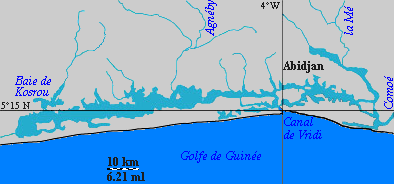
Lagoon Ébrié is a vast lagoon system separating Abidjan's districts, crossed by bridges and lined with fishing villages and waterfront neighborhoods. It is in unknown. Most visitors spend 45–60 min here. The free Lokali audio guide runs 5 minutes.
✓ Verified August 2026 · how we write these guides
Visitor facts
| Time needed | 45–60 min |
|---|---|
| Lokali audio guide | 5 min · free |
| Type | Waterfront |
| Best for | Photography |
| Location | unknown |
| Coordinates | 4.0333, -5.5333 |
| Languages | 45, in the Lokali app |
The story
Every great city has a mirror. Abidjan's mirror is made of water. The Ébrié Lagoon spreads through the middle of the city, wide and calm, holding the towers, the bridges, and the evening sky upside down in its surface.
This is not a lake, and not quite the sea. It is a lagoon, a long ribbon of brackish water trapped behind the coast, where river water meets salt. It stretches about 130 kilometers from east to west, and it is often called the largest lagoon in West Africa, covering more than 500 square kilometers. Abidjan grew up around its central basins, and the water still decides the shape of the city.
The name honors the Ébrié people, also called the Tchaman, who lived here long before the city. Their villages stood on these shores, and some still do, folded into the urban fabric. They fished these waters from dugout canoes and traded along the channels. Every commune of Abidjan stands on land they knew first.
Even the city's name may come from these shores. One old story says a colonial surveyor asked villagers the name of the place. They misunderstood the question and answered that they had just been cutting leaves. The phrase became Abidjan. The story may be legend, but Ivorians tell it with a smile.
For most of history, the lagoon had no direct door to the ocean here. A long sandbar sealed it from the Atlantic surf, and ships could not enter. Colonial engineers tried for decades to cut a passage, and failed more than once. The sea kept closing their channels with sand.
Then, in 1950, workers finished the Vridi Canal. The new cut held. Salt water and ocean ships entered the lagoon, and Abidjan's deep-water port opened soon after. That single channel changed the fate of the country. The port grew into one of the largest in West Africa, and Abidjan grew with it, from a colonial town into a metropolis of millions.
Stand at the water's edge and you can read the city's economy. Container ships and tankers wait near the port on the southern side. Cranes swing above the docks. Ferries angle across the channels, trailing white wakes. Fishing canoes slide past them, carrying men with nets, working the same waters their grandfathers worked. The scales are different. The water is the same.
Bridges stitch the city together across the water. The Houphouët-Boigny Bridge, opened in 1957, came first, named for the country's first president. The Charles de Gaulle Bridge followed in 1967. The Henri Konan Bédié Bridge, a long toll crossing, opened in 2014, and newer spans have followed as the city grows. At rush hour they carry rivers of cars, and the lagoon glitters beneath them, indifferent to the hurry.
The cheapest cruise in Abidjan costs about the price of a bus ticket. Public water buses called bateaux-bus run scheduled routes across the lagoon, linking Plateau, Treichville, and other districts. Rides are short, cheap, and frequent on weekdays. Commuters use them daily. Visitors get the best seats in the city: open water, moving air, and the skyline rising from the deck.
The lagoon has paid a price for the city's growth. Waste and runoff flow into its basins, and in places the water smells of the harbor rather than the sea. Officials and engineers speak often of cleaning it. Some projects have begun. The lagoon waits, patient, as it has always waited.
Out on the water, life continues. Fishermen throw round cast nets that open like parachutes and settle on the surface. Île Boulay, a large island facing the port, keeps village rhythms and weekend beach restaurants, minutes from downtown and a world apart. Pirogues ferry visitors across for a simple fee.
The best hour belongs to everyone. Come to the shore in late afternoon, when the heat softens. The sun drops behind the Plateau towers, and the whole skyline turns to silhouette. The water goes from grey to gold to deep violet. Lights come on across the bridges, and their reflections stretch toward you like slow fireworks.
Cities rise, argue, build, and change their minds. Water simply remains. The Ébrié people gave their name to this lagoon, the canal gave it ships, and the city gave it bridges and noise. It accepts all of this and holds the sky anyway. Look at the water one more time before you go. Abidjan is in it, upside down and shining.
Key facts
What to look for
Practical tips
Common questions
How long do you need at Lagoon Ébrié?
Plan 45–60 min. That is the time most visitors spend at Lagoon Ébrié. The free Lokali audio guide adds about 5 minutes of narration you can listen to as you walk, so it fits inside your visit rather than adding to it.
Is there a free audio guide to Lagoon Ébrié?
Yes — the Lokali app narrates Lagoon Ébrié free of charge in 50+ languages. It covers the history, what to look for on site and practical tips, and it works offline once downloaded.
Where is Lagoon Ébrié?
Lagoon Ébrié is in unknown, at 4.0333, -5.5333. Tap the map link on this page for directions from where you are.
What should you know before visiting Lagoon Ébrié?
Ride a bateau-bus across the lagoon on a weekday.
What is Lagoon Ébrié known for?
Stretches about 130 kilometers behind the Atlantic coast.
What is the best time to visit Lagoon Ébrié?
Sunset from the Pont de Gaulle offers unobstructed views across the water.
On the map
Opens directions to Lagoon Ébrié from your location.
More to see in unknown


Hear Lagoon Ébrié in your language
The full story, narrated, in 50+ languages. Download it before you go and it plays offline, at your own pace, with no ticket and no tour group.