
Photo: Diliff · CC BY-SA 3.0 · Wikimedia Commons
L'Oceanogràfic is an aquarium in Valencia, Spain. Built inside the old Turia riverbed after the 1957 flood. The free Lokali audio guide runs 7 minutes.
✓ Published October 2026 · how we write these guides
Visitor facts
| Lokali audio guide | 7 min · free |
|---|---|
| Type | Zoo |
| Location | Valencia, Spain |
| Coordinates | 39.4529, -0.3481 |
| Official website | cac.es |
| Languages | 50+, in the Lokali app |
The story
Listen for a moment. Under the hum of the city there is the soft slap of water against glass, the cry of gulls that have learned where the fish are, and a cool breath of air from the pools. The ground beneath you is pale stone, warm in the sun. Above, white concrete roofs curve upward like the petals of a flower. This is L'Oceanogràfic, Valencia's great aquarium, and you are standing at the edge of the sea without seeing the sea at all.
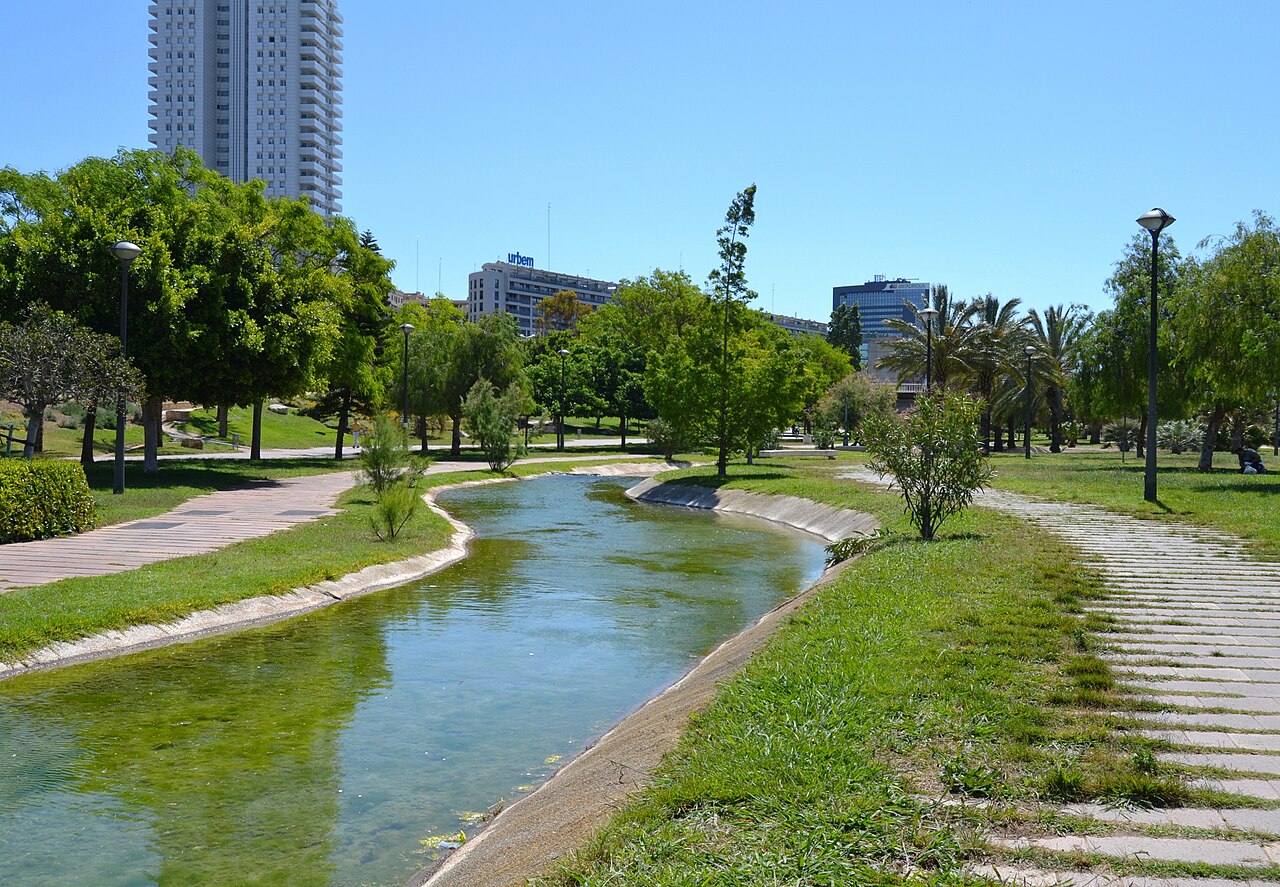
First, look at where you are. This whole complex sits inside a riverbed. The Turia river once ran right through Valencia. After a devastating flood in 1957, engineers moved the river south of the city. The old channel was left empty. Instead of filling it with motorways, Valencians turned it into a long green ribbon of gardens, paths and sports fields. The aquarium sits near the southern end of that ribbon.
L'Oceanogràfic is part of the City of Arts and Sciences, a cluster of large white buildings along the old riverbed. Most of its neighbours were designed by the Valencian architect Santiago Calatrava, with their ribs and bone-like forms. This aquarium is different. Its signature roofs come from another mind entirely — the Spanish architect Félix Candela. Once you know this, you can see the difference. Calatrava's buildings look like skeletons. Candela's look like thin sheets of paper, folded and lifted into the air.
Candela has a remarkable story. He was born in Madrid. After the Spanish Civil War, he went into exile in Mexico. There he became famous for very thin concrete shells. He built them in a geometry called the hyperbolic paraboloid. In simple words, it is a saddle shape: it curves up in one direction and down in the other. That double curve makes the concrete strong, so the shell can be surprisingly thin. Here is the quiet surprise. Candela died in 1997, before this aquarium opened in 2003. These roofs were among his final designs, completed by others.
Look up at the main entrance building, and follow the edges of the roof. The white shell rises at several points and dips between them. It looks a little like a water lily, or an open shell on the beach. Notice how little seems to hold it up. Sunlight passes under the raised edges. In the afternoon, reflections from the pools ripple across the underside. A great deal of weight sits over your head, yet it looks almost weightless.
Now, the animals. L'Oceanogràfic is often described as the largest aquarium in Europe. It holds tens of thousands of animals from hundreds of species. But the real idea here is not size. It is organisation. The park is divided by marine environments, not by animal type. You move from the Mediterranean to tropical seas, from wetlands to the polar regions. Each building tries to recreate a world.
Start, perhaps, close to home. The Mediterranean area shows the sea just a few kilometres east of where you stand. Many visitors rush past it toward the sharks. That is a mistake. Here you meet the fish that local fishermen have caught for centuries, the octopus, the rays, the seagrass meadows. These are the creatures behind the rice dishes and seafood stews of this coast. It is the most local room in the building.
Then comes the moment many people remember most — the underwater tunnel. You walk through a long curved passage of clear acrylic, with water above you and on both sides. Sharks glide overhead. Rays pass like dark kites. The light turns blue and moves gently across the floor. Children press their faces to the glass. Adults often go quiet. Take your time here. Stand still and let the animals come to you.
The polar areas feel like a change of season. In the Antarctic building, penguins move between ice-coloured rocks and cold water. On land they waddle. In the water they fly. The Arctic area is home to beluga whales. These are pale white whales with rounded heads. They are known for their range of sounds, from whistles to clicks. Watch their faces. Belugas can change the shape of their foreheads, which gives them an expressive, almost thoughtful look.
The aquarium is more than a display. Through its foundation, it takes part in rescue and research work for marine animals. Sea turtles found injured along the Valencian coast, for example, can be treated and later returned to the sea. Much of this work happens out of public view. Still, it gives a different meaning to the tanks around you. Some of what you see here is about learning how to protect the real Mediterranean outside.
There is one more surprise, inside the main building. Under a Candela roof, there is a restaurant surrounded by a large aquarium tank. Diners sit at their tables while fish swim around the walls beside them. It is an unusual experience — eating a meal in a room that feels like the bottom of the sea. Even if you do not eat there, the building itself rewards a slow walk.
Between the buildings, notice the outdoor landscape. Paths cross shallow pools and gardens, and the white architecture repeats in the water. The wetlands area recalls the Albufera, the large freshwater lagoon south of Valencia. Its marshes are where the region's rice grows. Here at the aquarium you see the birds and plants of that lagoon at close range. It is a reminder that Valencia lives between fresh water and salt water.
For a final view, walk to a spot where you can see the white roofs against the sky. Behind you, toward the city, Calatrava's buildings rise in a long line. In front of you, Candela's shells sit lower and softer. Two very different ideas of modern Valencia stand side by side here.
Before you leave, pause once more. Listen again for the water, the gulls, the voices of other visitors. Look at the thin edge of the nearest concrete roof, and remember that its designer never saw it finished. Then, as you walk out into the old riverbed, think of the real sea, only a short ride away. Everything inside these walls came from there, and all of it depends on it.
Key facts
What to look for
Practical tips
Common questions
Is there a free audio guide to L'Oceanogràfic?
Yes — the Lokali app narrates L'Oceanogràfic free of charge in 50+ languages. The guide runs about 7 minutes, covers the history, what to look for on site and practical tips, and works offline once downloaded.
Where is L'Oceanogràfic?
L'Oceanogràfic is in Valencia, Spain, at 39.4529, -0.3481. Tap the map link on this page for directions from where you are.
What is L'Oceanogràfic known for?
Built inside the old Turia riverbed after the 1957 flood. Signature roofs designed by Spanish architect Félix Candela.
What should you look for at L'Oceanogràfic?
Saddle-shaped white concrete shells on the entrance building. Rippling water reflections under the raised roof edges. Sharks and rays passing directly over the tunnel.
What should you know before visiting L'Oceanogràfic?
Book tickets online ahead to skip queues at the entrance. Visit the Mediterranean area first before the crowds arrive.
When is the best time to visit L'Oceanogràfic?
Visit the Mediterranean area first before the crowds arrive.
On the map
Opens directions to L'Oceanogràfic from your location.
More to see in Valencia



Hear L'Oceanogràfic in your language
The full story, narrated, in 50+ languages. Download it before you go and it plays offline, at your own pace, with no ticket and no tour group.