
Palau de les Arts Reina Sofía
39.4578° N · 0.3556° W · Opera House
Photo: Ben Bender · CC BY-SA 3.0 · Wikimedia Commons
Palau de les Arts Reina Sofía is an opera house in Valencia, Spain. Designed by Valencia-born architect and engineer Santiago Calatrava. The free Lokali audio guide runs 7 minutes.
✓ Published October 2026 · how we write these guides
Visitor facts
| Lokali audio guide | 7 min · free |
|---|---|
| Type | Opera House |
| Location | Valencia, Spain |
| Coordinates | 39.4578, -0.3556 |
| Official website | lesarts.com |
| Languages | 50+, in the Lokali app |
The story
Stand still for a moment and listen. Water moves gently in the shallow pools around you. Somewhere a skateboard clicks over the paving, and a bicycle bell rings along the path behind. Above you a white shell rises, curving out like the hull of a ship, or a helmet, or a seed pod split open. The light here is strong. It bounces off the pale surfaces and the water, and you may find yourself squinting. This is the Palau de les Arts Reina Sofía, Valencia's opera house.
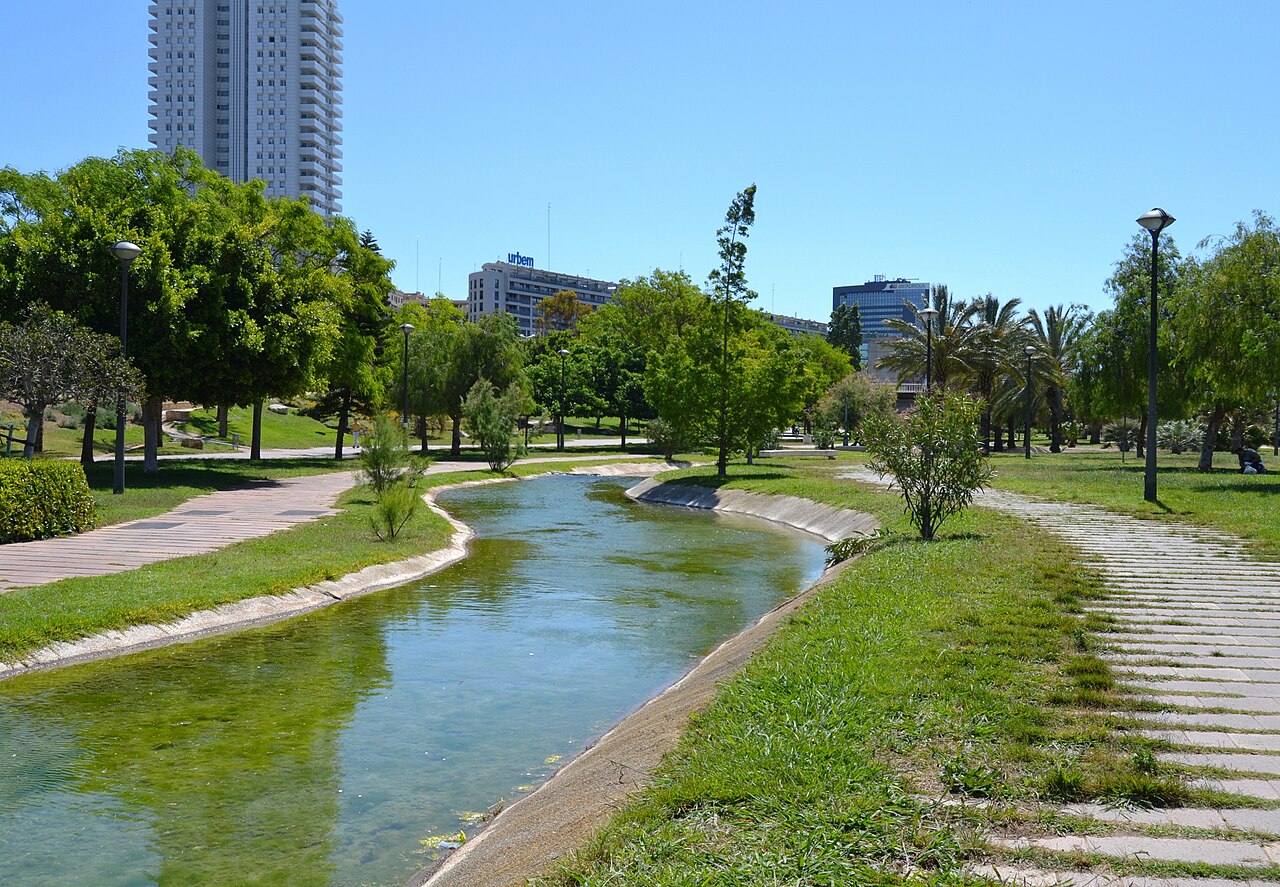
First, look down at the ground. You are standing in a riverbed. The Turia River once ran right through this space, past the old city and out to the sea. In 1957 a devastating flood hit Valencia and caused enormous damage. Afterwards the city made a bold decision and diverted the river south, away from the centre. That left a long, empty channel of dry land. For years, people argued about what to do with it. Some planners wanted a motorway.
In the end, the citizens got a garden instead. Today the old riverbed is a green park that winds for kilometres through the city. It has running tracks, playgrounds, orange trees and football pitches. At its eastern end it opens into the complex where you are now: the City of Arts and Sciences, a group of white buildings and bridges. The opera house is one of its largest pieces. Its neighbours include a science museum, a planetarium and an aquarium.
The man behind most of this complex is the architect and engineer Santiago Calatrava. He was born in the Valencia area, so this project was, in a sense, a homecoming. Calatrava is known around the world for bridges, railway stations and towers. They often look as if they come from bones, wings or ribcages. You can see that language here. The building does not sit like a box. It looks as if it might stretch, breathe or even move.
Now follow the great curved blade that sweeps over the top of the building. People often call it the plume, or the feather. It is a long steel structure that arcs over the roof without touching most of it. Here is the first thing many visitors miss: this crest is not a ceiling or a shelter in the usual way. It is mostly a gesture — a piece of sculpture on an architectural scale. It gives the building its profile against the sky.
Walk a little way around and watch how that profile changes. From one side the building looks like an eye. From another it looks like a ship about to sail, or a warrior's helmet. Calatrava designed it to be seen from many angles, and from far away along the park. The opera house is often described as one of the tallest in the world. Standing beneath it, that is easy to believe. The shell seems much bigger than the halls inside it.
The building opened in 2005, and it is named after Queen Sofía of Spain. Inside there are several performance spaces, not just one. The main hall hosts opera and large productions. Smaller rooms hold chamber concerts, recitals and teaching events. The house has its own orchestra. In its early years, it brought in well-known conductors, including Lorin Maazel and Zubin Mehta, to build its reputation. Very quickly, Valencia had a stage that attracted international singers and directors.
Now look closely at the white skin of the building. From a distance it seems smooth and painted. Up close, the surface was originally covered in trencadís. That is a mosaic technique made from small, broken pieces of ceramic tile, set close together. The Catalan architect Antoni Gaudí made it famous in Barcelona, on his benches and rooftops. Calatrava used it here on a huge scale. The idea was simple and beautiful: a building covered in a white mosaic that catches the Mediterranean sun.
And here is the second surprise. Only a few years after the opening, that mosaic began to fail. The ceramic covering wrinkled and started to come away from the structure beneath. Pieces became loose, and this was a real safety concern. Parts of the building had to close for a period while workers removed the damaged covering. The cladding was then replaced. It became a major public debate in Valencia about cost, maintenance and the risks of very ambitious architecture.
So the surface you see today carries that story. It is a reminder that buildings like this one are experiments as much as monuments. They are built to look effortless, but they need constant care. Sun, salt air and changes in temperature all put pressure on the materials. For many people in Valencia, the opera house is a point of pride and a subject of argument at the same time. Both feelings are part of the place.
Take a moment to notice the water again. The pools around the City of Arts and Sciences are shallow, but they matter a great deal. On a calm day they act like mirrors. The white curves double themselves, and the building seems to float. At night, when the lights come on, the reflections turn blue and gold. Locals walk their dogs here in the evening. Families sit on the edges, and couples stop for photographs.
If you have time, you can see the building from inside. Guided tours are sometimes available, and of course a ticket to a performance is the fullest way to experience it. Even from outside, though, you can sense how the spaces are arranged. Broad walkways and stairs wrap around the shell. They lead you up and along the building, so you can watch the park and the other structures from higher ground. Walking these paths is part of the design.
Before you leave, turn and look back toward the green line of the old riverbed. The water that once flooded this city now sits quietly in the pools at your feet. The steel crest rises above you, and the white surface holds the light. Joggers pass. A child runs toward the water. Listen once more to the small sounds around you — then let the building fade slowly behind you as you walk on into the park.
Key facts
What to look for
Practical tips
Common questions
Is there a free audio guide to Palau de les Arts Reina Sofía?
Yes — the Lokali app narrates Palau de les Arts Reina Sofía free of charge in 50+ languages. The guide runs about 7 minutes, covers the history, what to look for on site and practical tips, and works offline once downloaded.
Where is Palau de les Arts Reina Sofía?
Palau de les Arts Reina Sofía is in Valencia, Spain, at 39.4578, -0.3556. Tap the map link on this page for directions from where you are.
What is Palau de les Arts Reina Sofía known for?
Designed by Valencia-born architect and engineer Santiago Calatrava. The opera house opened to the public in 2005.
What should you look for at Palau de les Arts Reina Sofía?
The steel crest arching over the roof like a feather. Reflections of the white shell in the shallow pools. Broad external walkways wrapping around the curved shell.
What should you know before visiting Palau de les Arts Reina Sofía?
Walk the full circuit to see the profile change. Return after dark to see lit reflections in the pools.
On the map
Opens directions to Palau de les Arts Reina Sofía from your location.
More to see in Valencia


Hear Palau de les Arts Reina Sofía in your language
The full story, narrated, in 50+ languages. Download it before you go and it plays offline, at your own pace, with no ticket and no tour group.