
Museu de les Ciències Príncipe Felipe
39.4558° N · 0.3515° W · Museum
Photo: Aiolia del Leone · GPL · Wikimedia Commons
Museu de les Ciències Príncipe Felipe is a visitor attraction in Valencia, Spain. Designed by Valencian architect Santiago Calatrava. The free Lokali audio guide runs 6 minutes.
✓ Published October 2026 · how we write these guides
Visitor facts
| Lokali audio guide | 6 min · free |
|---|---|
| Type | Museum |
| Location | Valencia, Spain |
| Coordinates | 39.4558, -0.3515 |
| Official website | cac.es |
| Languages | 50+, in the Lokali app |
The story
Stand still for a moment and listen. Water laps quietly against the edge of a long, shallow pool. Above it rises a wall of white ribs, one after another, sharp against the Valencian sky. The light here bounces off everything at once: the pale concrete, the glass, the water. On a sunny day it can almost make you squint. This is the Museu de les Ciències Príncipe Felipe, the science museum at the heart of Valencia's City of Arts and Sciences.
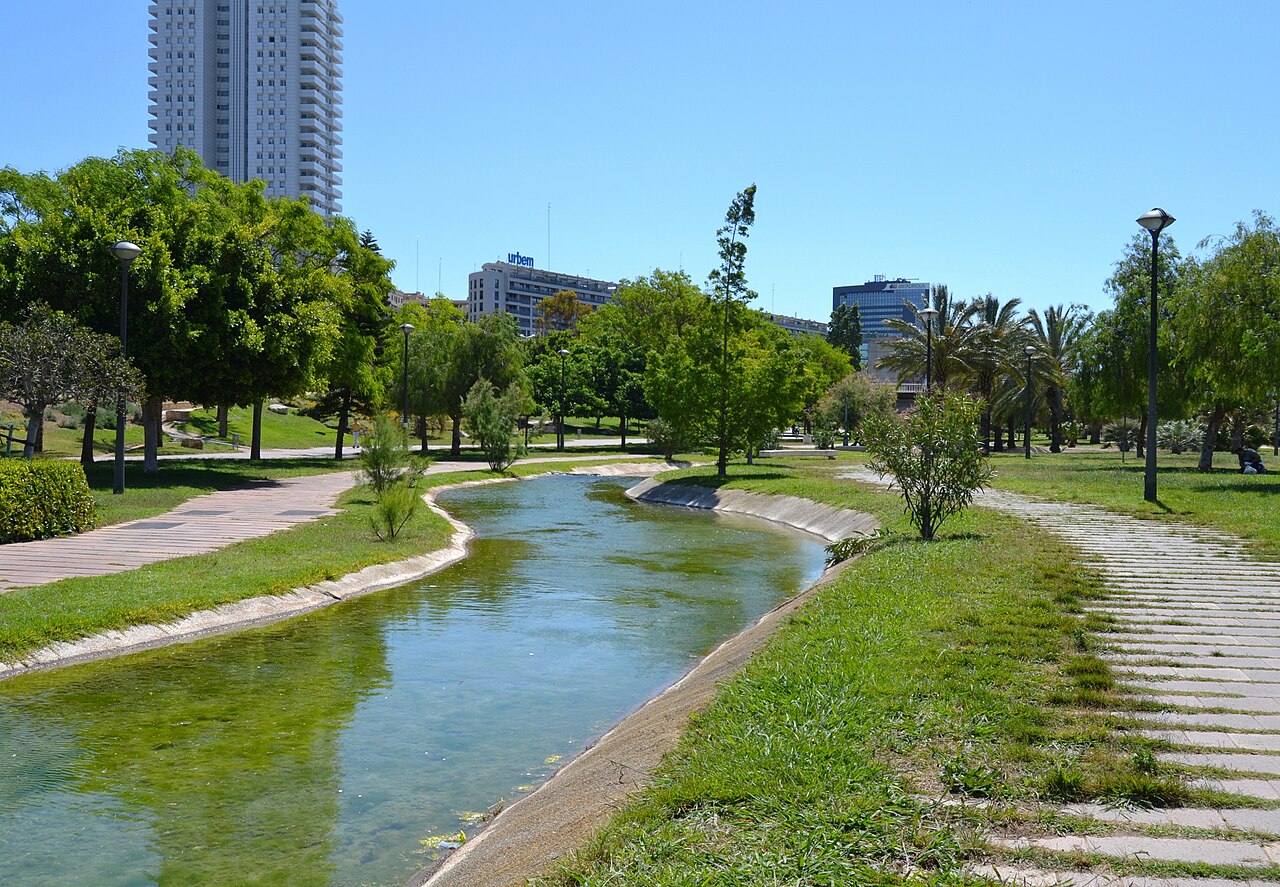
Before we look closer, think about the ground under your feet. You are standing in an old riverbed. The Turia River once ran right through this part of the city. After a devastating flood in 1957, Valencia diverted the river to the south. The old channel was left empty. For years people argued over what to do with it. In the end, the city turned it into a long ribbon of parks, and this end became something entirely new.
That new thing is the City of Arts and Sciences. Much of it comes from the Valencian architect Santiago Calatrava, who was born in this region. The science museum opened its doors in 2000. Calatrava trained as both an architect and an engineer, and you can see both sides of him here. The building is not only a shape. It is a structure that shows you exactly how it stands up, rib by rib.
Look along the length of the museum. Many visitors say it looks like the skeleton of a giant whale. Others see the bones of a dinosaur, or the hull of an upturned ship. Calatrava often took ideas from the natural world, from spines, wings and eyes. Here, the repeated white supports work like vertebrae. They march in a steady rhythm, more than two hundred metres from one end to the other.
Now here is a detail many people miss. The building is not the same on both sides. One long face is mostly glass, set between those slender ribs. The other face is more solid, with heavy concrete forms that look almost like tree trunks. Walk around if you have the time. The museum feels open and airy from one angle, and strong and closed from another.
The name has a story too. Príncipe Felipe means Prince Felipe. When the museum opened, he was the heir to the Spanish throne. Today he is King Felipe the Sixth. The name stayed the same, so the building carries a small record of the moment it was born. The word Museu, by the way, is Valencian, the local form of Catalan that you will see on signs across the city alongside Spanish.
Inside, this is not a museum of glass cases and quiet rooms. Its famous motto is Prohibido no tocar, which means forbidden not to touch. The idea is simple. You learn science by doing it. Children press buttons, pull levers and test ideas with their own hands. Adults often end up doing exactly the same, sometimes with even more enthusiasm.
The exhibitions change over time, so it is hard to say exactly what you will find on any given day. Expect a mix of physics, biology, space and the human body, spread across large open floors. The interior is enormous. Light pours through the glass wall and falls in long stripes across the halls. Even if you do not stop at a single exhibit, simply walking the length of the building is an experience.
Step back outside and look at the neighbours. Nearby you will see L'Hemisfèric, a building shaped like a huge eye, with a lid that can open and close. There is also L'Umbracle, a long garden walkway under white arches. Further along stands the Oceanogràfic, the aquarium, and the opera house, the Palau de les Arts Reina Sofía. Together they make one of the strongest pieces of modern architecture in Spain.
The water is not just decoration. The shallow pools around these buildings double their shapes in reflection. On a calm morning the museum seems to stand on its own mirror image. The water also keeps the space cooler in the Valencian summer, when the white surfaces grow hot in the sun. People sit along the edges, dip their hands in, and watch the reflections shiver when the wind passes.
The whole complex was not cheap, and it has never been without critics. Some locals felt the money could have gone elsewhere. Others questioned the cost of maintaining so much white surface in strong sun and salty air. Yet many Valencians now treat the area as part of daily life. They jog past it, cycle through it and bring visiting relatives to see it. Few modern projects become this woven into a city.
If you have time, follow the old riverbed back toward the historic centre. The Turia Gardens run for several kilometres through the city, full of orange trees, palms, football pitches and quiet benches. It is one of the most pleasant walks in Valencia. Seen from that path, the museum appears slowly through the trees, and you understand how it closes the long green line of the park.
Before you go, take one more look at the building in front of you. Notice how the light has shifted since you arrived. The shadows between the ribs are longer or shorter now. Listen again to the water, to the voices of families heading inside, to the bicycles rolling past. Once, a river ran exactly where you stand. Today a white skeleton of concrete and glass rises in its place, and as you walk away, it will keep changing with the light behind you.
Key facts
What to look for
Practical tips
Common questions
Is there a free audio guide to Museu de les Ciències Príncipe Felipe?
Yes — the Lokali app narrates Museu de les Ciències Príncipe Felipe free of charge in 50+ languages. The guide runs about 6 minutes, covers the history, what to look for on site and practical tips, and works offline once downloaded.
Where is Museu de les Ciències Príncipe Felipe?
Museu de les Ciències Príncipe Felipe is in Valencia, Spain, at 39.4558, -0.3515. Tap the map link on this page for directions from where you are.
What is Museu de les Ciències Príncipe Felipe known for?
Designed by Valencian architect Santiago Calatrava. The museum opened to the public in 2000.
What should you look for at Museu de les Ciències Príncipe Felipe?
Repeating white ribs that resemble a whale skeleton. Tree-like concrete supports on the more solid facade. The building mirrored in the shallow surrounding pools.
What should you know before visiting Museu de les Ciències Príncipe Felipe?
Walk around both long sides to compare the facades. Come early morning for calm reflections in the pools.
When is the best time to visit Museu de les Ciències Príncipe Felipe?
Come early morning for calm reflections in the pools.
On the map
Opens directions to Museu de les Ciències Príncipe Felipe from your location.
More to see in Valencia


Hear Museu de les Ciències Príncipe Felipe in your language
The full story, narrated, in 50+ languages. Download it before you go and it plays offline, at your own pace, with no ticket and no tour group.