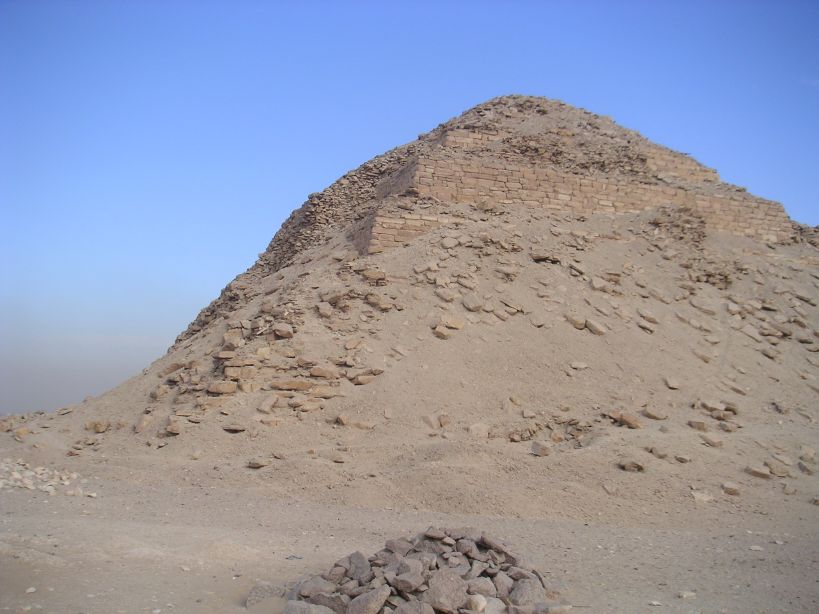
Pyramid of Neferirkare
29.8950° N · 31.2024° E · Archaeological Site
Photo: No machine-readable author provided. Neithsabes assumed (based on copyright claims). · Public domain · Wikimedia Commons
Pyramid of Neferirkare is the second pyramid to be built at the necropolis site of Abusir. Largest of the royal pyramids at Abusir. The free Lokali audio guide runs 6 minutes.
✓ Published October 2026 · how we write these guides
Visitor facts
| Lokali audio guide | 6 min · free |
|---|---|
| Type | Archaeological Site |
| Location | Abusir, Egypt |
| Coordinates | 29.8950, 31.2024 |
| Languages | 50+, in the Lokali app |
The story
Listen first. Out here at Abusir, the city falls away. There is wind moving over the sand, perhaps a dog barking in a distant village, and the soft crunch of grit under your shoes. In front of you rises a broad, stepped mass of grey-brown limestone. It looks unfinished, a little ragged at the edges. That roughness is part of its story.
This is the Pyramid of Neferirkare, the largest of the royal pyramids at Abusir. It belongs to the Fifth Dynasty of the Old Kingdom, the age that followed the great builders of Giza. Neferirkare was the third king of that dynasty. His birth name was Kakai. His throne name means, roughly, beautiful is the ka of Ra. The ka was the Egyptian idea of a person's life force, the part that lived on after death.
That name tells you something about the times. The Fifth Dynasty kings placed the sun god Ra at the centre of royal religion. Several of them built special sun temples in this area, open-air shrines with a great stone obelisk-like pillar. Neferirkare was one of these builders, although the remains of his sun temple have not been securely found. Kings now presented themselves as sons of Ra, and the sun was everywhere in their monuments.
There is a famous story about this. An ancient Egyptian text, known today as the Westcar Papyrus, tells a tale of three baby boys born to a woman named Rededjet. According to the story, they were sons of Ra himself, destined to rule Egypt. Their names match the first kings of this dynasty, and Kakai is one of them. It is folklore, written long after these men lived. But it shows how Egyptians later remembered this family — as kings chosen by the sun.
Now look closely at the shape in front of you. Can you see the steps? Archaeologists believe the monument was first planned as a step pyramid, a stack of shrinking layers, like the much older one at Saqqara to the south. Later, the plan changed. The builders began to fill the steps and add a smooth outer casing to make a true pyramid. That casing was never finished. So what you see today is the layered core, stripped and weathered.
Here is the first surprise. This structure was the tallest building at Abusir, and in its time it would have been one of the larger pyramids of the Old Kingdom. Yet it was built with smaller stones and rougher masonry than the pyramids of Giza. The core blocks were often local limestone, held with mortar and rubble. Over thousands of years, that construction has slumped and eroded. The pyramid you see is a skeleton of the ambitious monument the king intended.
On the east side, facing the river and the rising sun, stood the king's mortuary temple. This is where priests made offerings for the dead king, day after day, for generations. Neferirkare seems to have died before his complex was complete. His successors finished the temple quickly, and much of it was built in mud brick rather than fine stone. A grand royal project became a practical, hurried one.
And here is the second surprise — perhaps the most important thing about this place. In the late nineteenth century, papyrus fragments began to appear on the antiquities market. They came from the ruins of this mortuary temple. Today they are known as the Abusir Papyri. They are temple accounts: duty rosters for priests, lists of offerings, inventories of temple equipment, records of damaged objects. They are among the oldest substantial groups of written administrative records ever found in Egypt.
Why does that matter? Most of what survives from ancient Egypt is about death and the gods — tombs, statues, prayers. These papyri are different. They show daily life inside an institution. Who was on shift this month. Which bowl was chipped. How many loaves arrived. Reading them, you meet the clerks and priests who kept this place running long after the king was buried. The most ordinary paperwork became an extraordinary window into the past.
The complex was never only about one king. Just south of this pyramid stands a smaller pyramid belonging to Queen Khentkaus the Second, the wife of Neferirkare. Nearby are the pyramids of other Fifth Dynasty kings — Sahure to the north, Nyuserre close by, and the unfinished tomb of Neferefre. Nyuserre even took over the causeway that was intended for Neferirkare and redirected it to his own pyramid. Royal building here was shared, borrowed and reused.
The modern understanding of Abusir comes from long excavation work. German archaeologists, led by Ludwig Borchardt, explored the royal pyramids here in the early twentieth century. Later, the Czech Institute of Egyptology made Abusir the centre of decades of research. Their work uncovered more papyri, the queen's pyramid, and many tombs of officials. Much of what visitors know about the Fifth Dynasty began in the sand around you.
Take a moment to turn slowly in place. To the south, on a clear day, you may see the pyramids of Saqqara standing on the desert edge. To the north, very faintly, Giza may appear through the haze. To the east, the green line of fields marks the Nile valley. Abusir sits between these famous neighbours, quieter and less crowded. Here you can often stand with the pyramids almost entirely to yourself.
As you walk away, look back once more at those uneven steps. Notice how the late light catches each layer, and how the sand gathers in the gaps. A king planned this as a perfect geometric form. It became something else — a broken outline, a temple of mud brick, and a room full of papyrus records. Listen again to the wind. It is the same desert sound the temple priests heard here every day.
Key facts
What to look for
Practical tips
Common questions
Is there a free audio guide to Pyramid of Neferirkare?
Yes — the Lokali app narrates Pyramid of Neferirkare free of charge in 50+ languages. The guide runs about 6 minutes, covers the history, what to look for on site and practical tips, and works offline once downloaded.
Where is Pyramid of Neferirkare?
Pyramid of Neferirkare is in Abusir, Egypt, at 29.8950, 31.2024. Tap the map link on this page for directions from where you are.
What is Pyramid of Neferirkare known for?
Largest of the royal pyramids at Abusir. Built for Neferirkare Kakai, third king of Fifth Dynasty.
What should you look for at Pyramid of Neferirkare?
Visible stepped layers where the outer casing was never finished. Mud brick remains of the hurried mortuary temple. Smaller pyramid of Queen Khentkaus just to the south.
What should you know before visiting Pyramid of Neferirkare?
Wear a sun hat and bring plenty of water. Combine your visit with nearby Saqqara on one day.
When is the best time to visit Pyramid of Neferirkare?
Come early or late for softer light and cooler air.
On the map
Opens directions to Pyramid of Neferirkare from your location.
More to see in Abusir


Hear Pyramid of Neferirkare in your language
The full story, narrated, in 50+ languages. Download it before you go and it plays offline, at your own pace, with no ticket and no tour group.