
Pyramid of Nyuserre
29.8957° N · 31.2036° E · Archaeological Site
Photo: No machine-readable author provided. Neithsabes assumed (based on copyright claims). · Public domain · Wikimedia Commons
Pyramid of Nyuserre is a building in Egypt. Nyuserre ruled during Egypt's Fifth Dynasty, Old Kingdom. The free Lokali audio guide runs 7 minutes.
✓ Published October 2026 · how we write these guides
Visitor facts
| Lokali audio guide | 7 min · free |
|---|---|
| Type | Archaeological Site |
| Location | Abusir, Egypt |
| Coordinates | 29.8957, 31.2036 |
| Languages | 50+, in the Lokali app |
The story
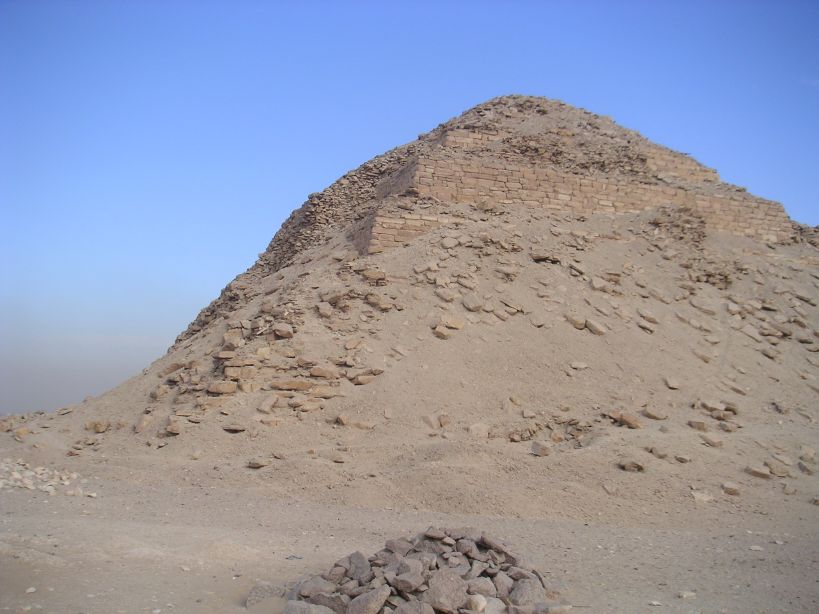
Listen first to the wind. Out here on the edge of the Western Desert it moves across the sand in long, dry breaths, and it carries a fine grit that settles on your sleeves. Underfoot the ground is loose and pale, scattered with chips of limestone. Ahead of you rises a mound of rough stone, broken and slumped, the colour of old bread crust. It does not look like the smooth pyramids of postcards. But this ruin was once the burial place of a king of Egypt.
This is the Pyramid of Nyuserre, at Abusir. You are standing in a royal cemetery of the Old Kingdom, the age of the great pyramid builders. Giza lies a short distance to the north. Saqqara lies to the south. Abusir sits between them, and it receives far fewer visitors than either. That quiet is part of what makes it worth the trip. Here you can stand with the monuments almost alone, and think about them without a crowd.
Nyuserre ruled during the Fifth Dynasty, around the middle of the third millennium before Christ. His full name is often given as Nyuserre Ini. The kings of this dynasty built smaller pyramids than their famous predecessors at Giza. They put more of their energy into temples, and into the worship of the sun god Ra. Several of them chose Abusir as their burial ground, and Nyuserre followed that choice.
Look closely at the stone in front of you. What you see is mostly the inner core, built from local limestone blocks of uneven size. Once, an outer casing of fine white limestone covered this core. That casing came from quarries across the Nile, and it gave the pyramid smooth, bright faces. In later centuries people stripped the casing away and reused the good stone. Without its skin, the core weathered and collapsed into the stepped, crumbling shape you see today.
Here is the first surprise. Nyuserre did not have a clean, open site for his monument. Abusir was already crowded. The pyramid of his predecessor Sahure stood to the north, and the large complex of Neferirkare stood to the south. Nyuserre squeezed his pyramid in among them. Because of this, his mortuary temple, where priests made offerings for the dead king, has an unusual bent plan. The builders adapted the standard layout to fit the space that was left.
The second surprise concerns the causeway. A royal pyramid normally had a valley temple near the edge of the cultivated land, joined to the mortuary temple by a long covered causeway. Neferirkare had begun such a causeway, but his works were left unfinished. Egyptologists believe Nyuserre took over that unfinished causeway and turned it toward his own pyramid. In a sense, he borrowed the road that was meant for another king.
This was not simply theft. Nyuserre also completed several monuments around him. Work on the complexes of Neferirkare, of the queen Khentkaus the Second, and of the short-reigning king Neferefre appears to have been finished during his reign. So Abusir shows a king who looked after the memory of his family, even as he reshaped their monuments for his own purposes. Ancient Egyptian royal tradition often mixed piety and practicality in exactly this way.
Now turn your attention to the wider landscape. Look north and you may make out the low silhouette of Sahure's pyramid. Look south and you can see the larger mass of Neferirkare's monument. Together these ruins form a small, tight group on the desert plateau. On a clear day, the tips of other pyramids appear on the horizon. The line of royal tombs runs for many kilometres along this desert edge, above the green strip of the Nile valley.
Nyuserre also built a sun temple a little to the north, at a site now called Abu Gurab. Sun temples were a special feature of the Fifth Dynasty. They were open-air sanctuaries for the cult of Ra, built around a great masonry obelisk on a raised base. Nyuserre's sun temple is one of the best preserved examples. It helps explain why his pyramid is modest. The king spread his building effort across several projects, not one giant tomb.
Modern knowledge of this site owes much to archaeology. In the early twentieth century, the German archaeologist Ludwig Borchardt excavated the pyramids of Abusir and published detailed plans of the temples. Later, Czech Egyptologists from Charles University in Prague began long-term work at Abusir. Their excavations have continued for decades. They have mapped tombs, temples, and workshops, and they have greatly changed how scholars understand this royal cemetery.
One of the most important finds from Abusir is a group of papyrus documents known as the Abusir papyri. They come from the temples of nearby kings, not from this pyramid itself. They record the daily running of royal mortuary cults: rotas of priests, lists of offerings, inventories of temple equipment. They are some of the oldest administrative papyri ever found in Egypt. Through them we can glimpse the ordinary paperwork that kept a dead king's cult alive.
Not far from here lies the mastaba of Ptahshepses, a high official of Nyuserre's court. A mastaba is a flat-topped, rectangular tomb for nobles, named after the Arabic word for a bench. Ptahshepses married a royal princess, and his tomb is one of the largest private tombs at Abusir. Its size shows how close he stood to the king. Even in death, the officials of this court stayed near their ruler.
As you walk around the pyramid, keep to the paths and watch your footing on the loose stone. The light here changes the mood of the place. In the early morning, low sun picks out every block and shadow in the core. At midday the glare flattens everything and the heat rises quickly. Late in the day the stone turns warm and golden. Bring water and a hat, whatever the season.
Before you leave, stand still for a moment and look again at the broken slope in front of you. Notice the rough edges of the core blocks, the sand gathered in the gaps, the scatter of white chips on the ground. Somewhere beneath this mound, a burial chamber once held a king. Listen to the wind moving across the plateau, and feel the ground under your feet. Kings, priests, and builders all walked on this same desert floor.
Key facts
What to look for
Practical tips
Common questions
Is there a free audio guide to Pyramid of Nyuserre?
Yes — the Lokali app narrates Pyramid of Nyuserre free of charge in 50+ languages. The guide runs about 7 minutes, covers the history, what to look for on site and practical tips, and works offline once downloaded.
Where is Pyramid of Nyuserre?
Pyramid of Nyuserre is near Abusir, Egypt, at 29.8957, 31.2036. Tap the map link on this page for directions from where you are.
What is Pyramid of Nyuserre known for?
Nyuserre ruled during Egypt's Fifth Dynasty, Old Kingdom. Builders squeezed the pyramid between Sahure's and Neferirkare's complexes.
What should you look for at Pyramid of Nyuserre?
Rough limestone core blocks left exposed after casing removal. Sahure's pyramid ruin on the horizon to the north. Neferirkare's larger pyramid mass rising to the south.
What should you know before visiting Pyramid of Nyuserre?
Visit early morning for softer light and cooler air. Carry plenty of water; the plateau has little shade.
When is the best time to visit Pyramid of Nyuserre?
Visit early morning for softer light and cooler air.
On the map
Opens directions to Pyramid of Nyuserre from your location.
More to see in Abusir


Hear Pyramid of Nyuserre in your language
The full story, narrated, in 50+ languages. Download it before you go and it plays offline, at your own pace, with no ticket and no tour group.