
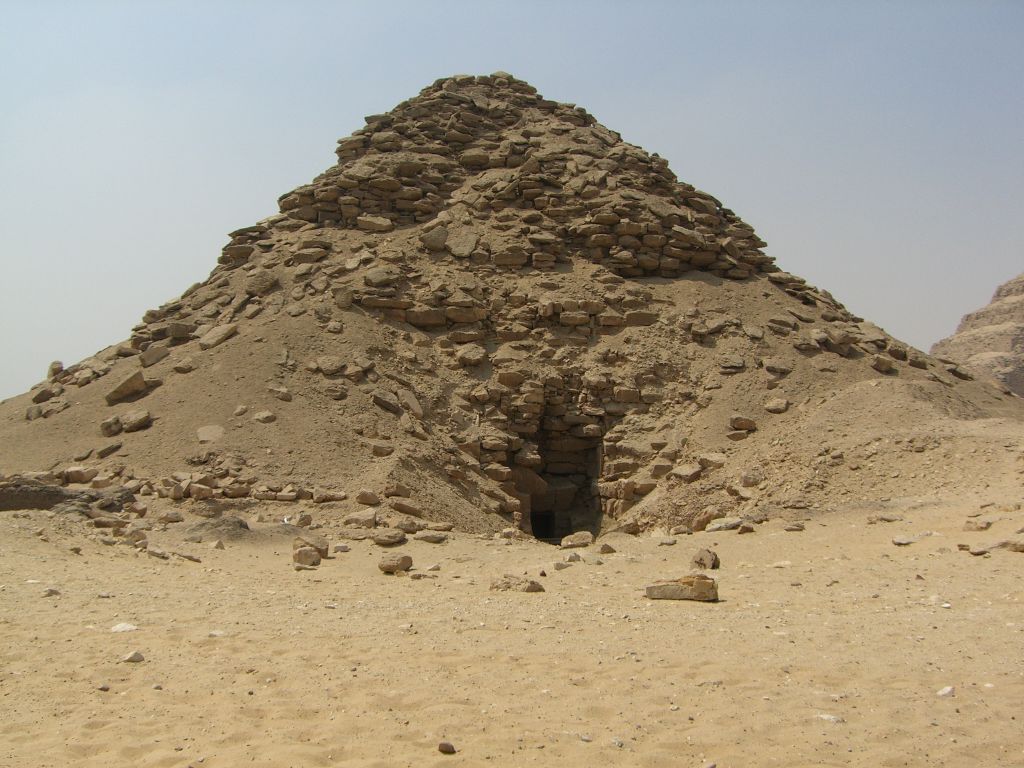
Photo: Jon Bodsworth · Copyrighted free use · Wikimedia Commons
Abu Gorab is a locality in Egypt. It is in Giza, Egypt. Sun temple built for King Nyuserre of the Fifth Dynasty. The free Lokali audio guide runs 7 minutes.
✓ Published October 2026 · how we write these guides
Visitor facts
| Lokali audio guide | 7 min · free |
|---|---|
| Type | Archaeological Site |
| Location | Giza, Egypt |
| Coordinates | 29.9039, 31.1942 |
| Languages | 50+, in the Lokali app |
The story
Listen for a moment. Out here, on the edge of the desert, the loudest sound is often the wind moving across the sand. The ground under your feet is a mix of grit, pale stone chips and old mud brick worn back into dust. To the east, the green fields of the Nile Valley sit flat and bright. To the west, there is only the desert. You are standing on a low rise at Abu Gorab, and more than four thousand years ago, this spot was built for the sun.
The name Abu Gorab is Arabic, and it is usually translated as father of crows. It is a modern name, given long after the original purpose of the place was forgotten. What stood here was a sun temple, built for a king of the Fifth Dynasty named Nyuserre. That was the era of the Old Kingdom, the age of the great pyramids. A short distance to the south, you can see the pyramids of Abusir, where Nyuserre and several of his relatives were buried.
Here is the first surprise. Kings of this dynasty built sun temples as well as pyramids. Ancient texts name around six of them. Yet archaeologists have only found two. This is one of them, and it is the best preserved. The other belongs to an earlier king, Userkaf, and lies not far away. So the ruins around you are a rare survivor of a whole category of building that has otherwise almost vanished.
Why build a temple to the sun beside a cemetery of kings? During the Fifth Dynasty, the sun god Ra rose to great importance in royal religion. Kings began to include his name in their own. A sun temple seems to have tied the living king, and his life after death, to the daily journey of the sun across the sky. The pyramid held the king's body. The sun temple linked him to the source of light and renewal.
The temple did not stand alone. Like a pyramid complex, it began down near the edge of the cultivated land, with a valley temple. From there, a covered causeway climbed up the slope to the main temple on the rise. Priests and offerings moved along this route. Today the causeway is hard to trace, but try to picture a long, enclosed corridor running from the green fields up into the dry, bright desert.
At the heart of the complex stood its most important feature, an obelisk. It was not a single tall needle of stone, like the obelisks you may know from later Egyptian temples or from city squares in Europe. Instead, it was built up from blocks of stone and raised on a massive base. Many scholars connect its shape with the benben, a sacred stone linked with the sun and with creation in the city of Heliopolis.
The obelisk itself has gone. What you see now is the low, broken mass of its base, a heap of stone that still marks the centre of the site. It is worth walking around it slowly. From some angles it looks like a natural mound. From others, you can make out worked blocks and straight edges. This was once the tallest point here, rising against the sky and catching the first light of morning.
Now look for the altar. This is the moment most visitors remember. In the open courtyard in front of the obelisk lies a large altar of pale, smooth stone, often described as alabaster or travertine. It is made from several blocks. In the centre sits a round block. Around it, facing outward in four directions, are four blocks carved in the shape of the hieroglyph hotep, which means offering, and also peace or satisfaction.
Take a second look at that design. Seen from above, the four hotep signs point roughly to the four points of the compass. Some writers suggest it means offerings to the sun in every direction, across the whole world. However you read it, the altar has survived here, in the open, for more than four thousand years. Its stone still feels cool and polished in a way the rough rubble around it does not.
Near the altar, archaeologists found an area that seems to have been used for slaughtering animals for offerings. Look for large stone basins and for channels cut into the paving. Many people believe they carried away blood and water. It is a reminder that this was a working temple, not only a symbol. Cattle, bread, beer and other goods were brought here, offered to the sun, and then probably shared out among priests and temple staff.
The site was excavated around the turn of the twentieth century by a German team led by Ludwig Borchardt. They found something remarkable: fine painted reliefs from a room now known as the Room of the Seasons. These scenes showed the natural year in Egypt — birds, fish, animals, farming and the flood of the Nile — all made possible, in the temple's thinking, by the sun. Those reliefs are no longer here. Surviving pieces were taken to museums, including in Berlin and Cairo.
Here is the second surprise. South of the temple, the excavators found a large model of a boat built from mud brick. Boats mattered greatly in Egyptian ideas about the sun, which was believed to cross the sky and the underworld by boat. A full-size brick ship, built on dry desert ground, makes that belief physical. It is a strange image to hold in your mind: a ship that was never meant to touch water, aimed at the sky instead.
Abu Gorab sees far fewer visitors than Giza or Saqqara, and access arrangements can change, so it is wise to check locally before you come. If you are here, enjoy the quiet. Bring water and sun protection, because there is little shade. The light is softest early in the morning and late in the afternoon, when the pale stone of the altar turns warm and the shadows across the ruins grow long.
Before you leave, stand by the altar once more and turn slowly in a full circle. To the south, the pyramids of Abusir. To the east, the fields and the river. To the west, open desert. Above you, the same sun this temple was built to honour, still crossing the same sky. As you walk back over the sand and the broken stone, notice how bright the ground is. Here, the sun is still the strongest presence in the landscape.
Key facts
What to look for
Practical tips
Common questions
Is there a free audio guide to Abu Gorab?
Yes — the Lokali app narrates Abu Gorab free of charge in 50+ languages. The guide runs about 7 minutes, covers the history, what to look for on site and practical tips, and works offline once downloaded.
Where is Abu Gorab?
Abu Gorab is in Giza, Egypt, at 29.9039, 31.1942. Tap the map link on this page for directions from where you are.
What is Abu Gorab known for?
Sun temple built for King Nyuserre of the Fifth Dynasty. One of only two Fifth Dynasty sun temples ever found.
What should you look for at Abu Gorab?
Four hotep signs carved around the central round altar block. Stone basins and channels in the old slaughter area. Worked blocks inside the broken mound of the obelisk base.
What should you know before visiting Abu Gorab?
Check access arrangements locally before making the trip. Carry plenty of water because shade is very limited.
When is the best time to visit Abu Gorab?
Visit early morning or late afternoon for softer light.
On the map
Opens directions to Abu Gorab from your location.
More to see in Giza


Hear Abu Gorab in your language
The full story, narrated, in 50+ languages. Download it before you go and it plays offline, at your own pace, with no ticket and no tour group.