
Pyramid of Sahure
29.8978° N · 31.2033° E · Archaeological Site
Photo: No machine-readable author provided. Neithsabes assumed (based on copyright claims). · Public domain · Wikimedia Commons
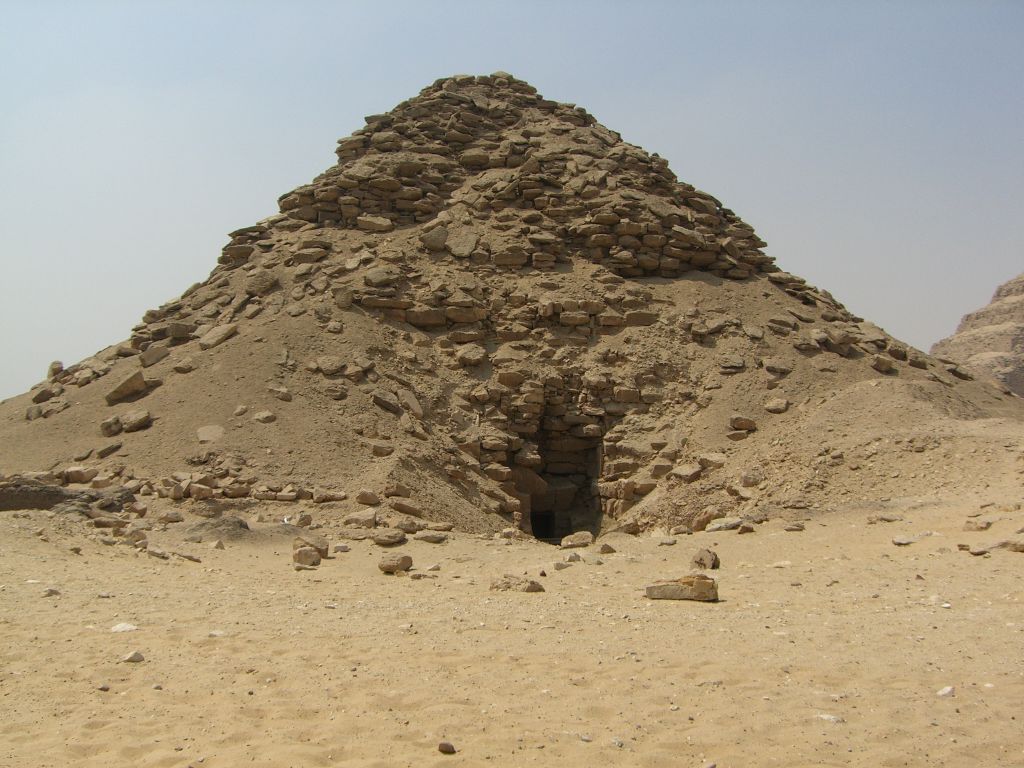
Pyramid of Sahure is a smooth-sided pyramid. It is near Abusir, Egypt. Sahure was the second king of the Fifth Dynasty. The free Lokali audio guide runs 7 minutes.
✓ Published October 2026 · how we write these guides
Visitor facts
| Lokali audio guide | 7 min · free |
|---|---|
| Type | Archaeological Site |
| Location | Abusir, Egypt |
| Coordinates | 29.8978, 31.2033 |
| Languages | 50+, in the Lokali app |
The story
Listen first. Out here at Abusir the wind moves across the desert edge, and fine sand ticks softly against the stone. Under your feet the ground is loose and pale. In front of you rises a slumped mound of rough limestone blocks. It looks less like a pyramid than a hill that someone once tried to shape. This is the Pyramid of Sahure, and its plain outline hides one of the most inventive building projects of ancient Egypt.
Sahure was the second king of the Fifth Dynasty. He ruled during the Old Kingdom, around the twenty-fifth century before the Common Era. That puts him a few generations after the kings who built the great pyramids at Giza. You can often see those Giza pyramids on the northern horizon on a clear day. Sahure chose a different place for his tomb. He came here, to a quieter stretch of desert between Giza and Saqqara.
Why does his pyramid look so worn? The answer is in the materials. The core was built from local limestone, which is rough and uneven. The builders then covered that core with a smooth outer casing of fine white limestone. In later centuries people carried most of that casing away as building stone. Without its smooth skin, the rough core has slowly slumped. What you see now is the inside of the pyramid, exposed to the weather.
Here is the first surprise. In ancient Egypt, a pyramid was never a single building. It was the centre of a complex. Sahure's complex followed a plan that became a model for the kings after him. A valley temple stood near the edge of the cultivated land, close to the water. From there a covered causeway climbed up the slope. At the top it reached the mortuary temple, built against the eastern face of the pyramid. Priests used this temple for the king's daily offerings.
Walk toward the remains of that mortuary temple, and look down. Parts of the floor are laid with dark basalt, a hard black volcanic stone. Against the pale limestone around it, the contrast is sharp. The builders brought this heavy stone from a distance on purpose. Dark basalt, red granite and white limestone were combined to create colour without paint. Even in ruin, you can still read that plan in the stones.
The temple courtyard was once lined with granite columns. Their tops were carved to look like the fronds of date palms, bound together. Scholars often describe these as among the earliest known palm columns in Egypt. Think about the effect. A visitor walked from the bright desert into a shaded court of stone palm trees. It was a garden made of granite, built to last forever.
The second surprise is practical rather than poetic. The temple had a drainage system. Rainwater from the roof flowed out through stone spouts carved as the heads of lions. Archaeologists also found channels inside the temple that were lined with copper. This was sophisticated plumbing for a building more than four thousand years old. Rain is rare here, but when it came, the builders wanted it carried safely away from the sacred rooms.
The walls of the complex were once covered with fine carved reliefs. Only fragments survive, but they are remarkable. Some show the king hunting animals in the desert. Others show ships with sailors and foreign visitors on board. These scenes are some of the earliest detailed pictures of Egyptian seagoing ships. Many of the best fragments were taken to museums, including collections in Berlin and Cairo. Standing here, you are looking at the empty frame where those pictures once hung.
Much of what we know about this site comes from excavations in the early twentieth century. A German archaeologist named Ludwig Borchardt led that work. He studied the pyramids of Abusir carefully and published detailed plans. His drawings helped later scholars understand how a Fifth Dynasty royal complex worked. More recent work has added to the picture. Excavations along the causeway found new relief blocks. Some of them seem to show an expedition to Punt, a distant land the Egyptians valued for incense and other rare goods.
Look around you now at the wider landscape. Sahure was not alone at Abusir. Other kings of the same dynasty built their pyramids nearby, and you can see their worn shapes close by. The Fifth Dynasty also built sun temples in this area, dedicated to the sun god Ra. This group of tombs and temples shows a period when royal religion focused strongly on the sun. Abusir was a royal cemetery with its own character, separate from Giza and Saqqara.
It helps to imagine the life of this place after the king's burial. Priests and workers served the cult of the dead king for many years. They brought offerings, kept records and looked after the temple rooms. Papyrus documents from a neighbouring pyramid temple at Abusir describe exactly this kind of daily work. So this desert was once full of people, schedules and routine. The silence you hear today is fairly new.
As you move around the site, pay attention to scale. These pyramids are smaller than the giants at Giza. The kings of this dynasty seem to have put more effort into their temples, with fine stone and carved walls, than into sheer size. That is a useful way to see Sahure's tomb. Its value was never only its height. It was in the detail, in the materials and in the planning.
Before you leave, stand still for a moment and face the pyramid again. Notice the light on the rough blocks. Notice the dark basalt at your feet, and the sand that keeps drifting into every gap. Somewhere under this mound is the burial chamber of a king whose builders invented stone palms and copper drains. As you walk back across the desert, look north once more. The famous pyramids stand on the horizon, but this quieter one has its own story, and now you know part of it.
Key facts
What to look for
Practical tips
Common questions
Is there a free audio guide to Pyramid of Sahure?
Yes — the Lokali app narrates Pyramid of Sahure free of charge in 50+ languages. The guide runs about 7 minutes, covers the history, what to look for on site and practical tips, and works offline once downloaded.
Where is Pyramid of Sahure?
Pyramid of Sahure is near Abusir, Egypt, at 29.8978, 31.2033. Tap the map link on this page for directions from where you are.
What is Pyramid of Sahure known for?
Sahure was the second king of the Fifth Dynasty. Built during the Old Kingdom, around the twenty-fifth century BCE.
What should you look for at Pyramid of Sahure?
Dark basalt paving inside the mortuary temple area. Red granite column fragments carved like bound palm fronds. The exposed rough limestone core of the pyramid.
What should you know before visiting Pyramid of Sahure?
Bring a hat and water; there is little shade here. Wear closed shoes for loose sand and uneven stone.
When is the best time to visit Pyramid of Sahure?
Visit early or late for softer light on the stones.
On the map
Opens directions to Pyramid of Sahure from your location.
More to see in Abusir


Hear Pyramid of Sahure in your language
The full story, narrated, in 50+ languages. Download it before you go and it plays offline, at your own pace, with no ticket and no tour group.