Ptolemais Hermiou
26.4769° N · 31.8036° E · Archaeological Site
Ptolemais Hermiou is an ancient city in Egypt. Founded by Ptolemy the First after Alexander's death. The free Lokali audio guide runs 7 minutes.
✓ Published October 2026 · how we write these guides
Visitor facts
| Lokali audio guide | 7 min · free |
|---|---|
| Type | Archaeological Site |
| Location | Akhmim, Egypt |
| Coordinates | 26.4769, 31.8036 |
| Languages | 50+, in the Lokali app |
The story
Stand still for a moment and listen. A tractor turns over somewhere in the fields. A donkey cart rattles past. The Nile moves slowly behind a screen of palms, and the air smells of wet earth and sugarcane. Nothing here looks like a great ancient city. And yet, under the houses and lanes around you, one of the most unusual cities of ancient Egypt once stood. Its name was Ptolemais Hermiou.
The city belongs to the age after Alexander the Great. When Alexander died, his general Ptolemy took control of Egypt and founded a dynasty. Ptolemy the First ruled from Alexandria, on the Mediterranean coast. But he also wanted a strong presence far to the south, in Upper Egypt, where old temple towns and powerful priests still held the real influence. So he founded a new city here, on the west bank of the river, and gave it his own name.
This was not simply a new town. It was planned as a Greek city, a polis, the kind of self-governing community that Greeks knew from their homeland. Only a handful of such cities ever existed in Egypt. Alexandria was one. Naukratis, an older trading settlement in the Nile Delta, was another. Ptolemais Hermiou joined that very short list. For a long time, it was the main Greek city of the entire south of the country.
What did that mean in daily life? Ancient documents show that the city had institutions borrowed directly from the Greek world. There was a council of citizens and an assembly. There were elected officials and public offices. Greek was the language of government and law. Settlers, soldiers and officials came here from across the Greek-speaking Mediterranean, and they built a community that tried to live like a city in Greece, even while it stood in the heart of the Nile valley.
Here is the first surprise. Almost nothing of that city is visible today. There is no grand theatre to walk through, no row of marble columns. Travellers in earlier centuries reported scattered remains, but the modern town of El Mansha has grown over the ancient site. The Nile, which shifts its banks over time, has also played its part. So when you look around, you are looking at a living Egyptian town that sits on top of a vanished Greek one.
That absence is part of the story. Mud brick, the most common building material in Egypt, does not survive well when people keep living on the same spot. Stone from old buildings was often reused in new ones. Over many centuries, the city was rebuilt again and again, and each layer covered the last. What remains of Ptolemais Hermiou survives mostly in writing, in papyrus documents and in inscriptions, rather than in standing walls.
It helps to picture the river at the centre of everything. The Nile was the highway of ancient Egypt. Boats carried grain, officials, soldiers and letters up and down its length. A Greek city placed here could watch traffic moving between the south and Alexandria. It could collect taxes, house garrisons, and keep an eye on the temple centres nearby. In that sense, the city was a tool of government as much as a home.
Now turn your attention across the water, toward Akhmim. In ancient times, Akhmim was known to the Greeks as Panopolis, the city of Pan. The local god there was Min, an Egyptian god of fertility and of the desert roads. Greek settlers looked at Min and saw something of their own god Pan, so they gave the town a Greek name. This kind of blending was very common in Ptolemaic Egypt, and this stretch of the river shows it clearly.
That is the second surprise. Two very different worlds lived side by side along this bend of the Nile. On one bank stood a planned Greek city with councils and Greek laws. Nearby stood ancient Egyptian temple towns with priests, festivals and gods many centuries older than any Greek settler. People traded, married, argued and worked across those lines. Over generations, the two cultures did not stay separate. They mixed, slowly and unevenly, into something new.
Akhmim also has a long connection with cloth. Its ancient cemeteries produced large numbers of woven textiles from the late Roman and early Christian periods, and many of those pieces are now in museums around the world. Weaving remains part of local life in the area today. If you travel on to Akhmim, you can also see the large statue of Meritamun, a daughter of the pharaoh Ramesses the Second, which was discovered there in the 1980s.
As the centuries passed, Egypt came under Roman rule, and later became largely Christian. The old Greek city did not disappear overnight. Its name survived in Egyptian and later Coptic form as Psoi, and Coptic is the final stage of the ancient Egyptian language, written with Greek letters. That small detail shows how the Greek and Egyptian layers of this place stayed tangled together, even in its name.
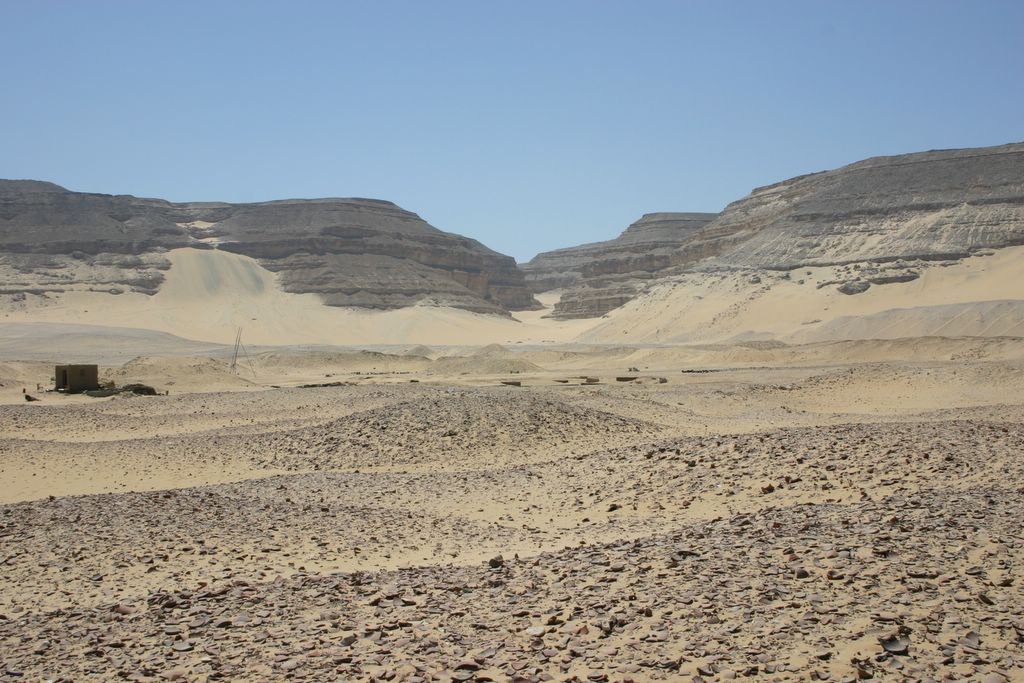
So what can you actually see here? You can see the setting that drew a king to build a city. The flat, fertile fields. The line of the river. The desert cliffs that rise along the edge of the valley. The same sun that dried mud bricks for Greek builders still bakes the walls of houses today. Life here still follows the river, the seasons and the harvest, much as it did when Greek officials walked these banks.
Before you move on, take one more look around. Notice the children walking home, the shopfronts, the mosque minaret, the palms bending in the breeze. Somewhere beneath your feet lie the foundations of a council house, a street plan, a Greek city that once governed the south. You cannot see it. But now you know it is there... and the ordinary street in front of you will never look quite so ordinary again.
Key facts
What to look for
Practical tips
Common questions
Is there a free audio guide to Ptolemais Hermiou?
Yes — the Lokali app narrates Ptolemais Hermiou free of charge in 50+ languages. The guide runs about 7 minutes, covers the history, what to look for on site and practical tips, and works offline once downloaded.
Where is Ptolemais Hermiou?
Ptolemais Hermiou is near Akhmim, Egypt, at 26.4769, 31.8036. Tap the map link on this page for directions from where you are.
What is Ptolemais Hermiou known for?
Founded by Ptolemy the First after Alexander's death. One of very few true Greek cities in Egypt.
What should you look for at Ptolemais Hermiou?
The line of the Nile beyond the palm trees. Desert cliffs rising along the edge of the valley. Mud-brick walls similar to ancient building material.
What should you know before visiting Ptolemais Hermiou?
Pair this stop with a visit to Akhmim nearby. Ask a local guide where ancient remains were reported.
When is the best time to visit Ptolemais Hermiou?
Visit in early morning to avoid the strongest heat.
On the map
Opens directions to Ptolemais Hermiou from your location.
More to see near Ptolemais Hermiou

Hear Ptolemais Hermiou in your language
The full story, narrated, in 50+ languages. Download it before you go and it plays offline, at your own pace, with no ticket and no tour group.