
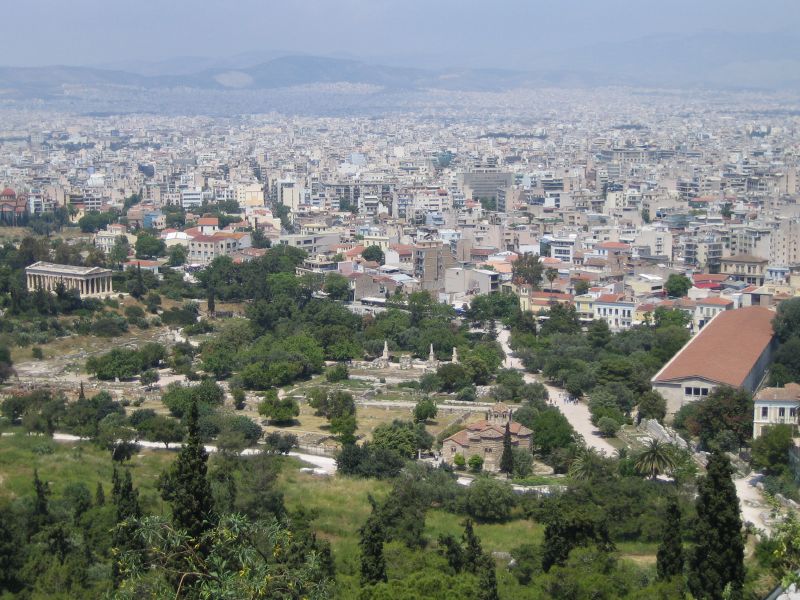
Photo: George E. Koronaios · CC0 · Wikimedia Commons
Kerameikos is an ancient graveyard and neighborhood in Athens. The word 'ceramic' comes from Kerameikos, the potters' quarter. The free Lokali audio guide runs 7 minutes.
✓ Published October 2026 · how we write these guides
Visitor facts
| Lokali audio guide | 7 min · free |
|---|---|
| Type | Archaeological Site |
| Location | Athens, Greece |
| Coordinates | 37.9783, 23.7186 |
| Languages | 50+, in the Lokali app |
The story
Listen for a moment. Under the traffic of modern Athens there is a quieter sound here: frogs in the reeds and the slow trickle of water in a narrow channel. Grass grows between broken marble. Cypress trees throw long shadows across the paths. You are standing in one of the oldest cemeteries of Athens, and also in one of its busiest ancient neighbourhoods. The two things sat side by side for centuries.
Start with the name, because it is still in your own language. Kerameikos comes from the Greek word for potters. This low, damp ground beside a stream gave them clay, and the potters' quarter grew here. The famous black and red painted vases of Athens came from workshops in this district. When you say the word 'ceramic', you are saying the name of this place.
That small stream is the Eridanos. In antiquity it was one of the rivers of Athens. Today it runs through a channel of ancient stone at the heart of the site. Look closely at the water and the muddy banks. Many visitors spot turtles resting in the sun, and frogs are often heard before they are seen. It is a surprising piece of wild life in the middle of a capital city.
Now look for the long line of stone walls that crosses the site. These are part of the city wall of ancient Athens. After the Persian armies burned the city in the early fifth century BCE, the Athenians rebuilt their defences very quickly, under the leadership of the statesman Themistocles. The historian Thucydides wrote that they worked in such a hurry that they took any stone they could find — including gravestones from the cemetery. Fragments of old monuments were built straight into the wall.
Two great gates opened in this wall. The first is the Dipylon, whose name means 'double gate'. It was the largest gate of the ancient city. Through it ran the broad road to the Academy, the grove where Plato later taught. The second is the Sacred Gate. Through it ran the Sacred Way, the road to Eleusis, about twenty kilometres to the west. Each year, a great procession left here for the Eleusinian Mysteries, a secret religious festival for the goddess Demeter and her daughter.
Between the two gates lie the foundations of a building called the Pompeion. The name comes from the Greek word for a procession. This was where the Athenians prepared for the Panathenaic festival, the city's greatest celebration in honour of Athena. From this point, the procession set out through the city and climbed to the Acropolis. So the parade that is carved on the Parthenon frieze began its journey in this spot.
Outside the walls, the Athenians buried their dead. The law did not allow burials inside the city, so the roads leading out became lined with tombs. Walk along the Street of Tombs and you will see family plots raised on stone terraces facing the road. They were built to be seen by every traveller. A grave here was a kind of public message about a family's wealth, its loss, and its place in society.
The oldest burials go back much further than classical Athens. In the eighth century BCE, families marked graves with enormous painted vases. Some stood almost as tall as a person. They are decorated in what scholars call the Geometric style — bands of zigzags, circles and meanders, with small stick-like figures mourning the dead. The best of these Dipylon vases are now in the National Archaeological Museum, but they were found here, in this ground.
Here is something many visitors miss. Not far from this road lay the public cemetery where Athens buried soldiers who died in war. Thucydides records that at one such burial, early in the war with Sparta, the statesman Pericles gave a famous funeral speech. In it he praised Athens as an open city and a democracy. The speech is still studied today. It was delivered to grieving families on the edge of this district.
The tombs became more and more elaborate. On the terraces you will see carved stone slabs, called stelai, and large marble vases made in stone. One family plot is crowned by a marble bull, standing high above the road. Many of the reliefs show quiet domestic scenes: a seated woman, a servant holding a jewellery box, a handshake between the living and the dead. In the late fourth century BCE, new laws limited this display, and grave monuments became much simpler. Many sculptures you see outside are copies; the originals are protected in museums.
The second surprise lies in the ground itself. Archaeologists found thousands of ostraka here — pieces of broken pottery with names scratched on them. In Athenian democracy, citizens could vote to send a powerful man into exile for ten years. They wrote his name on a potsherd. Among the names found are some of the most famous politicians of the age, including Themistocles himself, the man who built the wall beside you.
Kerameikos also carries scars of violence. In 86 BCE, the Roman general Sulla besieged Athens and broke into the city near the Sacred Gate. The writer Plutarch later described the slaughter in grim terms, saying the blood flowed through this district. Over the following centuries, the area was abandoned and covered by silt from the stream. That layer of earth protected the ruins until excavation began in the nineteenth century. German archaeologists have worked here since the early twentieth century, and research continues today.
Before you leave, visit the small museum on the site. It holds grave sculptures, painted vases and small personal objects found in the burials — toys, perfume bottles, and white vases painted for the dead. These pieces bring the scale back down to individual lives. A child's clay toy can say as much as a marble monument.
Now stand still once more. Look up the slope to the east, and you can see the Acropolis rising over the rooftops. The ancient processions walked from this low ground toward that rock. Around you, the modern city goes on: cafés in Thiseio, the old gasworks of Gazi, the noise of Ermou Street. As you walk out, listen again for the frogs in the Eridanos. They have outlasted the potters, the processions and the walls.
Key facts
What to look for
Practical tips
Common questions
Is there a free audio guide to Kerameikos?
Yes — the Lokali app narrates Kerameikos free of charge in 50+ languages. The guide runs about 7 minutes, covers the history, what to look for on site and practical tips, and works offline once downloaded.
Where is Kerameikos?
Kerameikos is in Athens, Greece, at 37.9783, 23.7186. Tap the map link on this page for directions from where you are.
What is Kerameikos known for?
The word 'ceramic' comes from Kerameikos, the potters' quarter. The Dipylon was the largest gate of ancient Athens.
What should you look for at Kerameikos?
Turtles sunning themselves on the banks of the Eridanos. Old grave fragments built into the city wall. The marble bull above a family plot on the Street of Tombs.
What should you know before visiting Kerameikos?
Visit in early morning for cooler air and soft light. Bring water and a hat; there is little shade.
When is the best time to visit Kerameikos?
Visit in early morning for cooler air and soft light.
On the map
Opens directions to Kerameikos from your location.
More to see in Athens



Hear Kerameikos in your language
The full story, narrated, in 50+ languages. Download it before you go and it plays offline, at your own pace, with no ticket and no tour group.