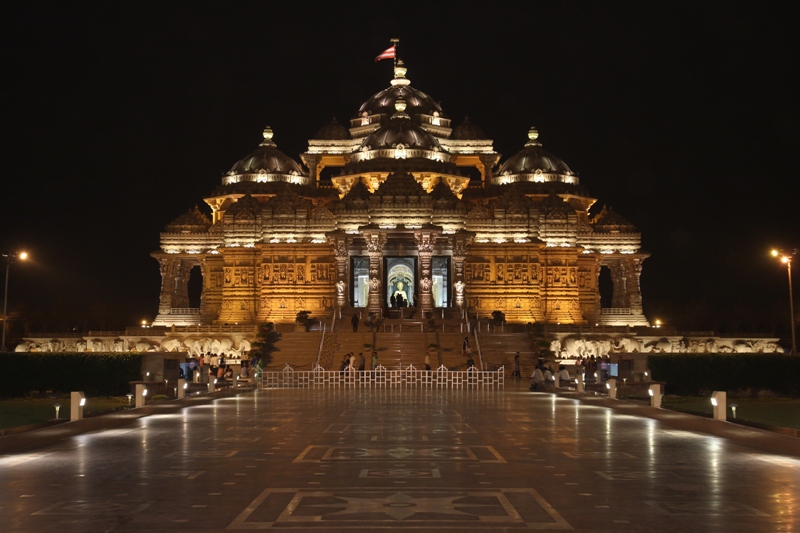
Akshardham is a temple complex in Delhi, India. Built entirely without steel or concrete, only stone. Two hundred and thirty-four hand-carved pillars, each unique. Most visitors spend 2-3 hours here. The free Lokali audio guide runs 6 minutes.
✓ Verified October 2026 · how we write these guides
Visitor facts
| Time needed | 2-3 hours |
|---|---|
| Lokali audio guide | 6 min · free |
| Type | Temple Complex |
| Best for | Families |
| Location | Delhi, India |
| Coordinates | 28.6127, 77.2773 |
| Languages | 45, in the Lokali app |
The story
The first thing you notice is the stone — not cold, but warm under the midday sun, carved so densely that entire walls seem to ripple with movement. This is Akshardham, a monument built entirely without steel or concrete, where twenty thousand sculptors worked for five years to turn pink sandstone and white marble into a vision of ancient temple architecture reborn in the twenty-first century. The light here changes everything. Early morning brings a soft glow that fills the carved recesses with shadow, turning each deity and dancer into a study in contrast. By afternoon, the stone blazes pale gold, and every surface seems to vibrate with detail.
The complex opened in two thousand and five, but its design reaches back across centuries of Hindu temple tradition. The central monument rises forty-three metres, supported by two hundred and thirty-four pillars, each one carved from a single block of stone. No two pillars are identical. Walk close and you will see elephants, musicians, gods in meditation, vines curling around lotus blooms — all rendered in stone that was cut and polished by hand. The architects studied temples in Gujarat and Rajasthan, then scaled up the proportions to create something vast but still rooted in classical form.
For photographers, the challenge is scale and light. The monument is enormous, and a wide lens will flatten it into a postcard. Instead, isolate details — a single carved bracket, the curve of a dome against the sky, the play of shadow across a frieze. The best light comes in two windows. Dawn, before the crowds arrive, when the stone glows soft and the air is still cool. And late afternoon, when the sun drops low and rakes across the facade, throwing every carved line into sharp relief. Avoid midday when the overhead sun washes out contrast and the marble turns flat white.
The surrounding gardens and water features are part of the composition. The Yagnapurush Kund, a stepped pool in front of the monument, reflects the entire structure when the water is calm. Arrive early and you can catch the reflection before wind ripples the surface. The pool is lined with one hundred and eight small shrines, each one a miniature temple in its own right. Frame the main monument through one of these shrines for a layered composition that gives a sense of the site's density.
Inside the monument, photography is not permitted, but the exterior offers endless material. The outer walls are covered in narrative friezes — scenes from Hindu epics, processions of saints, animals both real and mythical. These panels run for hundreds of metres, and each one is a standalone image. Look for the elephants at the base of the structure, carved at nearly life size, their trunks and tusks rendered with anatomical precision. The stone changes colour as you move around the building — pink sandstone on the lower levels, white marble above, and the transition line is a compositional element in itself.
The site sits on the banks of the Yamuna River, though the river itself is not visible from most vantage points. The architects created an artificial landscape, with lawns and pathways that guide visitors in a clockwise circuit around the monument. This circuit is deliberate — it mirrors the pradakshina, the ritual circumambulation practiced in Hindu temples. As you walk, the monument reveals different faces. The front is symmetrical and formal, but the sides and rear show more variation, with smaller shrines and pavilions clustered around the main structure.
Crowds peak in the late morning and early afternoon, especially on weekends and holidays. If you want clean shots without people, arrive at opening time. The site opens at nine thirty in the morning, and the first hour is the quietest. Security is strict — bags, cameras with large lenses, and tripods are not allowed inside, though phones and small cameras are permitted. Check the rules before you visit, as they change. The site also hosts an evening water show, and the monument is illuminated after dark, but the artificial lighting can be harsh and yellow. Natural light is your friend here.
The stone itself is the story. Pink sandstone from Rajasthan, white marble from Italy, both chosen for their durability and their ability to hold fine detail. The carvers worked in workshops across India, then shipped the finished blocks to Delhi for assembly. Each piece was numbered and fitted like a puzzle, with no mortar or adhesive holding the structure together. The monument is designed to last a thousand years, and the stone is already weathering — subtle shifts in colour where rain has darkened the surface, small deposits of dust in the deepest carvings.
One detail most visitors miss: the ceiling of the main dome, visible only if you tilt your head back as you pass beneath it. The underside is carved in concentric rings, each one a different pattern, spiraling up to a central lotus at the apex. It is a photographer's nightmare — too dark, too high, too much contrast — but if you can manage it, the geometry is stunning. The rings seem to pull your eye upward, a trick of perspective that makes the dome feel taller than it is.
As you leave, glance back at the monument from the exit pathway. The view from a distance, with the full structure framed by trees and sky, is often the most powerful. The scale makes sense from here — you can see how the central shikhara, the tower, rises above the surrounding pavilions, how the whole complex is layered like a mountain. The stone catches the light differently from every angle, and the monument seems to shift colour as you move. This is a place built to be seen, to be walked around, to be studied from every side. Take your time, and let the light do the work.
Key facts
What to look for
Practical tips
Common questions
How long do you need at Akshardham?
Plan 2-3 hours. That is the time most visitors spend at Akshardham. The free Lokali audio guide runs 6 minutes and is made to listen to while you walk.
Is there a free audio guide to Akshardham?
Yes — the Lokali app narrates Akshardham free of charge in 50+ languages. No ticket, tour group or subscription, and it works offline once downloaded.
Where is Akshardham?
Akshardham is in Delhi, India, at 28.6127, 77.2773. Tap the map link on this page for directions.
What should you know before visiting Akshardham?
Arrive at opening time for fewer crowds and softer light
What is Akshardham known for?
Built entirely without steel or concrete, only stone
What is the best time to visit Akshardham?
Arrive at opening time for fewer crowds and softer light
On the map
Opens directions to Akshardham from your location.
More to see in Delhi


Hear Akshardham in your language
The full story, narrated, in 50+ languages. Download it before you go and it plays offline, at your own pace, with no ticket and no tour group.