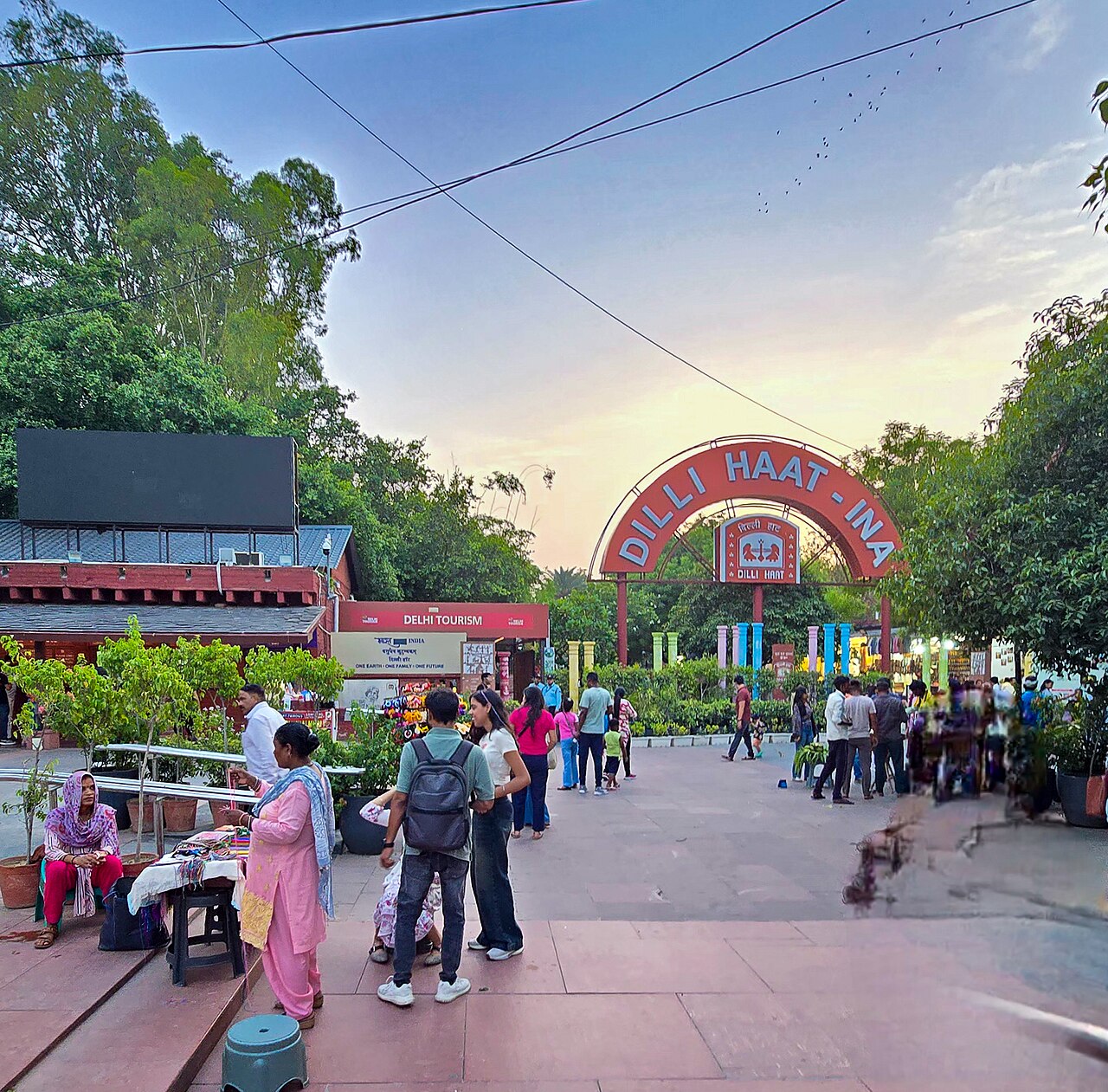
Delhi Haat is a market in Delhi, India. Established in the nineteen-nineties for rural artisans. Artisan stalls rotate every two weeks across India's states. Most visitors spend 1.5-2 hours here. The free Lokali audio guide runs 6 minutes.
✓ Verified October 2026 · how we write these guides
Visitor facts
| Time needed | 1.5-2 hours |
|---|---|
| Lokali audio guide | 6 min · free |
| Type | Market |
| Best for | Authentic finds |
| Location | Delhi, India |
| Coordinates | 28.5479, 77.2012 |
| Languages | 45, in the Lokali app |
The story
The smell hits you first — cardamom and frying samosas, wood smoke from clay tandoors, sandalwood incense drifting from a stall selling Rajasthani textiles. Delhi Haat feels less like a shopping plaza and more like a village square transplanted into the heart of the capital, a place where regional India gathers under open sky.
The concept emerged in the nineteen-nineties, when the Delhi Tourism and Transportation Development Corporation wanted to create a permanent space for India's rural artisans. Most craft fairs were temporary — a week here, a fortnight there — and artisans spent more time traveling than selling. Delhi Haat offered something different: rotating stalls where weavers, potters, and woodcarvers from every state could set up shop for two weeks at a time, then make way for the next wave. The model was simple, but it solved a real problem.
There are three Delhi Haat locations across the city now, but the original site in INA Colony remains the most visited. The architecture is deliberately low-key — brick pavilions with terracotta tile roofs, wide walkways shaded by neem and gulmohar trees, open-air courtyards where musicians perform in the evenings. Nothing here tries to look ancient or monumental. The design language is village vernacular scaled up just enough to handle crowds.
Walk the circuit and you are moving through a compressed map of India. One stall sells Pashmina shawls from Kashmir, the wool so fine you can pull an entire shawl through a wedding ring. Next door, a Tamil Nadu vendor demonstrates bronze casting using the lost-wax method, the same technique temple sculptors have used for a thousand years. A few steps further, Manipuri women in traditional phanek skirts sell hand-loomed textiles, the patterns passed down through generations without written instruction.
The food court is the real theater. Regional dishes rotate with the artisan stalls, so the menu changes every fortnight. You might find Assamese fish tenga one week, Gujarati dhokla the next, Goan prawn curry after that. The cooking happens in plain view — dosas spread thin on cast-iron griddles, kebabs turning over charcoal, bread puffing in wood-fired ovens. The cooks are not chefs in the formal sense; many are the artisans themselves, or their families, preparing the food they grew up eating.
Prices here are fixed and displayed, which is unusual for Indian craft markets. The government set this rule to spare artisans the exhausting dance of bargaining and to reassure visitors unfamiliar with haggling. It also means the vendors keep more of the sale — no middleman, no commission agent taking a cut. For many artisans, especially women from rural cooperatives, Delhi Haat is the first time they have sold directly to buyers and kept the full price.
The crowd is a mix. Tourists with cameras and guidebooks, yes, but also Delhi families out for a weekend stroll, college students meeting friends, elderly couples taking the evening air. There is no entry ticket, just a nominal gate fee that keeps the space maintained and the crowds manageable. The atmosphere is relaxed, unhurried — people sit on stone benches under trees, children chase pigeons across the courtyard, vendors chat with each other between customers.
Evening is the best time to come. The heat softens, the lights strung between pavilions begin to glow, and the musicians take the stage. You might hear a Baul singer from Bengal with a single-stringed ektara, or a Rajasthani folk ensemble with dholak drums and brass cymbals, or a Carnatic flute player working through a raga. The performances are informal, almost incidental, but they fill the space with sound and pull the crowd into a loose, collective rhythm.
The artisans change, but the structure remains. A weaver from Varanasi who was here last month is now back home at her loom. In her place, a potter from Khurja sets out his blue-glazed ceramics. The rotation keeps the market fresh and gives visitors a reason to return. It also means no single artisan depends entirely on Delhi Haat — it is one stop in a larger circuit, a fortnight of guaranteed sales before moving on.
What Delhi Haat does quietly, without much fanfare, is preserve a kind of knowledge that does not live in books. The block-printing technique a Rajasthani printer uses, the way a Kashmiri papier-mâché artist builds up layers of paper and glue, the exact angle a Karnataka sandalwood carver holds his chisel — these are skills learned by watching and doing, not reading. By giving artisans a platform and an income, the market keeps those traditions alive and visible.
As you leave, the sounds blend together — the sizzle of street food, the murmur of bargaining, the rhythmic clang of a metalworker shaping copper, a child laughing, a flute somewhere in the distance. The city is still out there beyond the gates, but for a few hours, Delhi Haat holds a different pace, a different scale. You walk back into the traffic and the noise, but the smell of cardamom lingers on your clothes.
Key facts
What to look for
Practical tips
Common questions
How long do you need at Delhi Haat?
Plan 1.5-2 hours. That is the time most visitors spend at Delhi Haat. The free Lokali audio guide runs 6 minutes and is made to listen to while you walk.
Is there a free audio guide to Delhi Haat?
Yes — the Lokali app narrates Delhi Haat free of charge in 50+ languages. No ticket, tour group or subscription, and it works offline once downloaded.
Where is Delhi Haat?
Delhi Haat is in Delhi, India, at 28.5479, 77.2012. Tap the map link on this page for directions.
What should you know before visiting Delhi Haat?
Visit in the evening when musicians perform and heat softens
What is Delhi Haat known for?
Established in the nineteen-nineties for rural artisans
What is the best time to visit Delhi Haat?
Visit in the evening when musicians perform and heat softens
On the map
Opens directions to Delhi Haat from your location.
More to see in Delhi


Hear Delhi Haat in your language
The full story, narrated, in 50+ languages. Download it before you go and it plays offline, at your own pace, with no ticket and no tour group.