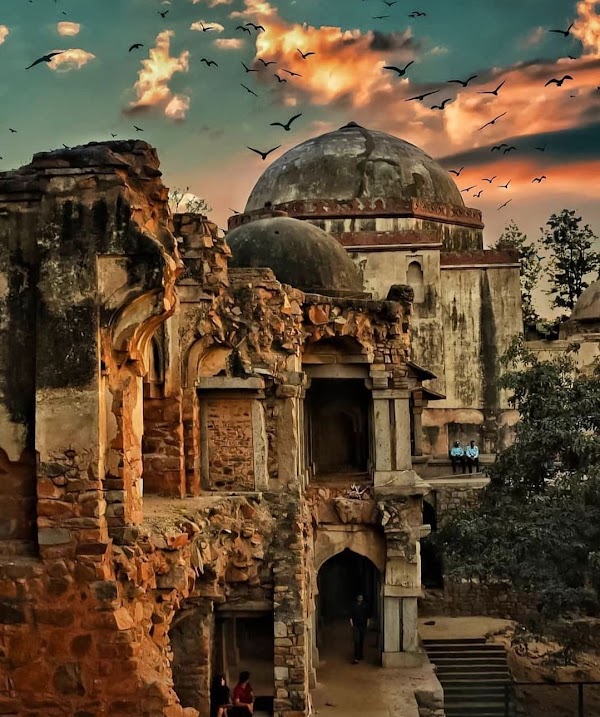
Hauz Khas Village is a neighborhood in Delhi, India. Reservoir dug in 1296 by Sultan Alauddin Khalji. Madrasa and tombs built by Firoz Shah Tughlaq mid-fourteenth century. Most visitors spend 1-2 hours here. The free Lokali audio guide runs 5 minutes.
✓ Verified October 2026 · how we write these guides
Visitor facts
| Time needed | 1-2 hours |
|---|---|
| Lokali audio guide | 5 min · free |
| Type | Neighborhood |
| Best for | Authentic finds |
| Location | Delhi, India |
| Coordinates | 28.5494, 77.1932 |
| Languages | 45, in the Lokali app |
The story
The air here smells of old stone and fresh coffee in equal measure. You are standing at the edge of Hauz Khas Village, where medieval ruins and modern cafés occupy the same few acres of south Delhi. The name means Royal Tank — a reference to the reservoir built in the thirteenth century to supply water to the second city of Delhi, Siri. That reservoir still lies at the heart of this place, a long sheet of green water flanked by crumbling pavilions and tombs.
The tank was dug in 1296 under the orders of Sultan Alauddin Khalji, one of the most ambitious rulers of the Delhi Sultanate. His engineers carved it from the rocky earth to feed a growing capital. By the mid-fourteenth century, the reservoir had silted up and Sultan Firoz Shah Tughlaq ordered it cleaned and expanded. Around the same time, he built a madrasa — an Islamic seminary — along its eastern bank. The complex grew to include lecture halls, prayer chambers, and a royal pavilion where the sultan himself came to study.
Walk toward the water and you will see the ruins of that madrasa rising in tiers above the shoreline. The walls are built from grey quartzite rubble, patched with later red sandstone repairs. Arched doorways lead into roofless chambers where pigeons nest in the niches that once held oil lamps. The stonework is plain compared to the Mughal monuments that came two centuries later — no inlay, no calligraphy, just sturdy functional masonry designed to last through monsoons and sieges.
Firoz Shah Tughlaq is buried here, in a domed tomb at the southern end of the complex. His grave lies in a square chamber with thick walls and a single entrance. The dome above is ribbed and slightly bulbous, a style that became common in Delhi during the fourteenth century. The tomb is locked most days, but you can peer through the iron grille to see the raised platform inside where the sultan rests. Around his tomb are smaller graves — members of his court, family, perhaps a few favoured scholars.
The village itself grew up around these ruins over the past century. What was once farmland and scrub became a dense urban neighbourhood in the nineteen-sixties and seventies. By the nineteen-nineties, artists and designers began renting the old village houses, converting them into studios and galleries. Cafés followed, then boutiques, then the weekend crowds. Today the narrow lanes are lined with shopfronts painted in bright colours, selling everything from hand-block textiles to imported vinyl records.
The contrast is deliberate and a little surreal. You can sit on a rooftop terrace with a cold drink and look directly down at Firoz Shah's tomb. The medieval and the contemporary do not blend here — they collide, and the friction is part of the atmosphere. Some visitors find it jarring. Others find it honest, a snapshot of how Indian cities actually evolve, layering new uses over old bones without erasing either.
If you walk the full circuit of the tank, you will pass a series of smaller domed pavilions scattered along the western shore. These were built as retreats or guesthouses, places where scholars could withdraw from the noise of the madrasa. Most are open to the sky now, their domes collapsed or stripped for stone in later centuries. The interiors are cool and dim even at midday, and the acoustics are strange — a whisper in one corner carries clearly to the opposite wall.
The reservoir itself is still fed by monsoon rains, though it no longer supplies drinking water. In summer the water level drops and the muddy bed shows through. In the rainy season it fills nearly to the top of the stone embankments, and egrets wade in the shallows. The Archaeological Survey of India maintains the monuments but does not control the village lanes, so the boundary between protected heritage and commercial sprawl is porous and constantly shifting.
Come in the late afternoon if you can. The light softens, the stone turns gold, and the crowds thin slightly. The cafés begin to fill with students and freelancers, and the ruins empty out except for a few photographers and couples looking for quiet corners. The call to prayer from a nearby mosque drifts over the water, mixing with the hum of motorbikes and the clatter of kitchen prep from the restaurants above.
This is not a place frozen in time. It is a place where time moves in multiple directions at once, where a fourteenth-century sultan's dream of a learned capital survives as a backdrop to twenty-first-century commerce and leisure. The stones do not mind. They have seen stranger transformations. As you leave, glance back at the tomb one more time. It has outlasted empires. It will outlast the cafés too.
Key facts
What to look for
Practical tips
Common questions
How long do you need at Hauz Khas Village?
Plan 1-2 hours. That is the time most visitors spend at Hauz Khas Village. The free Lokali audio guide runs 5 minutes and is made to listen to while you walk.
Is there a free audio guide to Hauz Khas Village?
Yes — the Lokali app narrates Hauz Khas Village free of charge in 50+ languages. No ticket, tour group or subscription, and it works offline once downloaded.
Where is Hauz Khas Village?
Hauz Khas Village is in Delhi, India, at 28.5494, 77.1932. Tap the map link on this page for directions.
What should you know before visiting Hauz Khas Village?
Visit late afternoon for softer light and smaller crowds
What is Hauz Khas Village known for?
Reservoir dug in 1296 by Sultan Alauddin Khalji
What is the best time to visit Hauz Khas Village?
Visit late afternoon for softer light and smaller crowds
On the map
Opens directions to Hauz Khas Village from your location.
More to see in Delhi


Hear Hauz Khas Village in your language
The full story, narrated, in 50+ languages. Download it before you go and it plays offline, at your own pace, with no ticket and no tour group.