Mehrauli Archaeological Park
28.5244° N · 77.1855° E · Park
Mehrauli Archaeological Park is a park in Delhi, India. Covers a hundred acres with over seventy monuments. Balban's Tomb features India's earliest true arch. Most visitors spend 2-3 hours here. The free Lokali audio guide runs 6 minutes.
✓ Verified October 2026 · how we write these guides
Visitor facts
| Time needed | 2-3 hours |
|---|---|
| Lokali audio guide | 6 min · free |
| Type | Park |
| Best for | Photography |
| Location | Delhi, India |
| Coordinates | 28.5244, 77.1855 |
| Languages | 45, in the Lokali app |
The story
The ground beneath your feet is uneven — cracked paving stones give way to red earth, and the roots of old banyan trees push through the pathways like arteries under skin. This is Mehrauli Archaeological Park, a hundred acres of monuments and ruins scattered through forest in the oldest continuously inhabited part of Delhi. The air smells of damp stone and wild grass, and if you listen past the city hum beyond the walls, you can hear parakeets calling from the canopy.
This land has been a seat of power since the eleventh century, when the Tomara Rajputs built Lal Kot, the first fortified settlement on this ridge. The Chauhans expanded it into Qila Rai Pithora in the twelfth century, and then came wave after wave of dynasties — Mamluks, Khaljis, Tughlaqs, Lodis, Mughals — each leaving tombs, gateways, step-wells, mosques. The park holds more than seventy structures, some restored, many crumbling, most unmarked. You are walking through eight hundred years of architectural memory, compressed into a single afternoon.
Start with Balban's Tomb, near the park's northern edge. Iltutmish's son, Ghiyas ud din Balban, ruled the Delhi Sultanate in the late thirteenth century, and this is one of the earliest surviving examples of a true arch in India — not corbelled, but built with radiating voussoirs. The tomb is roofless now, open to the sky, and the interior feels like a stone cathedral stripped to its bones. Stand inside and look up — the walls taper inward, and the light shifts as clouds pass overhead.
A few hundred metres south, through a thicket of neem trees, you will find Jamali Kamali Mosque and Tomb. Jamali was a Sufi poet who lived during the reigns of Sikander Lodi and Humayun, and his tomb sits beside that of Kamali, whose identity remains uncertain — a brother, a companion, perhaps a beloved. The tomb chamber is small and dark, and the ceiling is covered in painted plasterwork — geometric patterns in red, blue, and gold, faded but still vivid where the light catches them. The walls are inscribed with verses from Jamali's own poetry, written in Persian, celebrating divine love and the impermanence of earthly things.
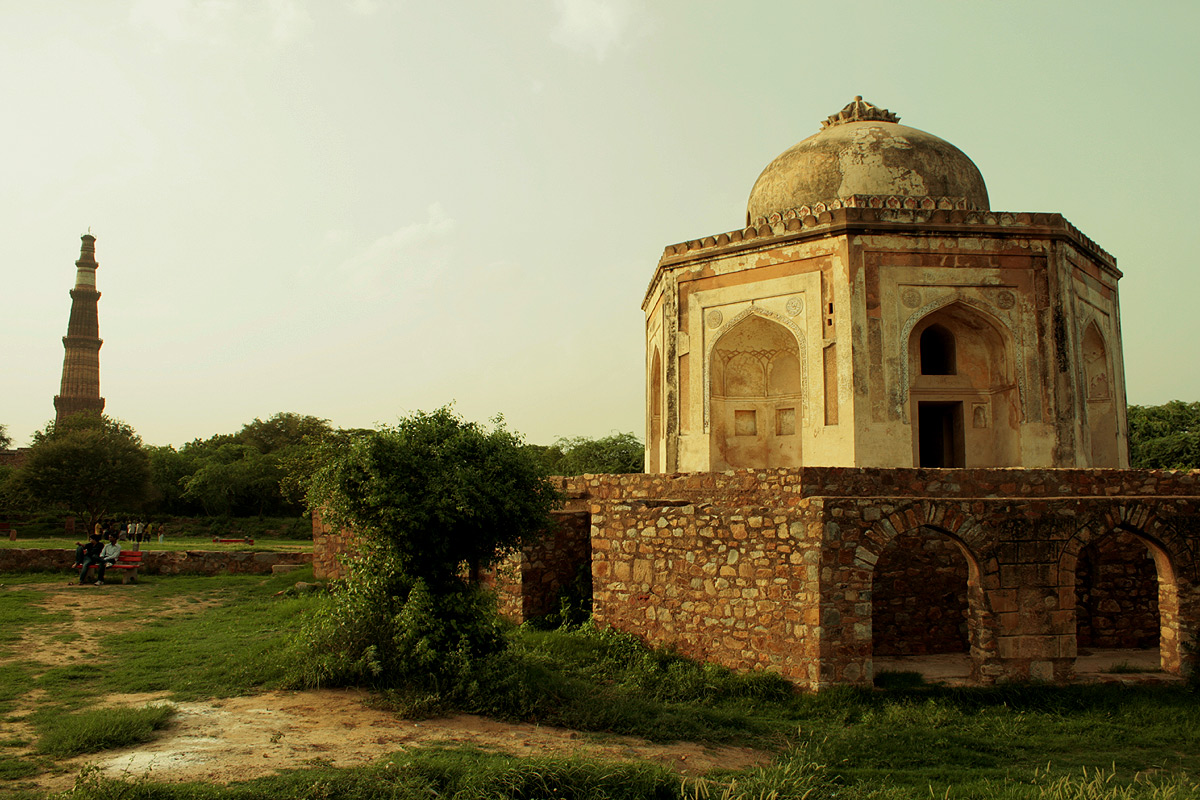
Nearby stands Metcalfe's Folly, a British-era embellishment built by Sir Thomas Metcalfe in the eighteen-thirties. Metcalfe was the British Resident in Delhi, and he turned a fourteenth-century Mughal pavilion into a summer retreat, adding a crenellated roofline and a colonnaded veranda. The result is a curious hybrid — Mughal arches dressed in Georgian trim, Delhi stone painted over with colonial ambition. It is half ruin now, the plaster peeling, the garden overgrown, but the view from the terrace still stretches across the park toward Qutb Minar in the distance.
Deeper into the park, past a dry reservoir and a collapsed gateway, you will come upon Rajon ki Baoli, a step-well built during the Lodi period in the early sixteenth century. The name means the masons' step-well, and it is one of the finest in Delhi — a long rectangular shaft lined with three levels of arched chambers, descending into shadow. The steps are steep and slick with moss, and the walls are carved with niches where oil lamps once burned. Step-wells like this were not just water sources — they were cool gathering places in the brutal summer heat, half infrastructure, half architecture.
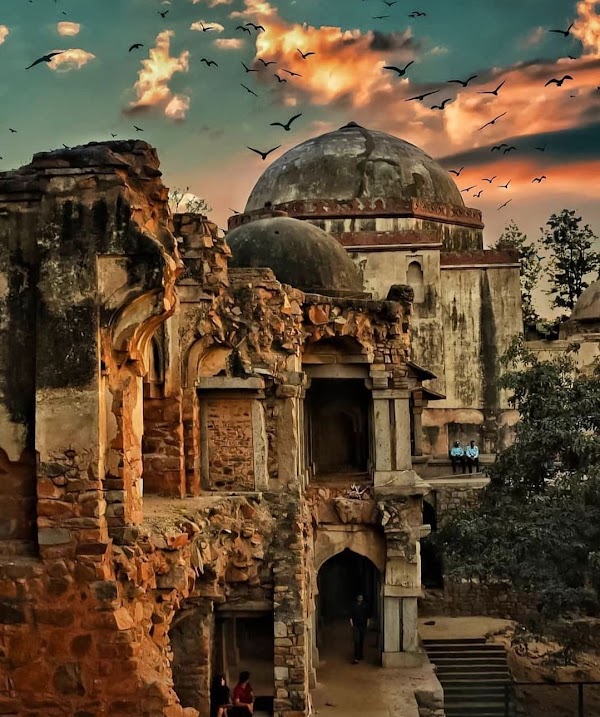
The park is not a manicured heritage site. There are no ticket booths, no audio kiosks, no roped-off pathways. Monuments appear suddenly through the trees — a domed tomb with no name, a collapsed archway strangled by roots, a fragment of wall carved with Quranic calligraphy. Goats graze near the ruins, and in the late afternoon, local families spread blankets under the trees for picnics. The Archaeological Survey of India maintains the major structures, but much of the park feels forgotten, left to the weather and the forest.
That sense of abandonment is part of the experience. Delhi is a city of layers — each dynasty built over the last, and the past is never fully buried. Mehrauli Archaeological Park is one of the few places where those layers remain visible, unpolished, overlapping. You can walk from a thirteenth-century tomb to a sixteenth-century mosque to a nineteenth-century folly in ten minutes, and the forest stitches them together into a single, fragmented narrative.
The best time to visit is early morning or late afternoon, when the light is low and the heat is bearable. Wear sturdy shoes — the paths are rough, and some of the monuments require scrambling over rubble. Bring water, and do not expect signage. The park rewards wandering, but it does not guide you. If you want context, hire a local guide at the entrance, or download a map beforehand.
As you leave, glance back at the canopy. The monuments are sinking slowly into the earth, and the trees are reclaiming the stone. In another century, some of these structures will be gone entirely, absorbed back into the ridge. For now, they are still here, silent and patient, waiting for the few visitors who take the time to look.
Key facts
What to look for
Practical tips
Common questions
How long do you need at Mehrauli Archaeological Park?
Plan 2-3 hours. That is the time most visitors spend at Mehrauli Archaeological Park. The free Lokali audio guide runs 6 minutes and is made to listen to while you walk.
Is there a free audio guide to Mehrauli Archaeological Park?
Yes — the Lokali app narrates Mehrauli Archaeological Park free of charge in 50+ languages. No ticket, tour group or subscription, and it works offline once downloaded.
Where is Mehrauli Archaeological Park?
Mehrauli Archaeological Park is in Delhi, India, at 28.5244, 77.1855. Tap the map link on this page for directions.
What should you know before visiting Mehrauli Archaeological Park?
Visit early morning or late afternoon for cooler temperatures
What is Mehrauli Archaeological Park known for?
Covers a hundred acres with over seventy monuments
What is the best time to visit Mehrauli Archaeological Park?
Visit early morning or late afternoon for cooler temperatures
On the map
Opens directions to Mehrauli Archaeological Park from your location.
More to see in Delhi




Hear Mehrauli Archaeological Park in your language
The full story, narrated, in 50+ languages. Download it before you go and it plays offline, at your own pace, with no ticket and no tour group.