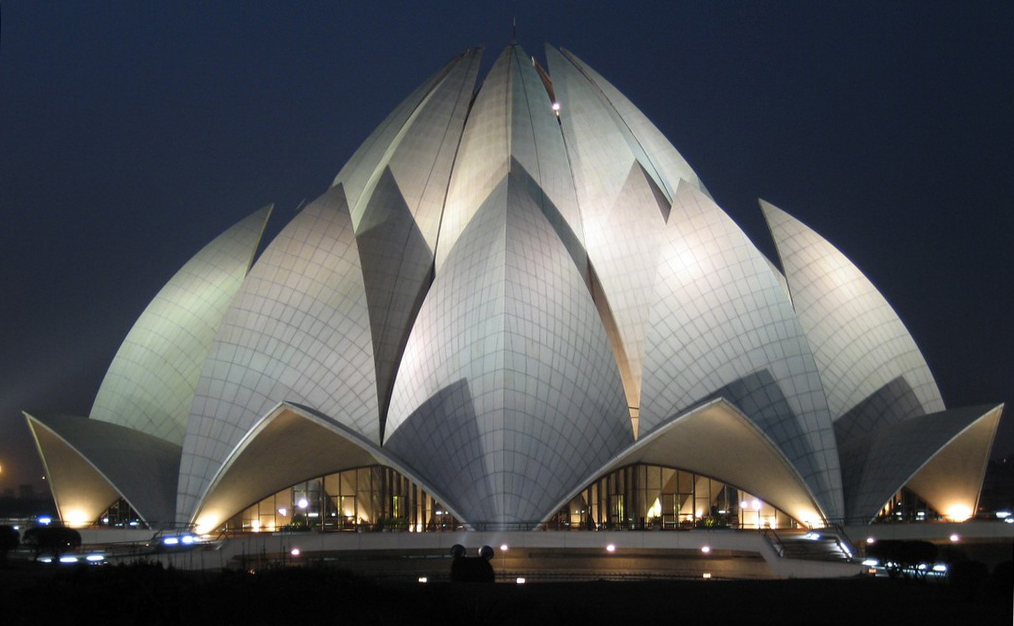
Lotus Temple is a temple in Delhi, India. Completed in 1986 after six years of construction. 2007 marble petals clad in Greek Pentelic marble. Most visitors spend 45-75 min here. The free Lokali audio guide runs 5 minutes.
✓ Verified October 2026 · how we write these guides
Visitor facts
| Time needed | 45-75 min |
|---|---|
| Lokali audio guide | 5 min · free |
| Type | Temple |
| Best for | Photography |
| Location | Delhi, India |
| Coordinates | 28.5535, 77.2588 |
| Languages | 45, in the Lokali app |
The story
The petals are the first thing you notice — 2007 of them, clad in white marble, curving upward like a flower about to open. Stand at the entrance, and the geometry feels almost biological, as if the building grew here rather than being constructed. The marble catches the Delhi light differently depending on the hour: soft and cool in the morning, blazing at midday, warm and golden as the sun drops.
This is the Bahá'í House of Worship, completed in 1986 after six years of construction. Architect Fariborz Sahba designed it as a lotus because the flower holds meaning across multiple Indian traditions — purity in Hinduism, enlightenment in Buddhism, divine beauty in Jainism. The Bahá'í faith teaches the unity of all religions, so the lotus became a symbol legible to everyone who walks through these gates.
The structure sits on a raised platform surrounded by nine pools. Water was not decorative afterthought — the pools reflect the petals and cool the air around the building, a passive climate strategy borrowed from Mughal garden design. On a still day, the reflections double the monument, turning the temple into a floating geometry. The pools also muffle the roar of South Delhi traffic, creating a pocket of quiet in one of the world's noisiest cities.
Inside, the central hall rises to a height of forty metres. No columns interrupt the space — the petals themselves form the structure, interlocking in a way that distributes weight without internal supports. Daylight filters through at the petal tips, casting soft patterns on the floor. The acoustics are remarkable: a whisper near the centre carries to the edges, while outside noise fades to almost nothing. Services here have no ritual, no sermon, no prescribed prayer — visitors sit in silence or read from any sacred text they choose.
The marble came from Greece, the same Pentelic quarries that supplied stone for the Parthenon. Sahba chose it for its fine grain and the way it weathers without staining. Over three decades, the petals have aged gracefully, developing a patina that softens their brilliance without dimming it. Close inspection reveals the precision of the joinery — each petal segment locks into the next with tolerances measured in millimetres.
The Bahá'í community does not accept donations from non-members, so the temple was funded entirely by Bahá'ís worldwide. Construction required unusual problem-solving: the petal shells are thin — only six centimetres of marble over a concrete frame — and the curves could not be cast using standard formwork. Workers built each petal in sections, adjusting the geometry by hand as they went. The final assembly took longer than planned, but the result is seamless.
More than ten thousand visitors pass through on an average day, making this one of the most-visited buildings in the world. The temple welcomes everyone regardless of faith, and the only rule is silence inside the hall. Shoes come off at the entrance, a custom borrowed from Indian temple practice. The grounds are maintained by volunteers who work in shifts, sweeping the marble walkways and tending the lawns that frame the pools.
The lotus metaphor extends beyond the building itself. The nine surrounding gardens represent the nine major world religions, each planted with species native to the regions where those faiths emerged. Walk the perimeter, and you pass through a botanical map of belief. The gardens are less manicured than the central platform, deliberately so — they soften the monument's geometry and tie it to the earth.
From the air, the temple reads as a perfect mandala, symmetrical in nine directions. Sahba studied sacred geometry for years before settling on this design, and the mathematics are precise: every angle, every curve, every pool aligns to a central axis. But from the ground, standing among the petals, the experience is less about geometry and more about light and space and the quality of stillness.
As you leave, notice how the building changes with your angle of approach. From the north, the petals seem to close protectively. From the south, they open wide. The monument shifts as you move, never quite the same twice. That instability — the sense that the form is breathing — is what makes the lotus more than a clever architectural idea. It feels alive.
Key facts
What to look for
Practical tips
Common questions
How long do you need at Lotus Temple?
Plan 45-75 min. That is the time most visitors spend at Lotus Temple. The free Lokali audio guide runs 5 minutes and is made to listen to while you walk.
Is there a free audio guide to Lotus Temple?
Yes — the Lokali app narrates Lotus Temple free of charge in 50+ languages. No ticket, tour group or subscription, and it works offline once downloaded.
Where is Lotus Temple?
Lotus Temple is in Delhi, India, at 28.5535, 77.2588. Tap the map link on this page for directions.
What should you know before visiting Lotus Temple?
Arrive early morning or late afternoon for softer light
What is Lotus Temple known for?
Completed in 1986 after six years of construction
What is the best time to visit Lotus Temple?
Arrive early morning or late afternoon for softer light
On the map
Opens directions to Lotus Temple from your location.
More to see in Delhi




Hear Lotus Temple in your language
The full story, narrated, in 50+ languages. Download it before you go and it plays offline, at your own pace, with no ticket and no tour group.