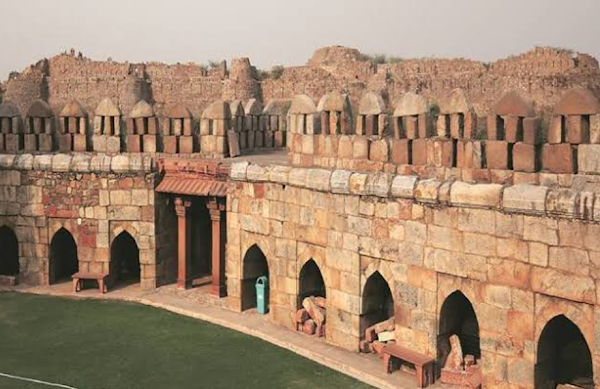
Tughlaqabad Fort is a fort in Delhi, India. Built in the early 1320s by Ghiyasuddin Tughlaq. Walls stretch nearly six kilometres around the ridge. Most visitors spend 1-2 hours here. The free Lokali audio guide runs 7 minutes.
✓ Verified October 2026 · how we write these guides
Visitor facts
| Time needed | 1-2 hours |
|---|---|
| Lokali audio guide | 7 min · free |
| Type | Fort |
| Best for | History |
| Location | Delhi, India |
| Coordinates | 28.5063, 77.2773 |
| Languages | 45, in the Lokali app |
The story
The stone beneath your feet is warm from the afternoon sun, and the silence here feels enormous — the kind of quiet that settles over ruins after centuries. You are standing inside Tughlaqabad Fort, a massive fourteenth-century citadel that sprawls across a rocky ridge in southern Delhi. The walls run for nearly six kilometres, enclosing what was once an entire city. Today, the ramparts are broken, the palaces roofless, the streets empty. But the scale still startles. This was not a fort tucked into a hillside. This was a capital.
Ghiyasuddin Tughlaq built this place in the early 1320s, shortly after founding the Tughlaq dynasty. He wanted a fortress city that could withstand siege and rebellion — Delhi had seen too many invasions, too many palace coups. So he chose this outcrop of rock, far from the older settlements, and raised walls that were four storeys tall in places, sloping outward at the base to resist battering rams. The stone is pale grey quartzite, hewn from the ridge itself. If you run your hand along the blocks, you can feel how tightly they fit, even now, seven hundred years later. No mortar in many sections — just gravity and precision.
The city inside these walls had everything: a royal palace, administrative quarters, barracks, granaries, a vast artificial reservoir fed by rainwater channels. Ghiyasuddin envisioned a self-sufficient stronghold, a seat of power that could outlast dynasties. But Tughlaqabad was occupied for barely five years. The sultan died in 1325 — some say crushed under a collapsing pavilion, others whisper poison or a curse. His son, Muhammad bin Tughlaq, moved the capital north to a new site. The fort was abandoned. The reservoir dried up. The roofs caved in. Within a generation, Tughlaqabad was already a ruin.
Walk toward the central palace complex, and you will see the bones of what was once the royal enclosure. The walls here are thicker, the gateways more elaborate. There are remnants of arched halls, stone staircases that climb to nowhere, narrow passageways that once connected private chambers. The layout is maze-like — defensive by design. Invaders who breached the outer walls would have found themselves lost in a warren of courtyards and blind alleys, exposed to archers above. Stand in one of these courtyards and listen. The wind moves through the broken arches with a low hum, almost a vibration. It is the only sound for kilometres.
To the south, across a causeway that once spanned the reservoir, you can see the tomb of Ghiyasuddin Tughlaq. It sits on a separate outcrop, walled off from the main fort — a small fortress in itself. The tomb is the only structure here that still has its roof intact, a sloping slab of red sandstone and white marble. The contrast between the pale fort and the warm red of the tomb is striking. Ghiyasuddin lies inside, beneath a marble cenotaph. The chamber is dim, cool, silent. Locals say the tomb was designed to be impregnable, even in death. The walls are sloped like the fort walls, the entrance a single narrow gate. It is a monument to a man who built for permanence and saw his city fall within his lifetime.
The fort's abandonment is often blamed on a curse. A Sufi saint named Nizamuddin Auliya lived in Delhi at the time, and Ghiyasuddin reportedly diverted labourers from the saint's hospice to speed up construction of the fort. Nizamuddin is said to have responded, "Either Tughlaqabad will be inhabited by shepherds, or it will remain desolate." Whether you believe in curses or not, the prophecy held. By the mid-fourteenth century, the fort was home only to jackals and wandering herdsmen. Today, it is a protected monument, but the wilderness still presses in — thorny scrub grows between the stones, peacocks nest in the crumbling bastions, and at dusk you can hear the calls of parakeets echoing off the ramparts.
Climb one of the surviving bastions if you can manage the broken steps. The view from the top is worth the effort. To the north, you can see the sprawl of modern Delhi, the highways, the apartment blocks, the haze of traffic. To the south and west, the land is still open — rocky scrubland dotted with acacia trees, the same landscape Ghiyasuddin would have surveyed seven centuries ago. The fort sits at the edge of two worlds, one ancient and one relentlessly modern. From up here, the scale of the fortifications becomes clear. These walls were not built to protect a palace. They were built to protect an idea — the idea that a dynasty could be made permanent through stone.
The engineering is remarkable. The walls follow the natural contours of the ridge, rising and falling with the terrain. Wherever the rock was too steep, the builders cut steps directly into the hillside. The gateways are massive, with corbelled arches and iron-reinforced doors that have long since rusted away. Look closely at the stonework near the gates, and you will see grooves worn smooth by centuries of ropes and pulleys. These were working defences, not ceremonial gestures. The fort saw little actual combat, but it was designed for war.
As you walk back toward the main entrance, notice the smaller details — the way light falls through the broken arches in the late afternoon, casting long shadows across the courtyards. The way the stone changes colour as the sun moves, from pale grey to amber to deep rust. The way the silence here feels different from the silence of a museum or a temple. This is the silence of a place that was meant to be loud with life — markets, soldiers, children, animals — and now holds only the memory of that noise. Tughlaqabad is not picturesque in the way some ruins are. It does not invite romance. It is too stark, too vast, too unforgiving. But it is honest. It shows you what ambition looks like when time strips away everything but the stone.
Before you leave, take a moment to stand still and look around. The fort is not on most tourist itineraries. You may have the place almost to yourself. The wind is picking up, carrying the smell of dust and dry grass. A few goats are grazing near the outer wall, their bells faint and metallic. The sun is lower now, and the shadows are lengthening across the ramparts. This is what remains of Ghiyasuddin Tughlaq's dream — not a living city, but a monument to the fragility of permanence. The stones are still here. The walls still stand. But the life that filled them is gone, and the silence is absolute.
Key facts
What to look for
Practical tips
Common questions
How long do you need at Tughlaqabad Fort?
Plan 1-2 hours. That is the time most visitors spend at Tughlaqabad Fort. The free Lokali audio guide runs 7 minutes and is made to listen to while you walk.
Is there a free audio guide to Tughlaqabad Fort?
Yes — the Lokali app narrates Tughlaqabad Fort free of charge in 50+ languages. No ticket, tour group or subscription, and it works offline once downloaded.
Where is Tughlaqabad Fort?
Tughlaqabad Fort is in Delhi, India, at 28.5063, 77.2773. Tap the map link on this page for directions.
What should you know before visiting Tughlaqabad Fort?
Wear sturdy shoes for uneven stone and broken steps
What is Tughlaqabad Fort known for?
Built in the early 1320s by Ghiyasuddin Tughlaq
What is the best time to visit Tughlaqabad Fort?
Visit late afternoon for softer light and cooler temperatures
On the map
Opens directions to Tughlaqabad Fort from your location.
More to see in Delhi



Hear Tughlaqabad Fort in your language
The full story, narrated, in 50+ languages. Download it before you go and it plays offline, at your own pace, with no ticket and no tour group.