
Photo: Olaf Tausch · CC BY-SA 3.0 · Wikimedia Commons
Gortyna is an ancient city in Crete, Greece. Gortyna was capital of Roman Crete and Cyrenaica. The free Lokali audio guide runs 7 minutes.
✓ Published October 2026 · how we write these guides
Visitor facts
| Lokali audio guide | 7 min · free |
|---|---|
| Type | Archaeological Site |
| Location | Gortyn, Greece |
| Coordinates | 35.0601, 24.9495 |
| Languages | 50+, in the Lokali app |
The story
Listen first. Cicadas buzz in the olive trees, and somewhere a goat bell clanks across the plain. The ground under your feet is dry and pale, scattered with broken stone. Around you, the Messara, the widest plain in southern Crete, runs flat towards distant mountains. This quiet farmland once held the capital of a Roman province. Welcome to Gortyna, also called Gortyn, one of the great ancient cities of Crete.
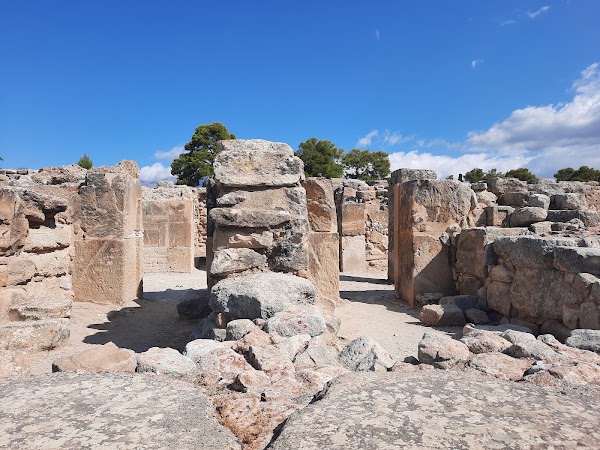
It is easy to miss how large this city was. The fenced area near the road holds only a small part of it. The rest lies across the fields, among the olive groves, on both sides of the modern road. Farmers have worked this soil for centuries, and their trees grow between columns, walls and foundations. In many places, a gnarled olive trunk stands right next to a fallen piece of marble. Ancient Gortyna and modern farming share the same ground.
Before the history, there is a myth. According to Greek legend, the god Zeus fell in love with Europa, a princess from Phoenicia, on the coast of the eastern Mediterranean. He took the form of a white bull, carried her across the sea, and brought her here. Locals say the pair met under a plane tree beside the river. The story adds that, because of this, the tree never lost its leaves. Keep this tale in mind. It returns near the end of our walk.
Now to firmer ground. Gortyna was already an important settlement in the Greek period, competing with cities such as Knossos for power on the island. Then Rome arrived. After the Roman conquest of Crete in the first century before Christ, Gortyna became the capital of a large Roman province. That province joined Crete with Cyrenaica, a region on the coast of what is now Libya. For several centuries, decisions made in this plain reached across the sea to North Africa.
The treasure of this site, though, is not a building. It is a piece of writing. Walk towards the brick and stone structure near the entrance, a small Roman theatre called an odeon. Behind it, under a protective roof, stands a curved wall of stone blocks. They are covered in neat lines of Greek letters. This is the Law Code of Gortyn, one of the oldest written legal codes in Europe, carved around the fifth century before Christ.
Here is the first surprise. The lines do not all read from left to right. One line runs left to right, and the next runs right to left, back and forth across the stone. The Greeks called this style boustrophedon, meaning as the ox turns, like a farmer ploughing a field. Fittingly, you are standing in a plain of farms. The script is an early local form of Greek, and the letters are cut sharply and evenly, even after so many centuries.
What does the code say? It is not about kings or wars. It deals with daily life. It covers marriage and divorce, inheritance, adoption, property, and the status of enslaved people. It sets out what a woman may keep when a marriage ends. It explains how children inherit from parents. The rules treat people very differently by class, and they reflect a world far from our own. Yet reading them, you can picture real families arguing over land and money.
The second surprise is how the inscription survived. It was not found in its first location. Later builders, in the Roman period, took the inscribed blocks and reused them in the wall of the odeon. In other words, a law that once mattered deeply became building material. Archaeologists working in the late nineteenth century, including the Italian scholar Federico Halbherr, uncovered and studied the text. Italian teams have worked at Gortyna for a very long time since then.
Turn now to the large ruined church close by. This is the Basilica of Saint Titus. Titus was a companion of the apostle Paul, and Christian tradition names him the first bishop of Crete. The church you see dates from the early Byzantine period, when the Eastern Roman Empire ruled the island. Much of it has fallen, but the apse still stands. That is the rounded end of the church, built from heavy stone blocks, rising against the sky.
Stand for a moment inside the old outline of the church. The walls are thick, and the stone is a warm honey colour in the sun. You can still sense the scale of the space. Christianity took root early on Crete, and this church shows how important Gortyna remained in that new age. Nearby, the village of Agioi Deka takes its name from ten Christian martyrs. Tradition says they were killed in this area during Roman persecution.
If you have time, explore beyond the main enclosure. Across the road, among the olive trees, lie the remains of other Roman buildings. There are traces of a large official complex called the praetorium, where the Roman governor worked. There are also sanctuaries, including a temple of Apollo and a shrine to Egyptian gods. These show how mixed the city was, with traders, soldiers and officials arriving from many corners of the Mediterranean. Paths can be rough, so walk carefully.
Why did such a powerful city fade? The answer is not one single event. Earthquakes struck the region more than once. In the ninth century, Arab forces took control of Crete, and Gortyna lost its importance. Over time, people moved away. The buildings collapsed, and the soil slowly covered them. Farmers planted olives over the streets. That is why so much of the city still lies hidden underground, waiting for future excavation.
Now, back to the myth. Near the river that runs past the site, look for the plane trees along the bank. Local tradition holds that one evergreen plane tree here is linked to Zeus and Europa. Botanists have noted that a rare form of plane tree on Crete does keep its leaves through winter. So the legend may rest on something real in nature. It is a lovely meeting of story and science.
Before you leave, pause once more by the stone code. Look at the grooves of each letter, cut by a careful hand long ago. Then lift your eyes to the olive groves and the wide plain beyond. The same light falls on these fields as it did on the city's judges and farmers. As you walk back to the road, listen again for the cicadas. Under your feet, the old city is still there.
Key facts
What to look for
Practical tips
Common questions
Is there a free audio guide to Gortyna?
Yes — the Lokali app narrates Gortyna free of charge in 50+ languages. The guide runs about 7 minutes, covers the history, what to look for on site and practical tips, and works offline once downloaded.
Where is Gortyna?
Gortyna is in Gortyn, Greece, at 35.0601, 24.9495. Tap the map link on this page for directions from where you are.
What is Gortyna known for?
Gortyna was capital of Roman Crete and Cyrenaica. The Law Code dates to around the fifth century BCE.
What should you look for at Gortyna?
Alternating line direction carved across the Law Code blocks. The standing stone apse of the Basilica of Saint Titus. Olive trunks growing beside fallen marble column pieces.
What should you know before visiting Gortyna?
Visit early morning to avoid the strong midday Messara heat. Bring water and a hat; shade on site is limited.
When is the best time to visit Gortyna?
Visit early morning to avoid the strong midday Messara heat.
On the map
Opens directions to Gortyna from your location.
More to see near Gortyna


Hear Gortyna in your language
The full story, narrated, in 50+ languages. Download it before you go and it plays offline, at your own pace, with no ticket and no tour group.