
Hagia Triada
35.0592° N · 24.7928° E · Archaeological Site
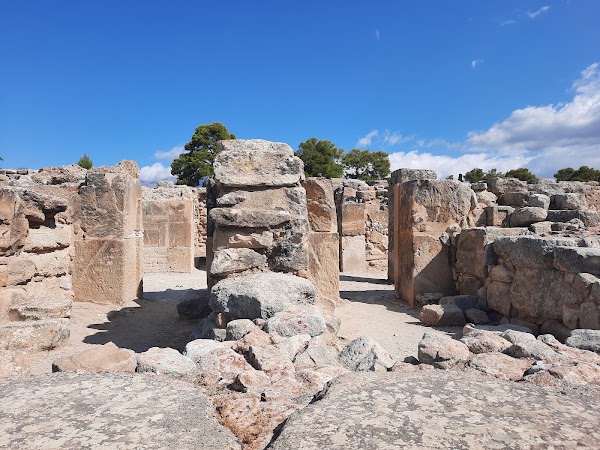
Photo: C messier · CC BY-SA 4.0 · Wikimedia Commons
Hagia Triada is a human settlement. It is near Matala, Greece. Name comes from a later Holy Trinity church nearby. The free Lokali audio guide runs 7 minutes.
✓ Published October 2026 · how we write these guides
Visitor facts
| Lokali audio guide | 7 min · free |
|---|---|
| Type | Archaeological Site |
| Location | Matala, Greece |
| Coordinates | 35.0592, 24.7928 |
| Languages | 50+, in the Lokali app |
The story
Listen for a moment. The wind moves through dry thyme and wild sage on the slope below you. Somewhere a goat bell rings, then stops. Under your feet the paths are pale limestone, worn smooth and warm by the sun. Ahead, low stone walls step down the hillside in neat terraces. Beyond them, the wide green Messara plain runs out toward the sea. This is Hagia Triada, one of the quietest Bronze Age sites on Crete.
You came here from Matala, a short drive away, where the sandstone cliffs are carved with old tombs. The coast feels close here too. On a clear day you can see a line of blue water to the west, the Gulf of Messara. Behind you, the mountains rise toward Mount Ida, the highest peak on the island. The Minoans chose this spot carefully. It watches the plain, the hills, and the sea at the same time.
First, a word about the name. Hagia Triada means Holy Trinity in Greek. But that name has nothing to do with the people who built these walls. It comes from a much later church of the Holy Trinity, which stood in a small village nearby. The Minoans lived here more than three thousand years ago, and we do not know what they called this place. The name you hear today is a borrowed one.
So who were the Minoans? They were the Bronze Age people of Crete, named in modern times after Minos, the legendary king of Greek myth. They built large palace complexes, painted bright frescoes, and traded across the eastern Mediterranean. The great palace of Phaistos stands only a few kilometres east of here, on the next ridge. Hagia Triada was smaller, but it was clearly important. Archaeologists still debate whether it was a royal villa, a summer residence, or an administrative centre tied to Phaistos.
Italian archaeologists began digging here in the early twentieth century. The work was led by Federico Halbherr and his team, the same Italian mission that uncovered Phaistos. What they found changed how people thought about this corner of Crete. The buildings here were richly built, with fine stonework, paved rooms, and painted walls. Some of the finest objects ever found from Minoan Crete came out of this hillside.
Here is the first surprise. This site produced more clay tablets in Linear A than almost anywhere else. Linear A is the writing system of the Minoans. And no one has ever deciphered it. Scholars can read some of the numbers and guess at some signs, but the language itself remains unknown. Many of these tablets look like records — counts of goods, perhaps grain, oil, or wine. Somebody here was keeping accounts. We can see the lists... but we cannot read the words.
Now look at the walls themselves. Notice how some blocks are cut square and fitted tightly, while others are rough rubble. The neat, dressed stone usually marks the grander rooms. The rough walls were often plastered and painted, so the Minoans did not need perfect stone everywhere. Look also for traces of stairways and narrow corridors. This was a building of many levels, with light wells and rooms opening onto views of the plain.
Around the middle of the fifteenth century before Christ, disaster came. Like many Minoan sites across Crete, Hagia Triada was destroyed by fire. The causes are still argued over — earthquake, conflict, or a wider collapse of Minoan power. The fire did something strange for archaeologists. It baked some clay tablets hard, and that is one reason they survived. Destruction, in this case, helped preserve the written record.
But the story did not end with the fire. People came back and built again. In the later Bronze Age, when mainland Greek influence was strong on Crete, new structures rose on the ruins. One was a large hall in the mainland style. Another was a long building with a row of rooms along a portico, often described as shops or storerooms. Some guides call this area the marketplace. Stand near it and imagine traders moving goods between the plain and the coast.
Now the second surprise, and perhaps the most famous one. Much of what made Hagia Triada known is not here at all. It is in the Archaeological Museum of Heraklion, in the north of the island. That includes the painted Hagia Triada sarcophagus, a limestone coffin covered in scenes of ritual. On its sides, figures carry offerings, play music, and pour liquid into a vessel. A bull lies bound on a table for sacrifice. It is one of the clearest pictures we have of Minoan religious life.
The museum also holds three carved stone vessels from this site. The Harvester Vase shows a crowd of men marching and singing, carrying farming tools. The Boxer Rhyton shows athletes boxing and bull leaping. The Chieftain Cup shows a young man with a staff facing another figure. These objects are small, but they are full of movement. If you visit Heraklion later, look for them. You will understand this hillside much better after seeing them.
Before you leave, find the small chapel of Saint George at the edge of the site. It is a modest building from the Venetian period, when Venice ruled Crete. It sits beside ruins that are thousands of years older. Inside, traces of old painted decoration may survive on the walls. Down the slope, toward the road, lie the remains of an ancient cemetery with round stone tombs. The dead and the living were never far apart here.
Take one last look around. The stone walls are quiet now, but the view is almost the same one the Minoans saw. The plain is still farmed. Olive trees still grow on the slopes. The sea still shines in the afternoon light to the west. As you walk back down the path, listen again to the wind in the dry grass... and to the goat bells, somewhere out of sight on the hillside.
Key facts
What to look for
Practical tips
Common questions
Is there a free audio guide to Hagia Triada?
Yes — the Lokali app narrates Hagia Triada free of charge in 50+ languages. The guide runs about 7 minutes, covers the history, what to look for on site and practical tips, and works offline once downloaded.
Where is Hagia Triada?
Hagia Triada is near Matala, Greece, at 35.0592, 24.7928. Tap the map link on this page for directions from where you are.
What is Hagia Triada known for?
Name comes from a later Holy Trinity church nearby. Major source of undeciphered Minoan Linear A tablets.
What should you look for at Hagia Triada?
Smooth dressed stone blocks marking the grander rooms. The row of rooms along the later portico. Small Venetian chapel of Saint George beside the ruins.
What should you know before visiting Hagia Triada?
Combine your visit with Phaistos, a few kilometres east. Bring water and a hat; shade is very limited.
When is the best time to visit Hagia Triada?
Come in late afternoon for softer light over the plain.
On the map
Opens directions to Hagia Triada from your location.
More to see near Hagia Triada


Hear Hagia Triada in your language
The full story, narrated, in 50+ languages. Download it before you go and it plays offline, at your own pace, with no ticket and no tour group.