
Photo: Qasimmirzaie · CC BY 4.0 · Wikimedia Commons
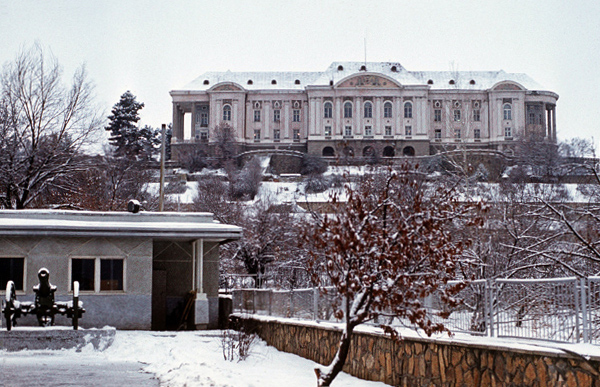
Darul Aman Palace is an architectural structure. It is near Kabul, Afghanistan. Built in the 1920s under King Amanullah Khan. The free Lokali audio guide runs 6 minutes.
✓ Published October 2026 · how we write these guides
Visitor facts
| Lokali audio guide | 6 min · free |
|---|---|
| Type | Palace |
| Location | Kabul, Afghanistan |
| Coordinates | 34.4648, 69.1089 |
| Languages | 50+, in the Lokali app |
The story
Start with the light. In the Kabul morning, the pale stone of Darul Aman Palace catches the sun before the streets below it do. The building sits on a low rise, and the air up here often feels thin and dry. Dust drifts in from the road. Mountains stand behind you in every direction, brown and folded, and the palace stands in the middle of them like a visitor from another continent.
That feeling is not an accident. Darul Aman means abode of peace, and the palace was built in the 1920s as the centrepiece of a new capital district. The man behind it was King Amanullah Khan. He led Afghanistan to full independence from British influence in 1919. He then wanted a modern seat of government, set apart from the crowded old city, and he looked to Europe for the style.
So look at the facade in front of you. This is European neoclassical architecture, the style of grand ministries and museums in Berlin or Paris. Neoclassical means design borrowed from ancient Greece and Rome: columns, symmetry, tall windows in long, even rows. European architects and engineers worked on the plans. In the Kabul of that era, a building like this was a public statement. It told the world that Afghanistan intended to join the modern age on its own terms.
Here is the first thing many visitors miss. The palace was never meant to stand alone. It was the anchor of a whole planned district, and a long, straight avenue was laid out to link it with the city. That road still carries the palace's name. Stand at the top of the slope and look back along it. The straight line toward the city is part of the original vision, a ceremonial approach for a new kind of state.
Amanullah's vision moved fast, perhaps too fast. His reforms touched education, dress, and the role of women in public life. Many of these changes met strong resistance, especially in rural areas and among religious leaders. In 1929, amid an uprising, the king gave up his throne and left the country. He spent the rest of his life in exile. His great palace was finished, but the future he imagined for it did not arrive.
In the decades that followed, the building found other uses. It served various government offices, and at different times it was linked with the ministry of defence. A fire damaged it in the late 1960s, and it was repaired. Then came the turbulence of the late 1970s. During the communist coup of 1978, fighting reached the palace, and fire struck the building again. Each new chapter of Afghan politics seemed to leave a mark on these walls.
The worst damage came in the 1990s. After the Soviet withdrawal, rival armed factions fought for control of Kabul. This hilltop sat close to the front lines, and the palace was shelled again and again. For many years afterward, the building was a hollow shell. Its roof was largely gone. Its walls were full of holes from bullets and artillery. Photographers from around the world came to frame its broken silhouette against the mountains.
That ruined image became a kind of shorthand for the country itself. Here is the second surprise. For a generation, the most famous picture of Darul Aman was not the palace as its builders imagined it. It was the wreck. Students, soldiers, and families posed in front of the scarred stone. The broken palace was, strangely, more recognisable than the intact one had ever been.
Then, in the 2010s, the Afghan government began a major restoration. Afghan engineers, architects, and craftspeople worked on the project for several years. The aim was to rebuild the structure and bring back much of its original appearance. The restored palace was opened in 2019, timed to mark one hundred years since the independence that Amanullah had won. The circle of history closed, at least for a moment, on the same hilltop where it began.
As you look at the building today, notice how clean and even the surfaces appear. That smoothness is the product of the restoration. Look closely at the stonework and the window frames. Some details follow the old design, while the materials themselves are newer. The palace you see is both an original and a reconstruction. It carries its 1920s outline, but much of what you touch belongs to the twenty-first century.
Turn your attention outward for a moment. Not far from here stands another hilltop building, Taj Beg Palace, sometimes called the Queen's Palace. It belonged to the same royal project and suffered similar damage over the years. Together, the two buildings show how large Amanullah's plan once was. They are less a pair of houses than the remains of an entire imagined city that never fully grew around them.
Since 2021, Afghanistan has been governed by the Taliban, and access to sites like this one can change without much notice. Rules on photography, entry to the grounds, and visits inside the building may vary. Ask locally before you raise a camera, and follow the guidance of anyone on duty. Treat the place with patience. For many Afghans, this palace holds memories of hope, of war, and of rebuilding, all at once.
Before you move on, stand still and take in the whole scene. The pale walls. The long road falling away toward the city. The mountains holding everything in a wide, dry bowl. A king built this as an abode of peace, and the country has waited a long time for that name to fit. As you walk away, look back once more... and notice how the stone still catches the light first.
Key facts
What to look for
Practical tips
Common questions
Is there a free audio guide to Darul Aman Palace?
Yes — the Lokali app narrates Darul Aman Palace free of charge in 50+ languages. The guide runs about 6 minutes, covers the history, what to look for on site and practical tips, and works offline once downloaded.
Where is Darul Aman Palace?
Darul Aman Palace is near Kabul, Afghanistan, at 34.4648, 69.1089. Tap the map link on this page for directions from where you are.
What is Darul Aman Palace known for?
Built in the 1920s under King Amanullah Khan. Darul Aman translates as abode of peace.
What should you look for at Darul Aman Palace?
Long rows of evenly spaced tall classical windows. The perfect symmetry of the main facade. The straight avenue running from the palace toward the city.
What should you know before visiting Darul Aman Palace?
Ask locally about current access rules before visiting. Check whether photography is permitted before using your camera.
When is the best time to visit Darul Aman Palace?
Come in early morning for softer light on the facade.
On the map
Opens directions to Darul Aman Palace from your location.
More to see in Kabul



Hear Darul Aman Palace in your language
The full story, narrated, in 50+ languages. Download it before you go and it plays offline, at your own pace, with no ticket and no tour group.