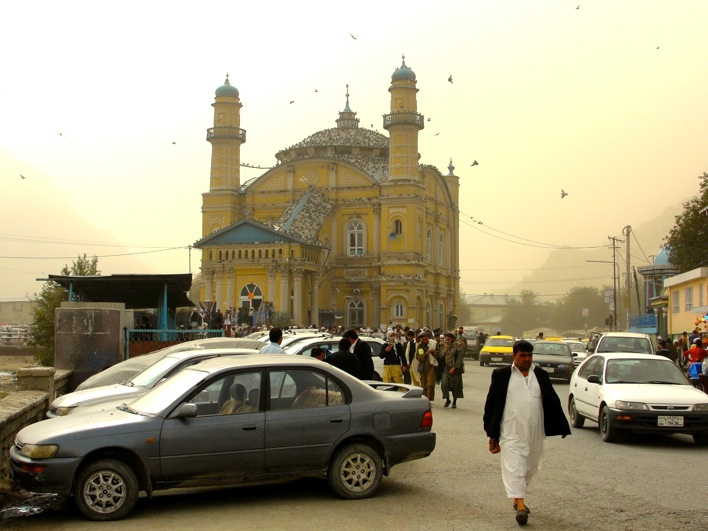
Photo: Michal Hvorecky from Slovak Republic · CC BY 2.0 · Wikimedia Commons
Shah-Do Shamshira Mosque is a mosque in Afghanistan. Built in the 1920s under King Amanullah Khan. The free Lokali audio guide runs 6 minutes.
✓ Published October 2026 · how we write these guides
Visitor facts
| Lokali audio guide | 6 min · free |
|---|---|
| Type | Mosque |
| Location | Kabul, Afghanistan |
| Coordinates | 34.5157, 69.1714 |
| Languages | 50+, in the Lokali app |
The story
Listen first. The Kabul River moves slowly beside you, low and brown in the dry months, louder after the spring snowmelt. Car horns come from the bridges. Somewhere close, a vendor calls out. Then you lift your eyes, and a yellow building appears above the traffic. It has columns, curved details and pale trim. For a moment it does not look like a mosque at all. It looks as if it came from a small European town.
This is the Shah-Do Shamshira Mosque, on the bank of the Kabul River near the old heart of the city. Many visitors walk past it and assume it is a former church or a government office. That surprise is a good place to begin. Few mosques in Afghanistan look like this one. To understand why it looks so different, you need to know a little about the man who ruled the country when it was built.
The mosque dates to the 1920s, during the reign of King Amanullah Khan. Amanullah came to power in 1919, the same year Afghanistan won full independence from British control over its foreign affairs. He was a young king with large plans. He wanted schools, new laws, modern dress and new buildings. He looked to Europe and to Turkey for ideas. Many accounts say his mother, the Queen Mother, sponsored the building of this mosque.
Now look at the architecture with that history in mind. The style borrows from European Baroque. Baroque is a style that grew in seventeenth-century Europe, known for curves, columns and theatrical decoration. Here those ideas were applied to a place of Islamic prayer. The result is a two-storey building with a painted yellow façade, decorative columns and arched openings. It is a small building, but it carries a big statement about one king's vision for his country.
Amanullah's other projects show the same thinking. On the edge of Kabul he began Darul Aman Palace, a large European-style palace meant to anchor a new government district. In the hills at Paghman, a resort area west of the city, he built a triumphal arch to mark independence. This mosque belongs to that family of buildings. It is one of the few in which Amanullah's European taste met religious architecture so directly.
The name has a story of its own. Shah-Do Shamshira means "the King of Two Swords." Here we move from history into legend. Locals tell a tale about a warrior from the early years of Islam who fought at Kabul with a sword in each hand. According to the story, he kept fighting even after a fatal wound, and he fell close to this spot. Versions differ from teller to teller. Historians cannot confirm the details.
The legend is tied to a shrine nearby, also called Shah-Do Shamshira. People sometimes mix up the two places. The shrine is the older devotional site, connected to the warrior's story. The mosque is the yellow 1920s building in front of you. For many Kabulis, the shrine and the mosque form one sacred corner of the river bank. People come to pray, to make a quiet wish, or simply to sit for a moment away from the traffic.
This corner of Kabul also carries a painful modern memory. In March 2015, a young woman named Farkhunda Malikzada was killed by a mob near the shrine after a false accusation. Her death shocked the country. Women carried her coffin at the funeral, which broke with local custom, and many Afghans protested. If you choose to remember her as you stand here, it is a respectful thing to do. It is part of the true story of this place.
Now turn back to the street. The neighbourhood around the mosque has always been busy. The old bazaars of Kabul lie close by, and the river bank has long been a place of trade. Expect money changers, fruit sellers, men pushing carts and taxis pulling in sharply to the kerb. The noise is constant. That contrast is part of the experience: a quiet sacred building, surrounded by the everyday hard work of the city.
The river itself deserves a moment. The Kabul River runs east out of the city and eventually joins the Indus in Pakistan. For much of the year, it is shallow in town, and in drought years it can shrink to a thin channel. After heavy snow in the mountains, the water rises and runs fast. Its state on the day you visit tells you a lot about the season and the year.
If you go closer, think about the visit as a guest. This is an active place of worship, not a museum. Dress modestly, with arms and legs covered. Women should cover their hair. Shoes come off before entering prayer areas. Rules for visitors, and especially for women, can change, so ask politely at the entrance before you go in. Avoid prayer times and Friday midday, when the space belongs to worshippers.
Photography needs the same care. The yellow façade is easiest to photograph from a little distance, where you can fit the columns and the roofline into one frame. The colour looks warmest in low sun, early or late in the day. Always ask before you photograph people, and accept a refusal with good grace. In Kabul, it is also wise to follow current local security advice and to keep your camera use discreet.
Before you leave, stand still once more and look up. Notice how the yellow paint meets the grey dust of the street. Notice the curves of the columns against the hard edges of the modern buildings around it. A king tried to remake his country here a century ago, and his mother left this mosque behind. As you walk away along the river, listen again to the water, the horns, and the vendors... the city goes on, and the yellow building stays.
Key facts
What to look for
Practical tips
Common questions
Is there a free audio guide to Shah-Do Shamshira Mosque?
Yes — the Lokali app narrates Shah-Do Shamshira Mosque free of charge in 50+ languages. The guide runs about 6 minutes, covers the history, what to look for on site and practical tips, and works offline once downloaded.
Where is Shah-Do Shamshira Mosque?
Shah-Do Shamshira Mosque is near Kabul, Afghanistan, at 34.5157, 69.1714. Tap the map link on this page for directions from where you are.
What is Shah-Do Shamshira Mosque known for?
Built in the 1920s under King Amanullah Khan. Often credited to Amanullah's mother, the Queen Mother.
What should you look for at Shah-Do Shamshira Mosque?
The yellow painted façade with pale decorative trim. Columns and curves borrowed from European Baroque style. The nearby shrine linked to the two-sword legend.
What should you know before visiting Shah-Do Shamshira Mosque?
Dress modestly with arms and legs fully covered. Women should bring a scarf to cover their hair.
On the map
Opens directions to Shah-Do Shamshira Mosque from your location.
More to see in Kabul


Hear Shah-Do Shamshira Mosque in your language
The full story, narrated, in 50+ languages. Download it before you go and it plays offline, at your own pace, with no ticket and no tour group.