
National Museum of Afghanistan
34.4675° N · 69.1200° E · Museum
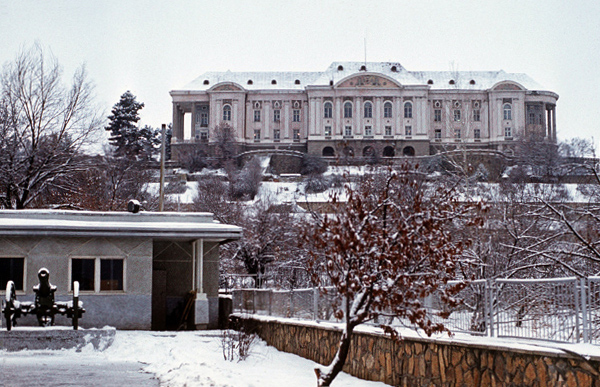
Photo: Michal Hvorecky from Slovak Republic · CC BY 2.0 · Wikimedia Commons
National Museum of Afghanistan is a museum. It is near Kabul, Afghanistan. Collection moved into this building in the early 1930s. The free Lokali audio guide runs 7 minutes.
✓ Published October 2026 · how we write these guides
Visitor facts
| Lokali audio guide | 7 min · free |
|---|---|
| Type | Museum |
| Location | Kabul, Afghanistan |
| Coordinates | 34.4675, 69.1200 |
| Official website | afghan-web.com |
| Languages | 50+, in the Lokali app |
The story
Listen for a moment. Beyond the gate, traffic from the long avenue fades into a softer hum. Dust settles on the steps. Inside, the air is cool and still, and it smells faintly of old stone and polished wood. You are standing in a building that has been shelled, looted, emptied and patiently rebuilt. The objects around you are here because ordinary people refused to let them disappear.
This is the National Museum of Afghanistan, in the Darulaman area on the southwestern edge of Kabul. The collection began in the early twentieth century as a royal assemblage of manuscripts, weapons and art. It grew into a public museum during the reforming years of the 1920s. In the early 1930s it moved into this building, which was not originally designed as a museum at all. Look at the plain, sturdy lines of the facade. This was a government office before it became the keeper of a nation's memory.
Now turn your head towards the hill nearby. On clear days you can see Darul Aman Palace, a large European-style palace built for King Amanullah Khan in the 1920s. He imagined a new modern capital rising around it. That plan never fully came true. But the museum and the palace still stand near each other, two neighbours from the same ambitious decade. Both were badly damaged in the decades of war that followed.
To understand the galleries, it helps to picture a map. Afghanistan sits where several great routes meet. Traders, armies, monks and pilgrims passed through these valleys for thousands of years. Persian, Greek, Indian, Central Asian and Chinese influences all reached this land. The museum's strength is that it holds the evidence of these meetings. Walk slowly, and you will see one culture's style blend into another's, sometimes within a single object.
Here is the first surprise. In the 1930s, French archaeologists excavated a site called Begram, north of Kabul. In two sealed rooms they found a remarkable store of goods. There were carved ivory plaques from India, painted glass from the Roman Mediterranean, and lacquer from China. These things were gathered in one place roughly two thousand years ago, during the Kushan period. The Kushans were a dynasty who ruled a wide empire across Central and South Asia. If ivory panels from Begram are on display today, look closely at the tiny figures of women standing under gateways and among flowers.
Now the hardest chapter. During the civil war of the 1990s, this neighbourhood sat on a front line. Rockets struck the building, and part of the roof was destroyed. In the chaos, the museum was looted. Much of the collection vanished onto the international antiquities market. Some pieces have since come home, returned by museums and governments abroad. Many others are still missing. When you see an empty case, or a label for a returned object, remember that journey.
Then, in 2001, came another blow. That year, the Taliban destroyed the giant Buddhas carved into the cliffs at Bamiyan. Inside this museum, figurative sculptures were also smashed. Statues of Buddhist figures, Kushan rulers and carved wooden ancestor figures were broken into fragments. Afterwards, museum conservators collected the pieces. Over many years, often with international partners, they fitted thousands of shards back together. Some restored statues still show their seams. Those lines are part of the story now.
The second surprise is perhaps the greatest. For years, people outside Afghanistan believed the museum's finest treasures were lost forever. They were not. Museum staff had quietly moved key objects into secure vaults beneath the presidential palace complex in central Kabul. A small group of key holders protected the secret through war and changes of government. In the early 2000s, the vaults were opened, and the treasures were found safe.
Among them was the hoard known as the Bactrian Gold. Bactria is the ancient name for the region of northern Afghanistan. In 1978, an archaeological team led by Viktor Sarianidi excavated burial mounds at a site called Tillya Tepe, which means hill of gold. They found graves of nomadic nobles from around two thousand years ago. These were filled with gold ornaments: crowns, belts, clasps and thousands of tiny sewn decorations. The collection later toured museums around the world, so people overseas could see what had survived.
One object from that hoard is a folding gold crown. It is built from thin sheets shaped like trees and flowers. It was made so that it could be taken apart and carried, which suited people who travelled with their herds. Whether that crown is in Kabul on the day you visit depends on current arrangements. Exhibitions here change, and many pieces have spent long periods abroad or in storage. Ask staff what is on view today.
As you move through the rooms, look for the quieter objects too. There are Buddhist sculptures in a style called Gandharan, which mixed Indian religious themes with Greek and Roman ways of carving drapery and faces. There are Islamic-era ceramics, metalwork and calligraphy. There are carved wooden figures from Nuristan, a mountainous eastern region with its own distinct traditions. Each room covers a different century, but the same land connects them all.
Visitors who came after the reconstruction often described a banner at the entrance. Its message said that a nation stays alive when its culture stays alive. Whether or not it hangs there today, the idea is everywhere in this building. You can see it in the repaired statues, the returned objects, and the careful labels. A museum like this is not only a store of old things. It is proof that people chose to protect them.
Before you leave, stand on the steps and look around once more. Notice the mountains on the horizon, the dust on the road, and the palace on its hill. Listen to the city beyond the gate. The objects behind you crossed deserts, survived burials, endured rockets and waited in the dark of a vault. And now, for a moment, they share this afternoon with you.
Key facts
What to look for
Practical tips
Common questions
Is there a free audio guide to National Museum of Afghanistan?
Yes — the Lokali app narrates National Museum of Afghanistan free of charge in 50+ languages. The guide runs about 7 minutes, covers the history, what to look for on site and practical tips, and works offline once downloaded.
Where is National Museum of Afghanistan?
National Museum of Afghanistan is near Kabul, Afghanistan, at 34.4675, 69.1200. Tap the map link on this page for directions from where you are.
What is National Museum of Afghanistan known for?
Collection moved into this building in the early 1930s. Begram hoard mixed Indian ivory, Roman glass, Chinese lacquer.
What should you look for at National Museum of Afghanistan?
Visible seams on statues rebuilt from smashed fragments. Tiny carved female figures on Begram ivory plaques. Greek-style drapery on Gandharan Buddhist sculptures.
What should you know before visiting National Museum of Afghanistan?
Check current access and visitor rules locally before travelling. Ask staff before photographing any gallery or object.
On the map
Opens directions to National Museum of Afghanistan from your location.
More to see in Kabul



Hear National Museum of Afghanistan in your language
The full story, narrated, in 50+ languages. Download it before you go and it plays offline, at your own pace, with no ticket and no tour group.