
Photo: Gary Todd from Xinzheng, China · CC0 · Wikimedia Commons
KV2 is a tomb of Ramesses IV. Built for Ramesses the Fourth, a Twentieth Dynasty pharaoh. The free Lokali audio guide runs 7 minutes.
✓ Published October 2026 · how we write these guides
Visitor facts
| Lokali audio guide | 7 min · free |
|---|---|
| Type | Archaeological Site |
| Location | Luxor, Egypt |
| Coordinates | 25.7415, 32.6023 |
| Languages | 50+, in the Lokali app |
The story
Step out of the white glare and into the shade of the doorway. The air changes almost at once. It feels a little cooler, a little stiller, and it carries the dry, chalky smell of cut limestone. Behind you, the Valley of the Kings lies pale and silent under the sun. Ahead, a long corridor slopes gently down into the rock. This is KV2, one of the first tombs you reach after you enter the valley, and one of the easiest to walk into.
The tomb was made for Ramesses the Fourth, a pharaoh of the Twentieth Dynasty. He ruled in the twelfth century before Christ. He was a son of Ramesses the Third, the last great warrior king of the New Kingdom. By his time, Egypt was still rich and still powerful, but the long golden age was slowly coming to an end. Ramesses the Fourth did not have long on the throne. His reign lasted only a handful of years.
He seems to have hoped for much more. An inscription that he left at Abydos, the sacred city of the god Osiris, is often quoted by historians. In it, the king asks the gods for a long reign. He even asks for a reign longer than that of his famous ancestor, Ramesses the Second. The gods did not grant that wish. Yet the tomb around you was finished to a high standard, with its decoration largely complete. That tells you something about how hard his workers laboured in the time they had.
Notice the shape of the space. The tomb runs in a long, straight line, almost like an arrow fired into the cliff. Earlier royal tombs in this valley often turned sharply or bent at an angle. By the later Ramesside period, which is the era of the kings named Ramesses, the plan had become straight and direct. The corridors are wide and tall. The slope is gentle. This design made the work faster, and it lets the eye travel all the way toward the burial chamber.
Now look at the walls. The surfaces carry painted scenes and long columns of hieroglyphs. These are religious texts. They describe the dangerous journey of the sun god through the twelve hours of the night, and the king's hope to travel with him and rise again each morning. Look for the yellows, reds and blues. In many places the colour has held on well for more than three thousand years. In other places, you will see bare stone, faded paint, and patches of later damage.
Here is a detail that many visitors never hear about. An ancient plan of this very tomb survives on a papyrus. Today it is kept in the Egyptian Museum in Turin, in Italy. Someone in the twelfth century before Christ drew the corridors and the chambers, and added notes in ink. It is one of the very few architectural drawings to survive from ancient Egypt. Scholars have compared it with the real tomb, and the drawing matches the tomb's layout closely. So you are walking through a building whose original plan you could, in theory, still go and see.
Now look closely at the walls near the entrance. Among the ancient paintings, you will find small scratched letters. These are not Egyptian. They are graffiti in Greek, and some in Latin, left by visitors in the Greek and Roman periods. This tomb has stood open since ancient times. Travellers came here centuries after the king's burial, to stare at the same corridors you see now. Some of them carved their names and short comments. In a sense, they were the first tourists of this valley.
The story does not end there. Later, Coptic Christians came to the valley. The Copts are the Christians of Egypt, and their church is one of the oldest in the world. Some of them used this tomb as a shelter or a place to live. They left their own marks on the walls, including inscriptions in the Coptic script. So one stretch of stone may carry a pharaoh's prayer, a Greek visitor's name, and a Christian's writing, all within a short distance of one another.
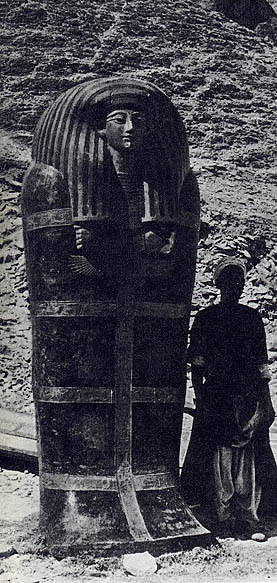
Walk on toward the end of the tomb, and the corridor opens into the burial chamber. At its centre stands a huge stone sarcophagus. This is the outer coffin that once held the king's body. It is far too large and heavy to carry out through the corridors, and that is one reason it is still here. Look at its size, and its smooth carved surfaces. Picture the workers who moved it into place, by hand, in the light of oil lamps.
Now tilt your head back. On the ceiling of the burial chamber, the goddess Nut stretches across the darkness. In Egyptian belief, Nut was the sky itself. Each evening she swallowed the sun, and each morning she gave birth to it again. Her long body arches over the room, and stars and texts cover the surface around her. For the king lying in his sarcophagus below, this ceiling was a promise. Just like the sun, he too would be reborn.
The king himself is no longer here. Like many royal tombs, this one was robbed in ancient times. Priests later gathered several royal mummies and hid them together to protect them. The mummy of Ramesses the Fourth was found in 1898, inside the tomb of another king, Amenhotep the Second, which is also in this valley. So the body and the tomb have been apart for a very long time.
Take a moment to notice how you are moving through the space. Modern floors and handrails protect the ancient surfaces. Electric light now does the job of the oil lamps. Because the tomb sits so close to the entrance of the valley, it is often busy, and voices echo along the corridors. If you can, wait for a quiet moment. Stand still and listen. Without the crowd, the tomb becomes very silent, and the scale of the place feels much larger.
As you walk back up toward the light, look again at those scratched Greek letters near the doorway. They are a reminder that you are part of a very long line of visitors. A pharaoh hoped this place would carry him into eternity. Strangers came to wonder at it, and later, people came to live in it. Now you are here too. When you step outside, feel the heat return to your skin, and look up at the pale cliffs above. Somewhere in that rock, the night journey of the sun goes on.
Key facts
What to look for
Practical tips
Common questions
Is there a free audio guide to KV2?
Yes — the Lokali app narrates KV2 free of charge in 50+ languages. The guide runs about 7 minutes, covers the history, what to look for on site and practical tips, and works offline once downloaded.
Where is KV2?
KV2 is near Luxor, Egypt, at 25.7415, 32.6023. Tap the map link on this page for directions from where you are.
What is KV2 known for?
Built for Ramesses the Fourth, a Twentieth Dynasty pharaoh. An ancient plan of the tomb survives in Turin.
What should you look for at KV2?
Scratched Greek graffiti on the walls near the entrance. Coptic inscriptions left by later Christian residents. The goddess Nut stretched across the burial chamber ceiling.
What should you know before visiting KV2?
Visit early, before tour groups fill the narrow corridors. Check which tombs your valley ticket covers at the gate.
When is the best time to visit KV2?
Visit early, before tour groups fill the narrow corridors.
On the map
Opens directions to KV2 from your location.
More to see in Luxor



Hear KV2 in your language
The full story, narrated, in 50+ languages. Download it before you go and it plays offline, at your own pace, with no ticket and no tour group.