
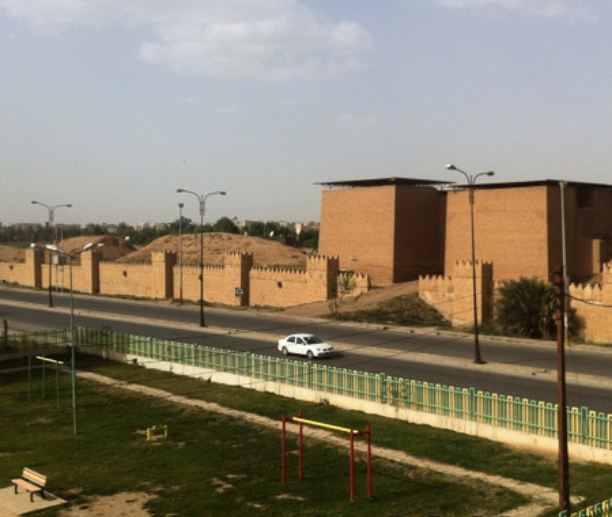
Photo: Roland Unger · CC BY-SA 3.0 · Wikimedia Commons
Al-Nabi Yunus Mosque is a mosque in Nineveh, Mosul. Yunus is the Arabic name for the prophet Jonah. The free Lokali audio guide runs 6 minutes.
✓ Published October 2026 · how we write these guides
Visitor facts
| Lokali audio guide | 6 min · free |
|---|---|
| Type | Mosque |
| Location | Mosul, Iraq |
| Coordinates | 36.3479, 43.1595 |
| Languages | 50+, in the Lokali app |
The story
Stand still for a moment and feel the slope under your feet. This is not natural ground. The hill you are standing on was built up by people, layer upon layer, over thousands of years. Below the dust, the broken stone, and the modern streets lies the floor of an ancient capital. The wind comes up from the Tigris River to the west, and on a clear day you can see across the water to the old city of Mosul.
This is the hill of Nabi Yunus, which means the Prophet Jonah. Yunus is simply the Arabic form of his name. For centuries, a mosque on this summit marked the place where local tradition holds that Jonah is buried. The mosque was one of the most visited holy sites in northern Iraq. Families came here to pray, to make vows, and to walk among the graves on the hillside.
To understand why this hill matters, you need to know what lies beneath it. You are on the eastern bank of the Tigris, inside the boundaries of ancient Nineveh. Nineveh was one of the great cities of the Assyrian Empire, which ruled much of the Middle East in the first millennium before the common era. Two large mounds rise from the ruins of the old city. One is called Kuyunjik. The other is the hill where you are now.
The story of Jonah connects three faiths. Jews, Christians, and Muslims all tell how God sent Jonah to warn the people of Nineveh. In the best-known version, Jonah tries to run away, is thrown into the sea, and is swallowed by a great fish. Later he reaches Nineveh, and the city repents. In the Quran, a whole chapter carries his name. That shared story is one reason this hill drew pilgrims of different backgrounds for so long.
The building that stood here had several lives. Before it became a mosque, the site is widely described as the place of a Christian church or monastery linked to the Church of the East, the ancient Christian community of Mesopotamia. Over the medieval centuries, it was converted to Muslim use and rebuilt many times. So the hill carries an Assyrian palace, a Christian sanctuary, and an Islamic shrine, stacked one above another like pages in a book.
Here is a detail that many visitors miss. Locals say that the old mosque once displayed a very large bone, described as part of a whale. According to popular tradition, it was linked to the great fish in Jonah's story. Whether that is true is a matter of faith, not of record. But the tale shows how closely the people of Mosul tied this place to the prophet, and how stories become part of a building.
For generations, the mosque's dome and minaret rose above the eastern side of the city. People crossing the river could see the shrine on its hill. Around it spread a large cemetery, because many families wanted their dead buried close to the prophet. Houses crowded up the lower slopes. The hill was never a quiet museum. It was a living neighbourhood, with children, traders, and worshippers moving through the same streets.
Then, in July 2014, that long continuity broke. The group known as the Islamic State, which had seized Mosul, blew up the shrine. They considered the veneration of tombs to be forbidden. Videos of the explosion spread around the world. For many people in Mosul, of every faith, the loss was personal. A place that had marked births, deaths, and prayers for centuries was reduced to rubble in seconds.
The second surprise came after the destruction. Eastern Mosul was retaken in early 2017. Archaeologists who entered the hill found that the militants had dug tunnels deep beneath the ruined shrine, probably searching for artefacts to sell. Inside those tunnels, specialists found walls of an Assyrian palace that had never been excavated. They documented carved stone, inscriptions, and sculpted figures. The destruction had opened a door to the past that pious tradition had kept closed.
That palace is linked to Assyrian kings of the seventh century before the common era, including Esarhaddon, whose name appears in inscriptions found at the site. It served as an arsenal and palace complex, a place to store weapons and review the army. Earlier explorers knew something important lay under the shrine, but the mosque and cemetery made proper digging impossible. Now experts must balance two duties: protecting the ancient remains below and respecting the sacred site above.
As you look around today, what you see depends on the stage of work when you visit. Clearing, conservation, and plans for rebuilding the shrine have all been discussed and carried out in phases since the city was freed. You may see fences, scaffolding, fresh stone, or open ground. Treat it all as a working site. Every patch of earth here may hold the remains of a palace, a church, or a grave.
Take a moment to look outward rather than down. To the north, the line of the old city walls of Nineveh once ran across this plain. To the west, the Tigris moves slowly between its banks. Beyond it, the old quarter of Mosul is slowly being rebuilt after the war. From up here, you can understand why kings, monks, and imams all chose this hill. It commands the river, the roads, and the horizon.
Before you walk away, listen to the sounds around you. Traffic, a call to prayer from a nearby mosque, voices from the houses below. These are the sounds of a city that has been destroyed and rebuilt more than once. Under your feet lies an Assyrian palace. Around you, a neighbourhood that lost its shrine and is working to recover it. Look back once as you go down the slope... and remember how many layers you have just walked across.
Key facts
What to look for
Practical tips
Common questions
Is there a free audio guide to Al-Nabi Yunus Mosque?
Yes — the Lokali app narrates Al-Nabi Yunus Mosque free of charge in 50+ languages. The guide runs about 6 minutes, covers the history, what to look for on site and practical tips, and works offline once downloaded.
Where is Al-Nabi Yunus Mosque?
Al-Nabi Yunus Mosque is in Mosul, Iraq, at 36.3479, 43.1595. Tap the map link on this page for directions from where you are.
What is Al-Nabi Yunus Mosque known for?
Yunus is the Arabic name for the prophet Jonah. The hill is one of two main mounds of Nineveh.
What should you look for at Al-Nabi Yunus Mosque?
The steep man-made slope of the ancient mound. Graves of the old cemetery on the hillside. Fresh stone or scaffolding marking rebuilding work.
What should you know before visiting Al-Nabi Yunus Mosque?
Dress modestly, as this remains a sacred site. Ask permission before photographing worshippers or graves.
On the map
Opens directions to Al-Nabi Yunus Mosque from your location.
More to see in Mosul



Hear Al-Nabi Yunus Mosque in your language
The full story, narrated, in 50+ languages. Download it before you go and it plays offline, at your own pace, with no ticket and no tour group.