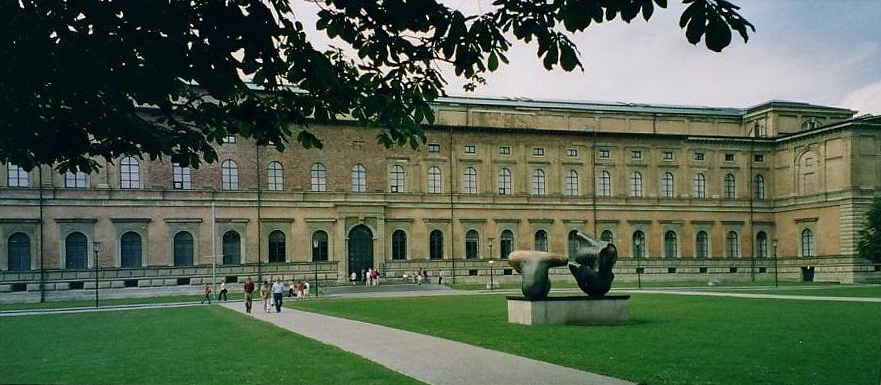
Photo: Markus Würfel · CC BY-SA 3.0 · Wikimedia Commons
Alte Pinakothek is an art museum in Munich, Germany. Commissioned by King Ludwig I of Bavaria. The free Lokali audio guide runs 8 minutes.
✓ Published October 2026 · how we write these guides
Visitor facts
| Lokali audio guide | 8 min · free |
|---|---|
| Type | Museum |
| Location | Munich, Germany |
| Coordinates | 48.1483, 11.5700 |
| Official website | pinakothek.de |
| Languages | 50+, in the Lokali app |
The story
Start on the grass outside. The lawns around this long building are wide and open, and on a mild day students sit here with books and coffee. Now look at the south wall. Most of it is pale, carefully dressed stone. But in places the stone stops, and plain, unplastered brick fills the gaps. Those patches look unfinished, almost raw. They are not a mistake. They are one of the most honest repairs in any museum in Europe, and we will come back to them.
The name sounds grand, but it is simple. Pinakothek comes from an old Greek word for a picture gallery. Alte means old in German. The word was added later, once a second gallery, the Neue Pinakothek, opened nearby in the middle of the nineteenth century. So this is the old picture gallery. It is also one of the oldest public painting galleries in the world, built when the idea of a museum open to ordinary citizens was still quite new.
The building was the project of King Ludwig I of Bavaria. Ludwig loved art, and he loved Italy even more. He wanted Munich to feel like a capital of culture, and he paid for museums, monuments, and whole new streets. His architect was Leo von Klenze. Construction began in 1826, and the gallery opened to the public in 1836. Klenze looked to the palaces of Renaissance Italy, the period of rebirth in art around the fifteenth and sixteenth centuries, for his model.
Klenze thought carefully about how people would see the paintings. Along the centre of the building he placed a row of large halls, lit from above through skylights. Big canvases could hang there in soft, even daylight. Along the north side he added a line of small rooms, called cabinets, for small paintings that need to be seen up close. This plan was copied by other museums. Many galleries built later followed the same idea of daylight from above.
Now, the brick. During the Second World War, bombs struck Munich again and again, and this building was badly hit. Large sections were burned out and open to the sky. Fortunately, the paintings had been moved away to safe storage before the worst raids. After the war, some people wanted to demolish the ruin. Others wanted a perfect copy of the old facade. The architect Hans Döllgast chose a third way. He rebuilt the walls with simple brick and left the wounds visible.
Döllgast did not try to hide the damage, and he did not try to fake the lost ornament. Where carved stone had been destroyed, he used plain brick and thin steel columns instead. The gallery reopened in the 1950s. At first, many visitors disliked the result. Today, architects often point to it as a model for repairing a damaged historic building. Stand back and you can read the line between the old work and the new work clearly.
Inside, Döllgast made another bold change. The original entrance route was lost, so he built a pair of long, straight staircases inside the space of the destroyed southern loggia, which was an open, covered gallery along the outside wall. As you climb, you walk along almost the full length of the building. The stairs are calm and plain, with light coming from the side. Many visitors rush up them. Try to slow down and notice how the space opens as you rise.
The collection grew from the paintings gathered by the Wittelsbach family, who ruled Bavaria for centuries. It covers European painting from roughly the fourteenth century to the eighteenth century. German, Dutch, Flemish, Italian, Spanish and French masters all hang here. Because princes collected what they personally liked, the collection has strong peaks. Flemish painting, especially, is unusually rich. You could spend a whole day here and still feel you had only walked the main corridors.
One painting stops almost everyone. It is Albrecht Dürer's self-portrait from the year 1500. Dürer faces you directly, with long curling hair and a fur-trimmed coat. At the time, a frontal pose like this was usually kept for images of Christ. Dürer was making a quiet, confident claim about the dignity of the artist. Come close and look at the fur on his sleeve. Each hair seems painted one at a time. Then look at the hand resting on the collar.
The largest room in the building belongs to Peter Paul Rubens, the great Flemish painter of the seventeenth century. Klenze designed this hall with one painting in mind, Rubens' Great Last Judgment. The canvas is roughly six metres tall. Bodies rise and fall across it in a huge spiral, some lifted toward heaven, some pulled down. Around it hang many more works by Rubens, from hunting scenes to tender portraits of his family. Few places hold so much of his work together.
Look out for Albrecht Altdorfer's Battle of Alexander at Issus, painted in 1529. It shows an ancient battle between Alexander the Great and the Persian king. Thousands of tiny soldiers fill the lower half, every lance and banner carefully drawn. Above them the sky curls, and you can see the curve of the earth, the sea, and distant mountains. The sun and moon face each other across the clouds. It feels less like a single battle and more like a view of the whole world.
The Italian rooms hold quieter surprises. There is an early Madonna by Leonardo da Vinci, the Madonna of the Carnation, painted when he was still young. There are works by Raphael and Titian. In the Dutch rooms you will find Rembrandt and the small, careful scenes of everyday life that Dutch buyers loved. Pieter Bruegel's Land of Cockaigne shows three men lying asleep, stuffed with food, under a table. It is a joke about laziness and greed.
Parts of the building are sometimes closed for conservation work, and paintings move between rooms. If a favourite piece is missing from its wall, ask a member of staff. It may be in another hall or on loan. The gallery also sits at the heart of a wider museum quarter. Modern art, design, and ancient sculpture are all within a short walk. Many visitors combine two museums in one day, with a rest on the lawns in between.
When you leave, walk once more along the south side. Look at the brick and stone sitting side by side. Inside are paintings made to last for centuries. Outside is a wall that shows how close they came to being lost. Notice the people on the grass, the trams in the distance, the light on the long facade. The building did not pretend the war never happened. It simply kept going... and so does the city around it.
Key facts
What to look for
Practical tips
Common questions
Is there a free audio guide to Alte Pinakothek?
Yes — the Lokali app narrates Alte Pinakothek free of charge in 50+ languages. The guide runs about 8 minutes, covers the history, what to look for on site and practical tips, and works offline once downloaded.
Where is Alte Pinakothek?
Alte Pinakothek is in Munich, Germany, at 48.1483, 11.5700. Tap the map link on this page for directions from where you are.
What is Alte Pinakothek known for?
Commissioned by King Ludwig I of Bavaria. Designed by architect Leo von Klenze.
What should you look for at Alte Pinakothek?
Plain brick patches filling bomb damage on the south wall. Hand-painted fur hairs on Dürer's 1500 self-portrait sleeve. The curving earth and sky in Altdorfer's battle scene.
What should you know before visiting Alte Pinakothek?
Climb Döllgast's long staircase slowly to enjoy the space. Ask staff if a painting is missing from its wall.
On the map
Opens directions to Alte Pinakothek from your location.
More to see in Munich


Hear Alte Pinakothek in your language
The full story, narrated, in 50+ languages. Download it before you go and it plays offline, at your own pace, with no ticket and no tour group.