
Photo: Rufus46 · CC BY-SA 3.0 · Wikimedia Commons
Pinakothek der Moderne is an art museum in Munich, Germany. Opened in 2002, designed by architect Stephan Braunfels. The free Lokali audio guide runs 7 minutes.
✓ Published October 2026 · how we write these guides
Visitor facts
| Lokali audio guide | 7 min · free |
|---|---|
| Type | Museum |
| Location | Munich, Germany |
| Coordinates | 48.1472, 11.5723 |
| Official website | pinakothek-der-moderne.de |
| Languages | 50+, in the Lokali app |
The story
Listen for a moment. Footsteps echo upward, soften, and disappear somewhere high above you. You are standing in a great white rotunda, and the light falls from a glass dome overhead. It moves across smooth concrete walls without a single painting on them. Voices carry here in a strange, gentle way. Children notice it first. Adults usually notice it a few seconds later, when they look up. This is the heart of the Pinakothek der Moderne, and the building wants you to pause here.
The museum opened in 2002, and it was designed by the German architect Stephan Braunfels. Munich waited a long time for it. The city already had two famous picture galleries next door, the Alte Pinakothek for old masters and the Neue Pinakothek for the nineteenth century. What the city lacked was a proper home for the twentieth century and beyond. This building answered that need. Its name follows the family pattern. "Pinakothek" comes from an ancient Greek word for a picture gallery.
Here is the first surprise. This is not one museum. It is four museums under one roof. One collection shows modern and contemporary art. Another, Die Neue Sammlung, focuses on design. A third is the architecture museum of the Technical University of Munich. The fourth is the state collection of prints and drawings. Few buildings anywhere bring painting, design, architecture, and works on paper together like this. The rotunda is the point where all four meet.
Look around the rotunda again. Wide corridors and staircases lead away from it in different directions, like the spokes of a wheel. Braunfels used this centre so visitors never feel lost for long. You can always return to the light. The materials are calm and simple. There is pale concrete, white plaster, glass, and stone floors. The architect kept the surfaces quiet on purpose. The idea is simple. In a museum of modern art, the building should not compete with the work.
Notice the grand staircase as you move toward the upper floors. It is broad and gently angled, and it rises toward the galleries in long, steady runs. Many visitors stop halfway up and look back down. From there, the rotunda becomes a shape of light and shadow. People below look small. It is one of the most photographed views inside the building. The staircase turns the act of climbing into part of the visit.
Upstairs, the painting and sculpture collection begins. It covers the major movements of the twentieth century. You can meet German Expressionism, with its strong colours and rough brushwork. You can also find Cubism and Surrealism, and later, Pop Art and contemporary work. Artists such as Pablo Picasso, Wassily Kandinsky, and Andy Warhol appear in the collection. The displays change over time, so the rooms you see today may differ from what a friend saw last year.
One painter has a special place here. Max Beckmann was a German artist who worked through the turmoil of the early twentieth century. The museum holds an important group of his works, including large triptychs. A triptych is a painting in three panels, a form once used for church altarpieces. Beckmann used it for crowded, dreamlike scenes of modern life. Stand close and look at the heavy black outlines. Then step back and see how the three panels speak to one another.
The collection also gives serious space to Joseph Beuys, one of the most influential German artists after the Second World War. Beuys worked with unusual materials, such as felt, fat, and everyday objects. His rooms can puzzle first-time visitors. That reaction is normal. Beuys wanted people to think about art as something closer to life, healing, and society. Take your time in these rooms. Read the wall texts. The objects make more sense when you know the ideas behind them.
Now for the second surprise. Go down to the lower level and enter Die Neue Sammlung, the design collection. Its roots go back to the 1920s, which makes it one of the oldest design museums of its kind. Here, everyday objects become the art. You may see chairs, lamps, typewriters, computers, and household tools. You may also see cars and motorbikes. Many visitors arrive for the paintings and leave talking about a chair.
The design rooms ask a quiet question. Why does one object feel elegant and another feel clumsy? Walk slowly past the shelves and look at the curves, the joints, and the materials. Plastic, steel, bent wood, and glass all appear here. Many of these objects were once ordinary. Perhaps your grandparents owned something similar. Seeing them in a museum changes them. The familiar becomes strange for a moment, and you begin to look more carefully.
The architecture museum and the prints and drawings collection usually work through changing exhibitions. Architecture is difficult to put in a gallery, because buildings do not fit indoors. So this museum shows drawings, plans, photographs, and models. The prints and drawings collection is very large, but works on paper are sensitive to light. For that reason, only a small part is shown at any time. Check what is on during your visit. These rooms often hold the quietest discoveries in the building.
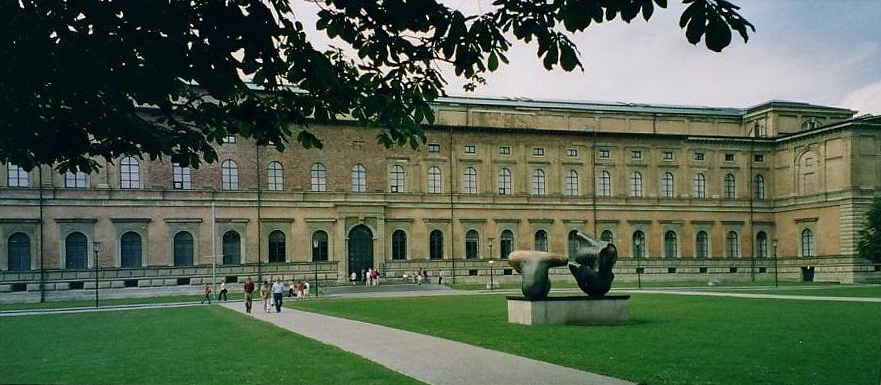
When you step outside, look at the whole building from the lawn. Its long, clean lines and tall columns stand in clear contrast to the older stone museums nearby. This district is called the Kunstareal, which means "art area". It is part of the Maxvorstadt neighbourhood, close to the university. Within a short walk, you can find several other museums and galleries. Students cross the paths on bicycles. On warm days, people sit on the grass with coffee and books.
Before you leave, return to the rotunda one last time, if you can. Stand in the centre and look up at the dome. The light will have shifted a little since you arrived. Listen again to the footsteps and the soft voices around you. Then walk out slowly, and look at the street with fresh eyes. Notice the shape of a lamp, the line of a bench, the design of a passing tram. The museum does not really end at the door.
Key facts
What to look for
Practical tips
Common questions
Is there a free audio guide to Pinakothek der Moderne?
Yes — the Lokali app narrates Pinakothek der Moderne free of charge in 50+ languages. The guide runs about 7 minutes, covers the history, what to look for on site and practical tips, and works offline once downloaded.
Where is Pinakothek der Moderne?
Pinakothek der Moderne is in Munich, Germany, at 48.1472, 11.5723. Tap the map link on this page for directions from where you are.
What is Pinakothek der Moderne known for?
Opened in 2002, designed by architect Stephan Braunfels. Four separate museums share one building.
What should you look for at Pinakothek der Moderne?
Glass dome lighting the empty white rotunda walls. Beckmann's three-panel paintings with heavy black outlines. Felt and everyday materials in the Joseph Beuys rooms.
What should you know before visiting Pinakothek der Moderne?
Start in the rotunda to get your bearings. Check current temporary exhibitions before planning your route.
On the map
Opens directions to Pinakothek der Moderne from your location.
More to see in Munich


Hear Pinakothek der Moderne in your language
The full story, narrated, in 50+ languages. Download it before you go and it plays offline, at your own pace, with no ticket and no tour group.