
Staatliche Antikensammlungen
48.1452° N · 11.5649° E · Museum
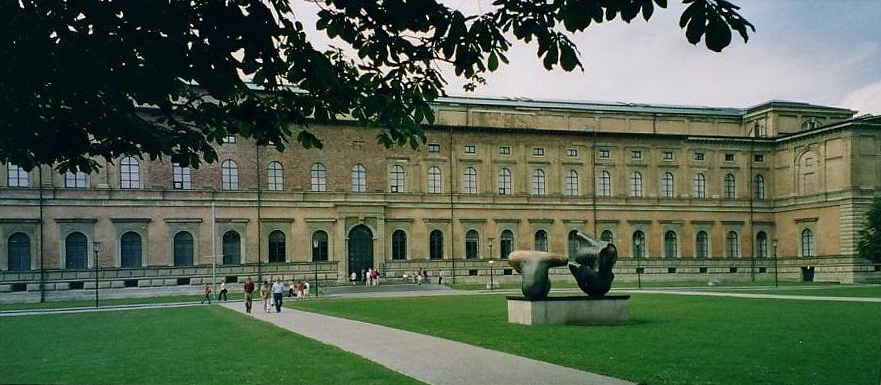
Photo: Burkhard Mücke · CC BY-SA 4.0 · Wikimedia Commons
Staatliche Antikensammlungen is a collection of graeco-roman antiquities in Munich. Designed by architect Georg Friedrich Ziebland for King Ludwig I. The free Lokali audio guide runs 6 minutes.
✓ Published October 2026 · how we write these guides
Visitor facts
| Lokali audio guide | 6 min · free |
|---|---|
| Type | Museum |
| Location | Munich, Germany |
| Coordinates | 48.1452, 11.5649 |
| Official website | antike-am-koenigsplatz.mwn.de |
| Languages | 50+, in the Lokali app |
The story
Stand for a moment at the foot of the steps. Feel the weight of the pale stone under your shoes. Above you, tall columns rise toward a triangular pediment, and behind you the wide lawns of Königsplatz stretch out in green and gravel. Traffic hums somewhere beyond the trees. Here the city goes quiet. You are standing at the door of the State Collections of Antiquities, one of the great homes of ancient Greek pottery anywhere in the world.
This building is one third of a single grand idea. In the early nineteenth century, King Ludwig the First of Bavaria wanted Munich to become a new Athens. He loved ancient Greece with real passion. He gathered sculpture, vases and bronzes, and he wanted temples to hold them. So he planned this square as an open-air stage of classical architecture. Each building would speak in the language of the ancient world.
Look across the lawn. Directly opposite stands the Glyptothek, the sculpture museum designed by Leo von Klenze. Its columns follow the Ionic order — slender, with scroll-shaped tops. Now look up at the columns above you. These are Corinthian, crowned with carved acanthus leaves. And to the west, the great gateway called the Propyläen uses the plain, heavy Doric order. Three buildings, three classical styles. The square works like a lesson in Greek architecture, carried out in stone.
The architect of this building was Georg Friedrich Ziebland. It was completed in the late 1840s. Here is the first surprise. It was not built for ancient vases at all. Originally it served as an exhibition hall for art and industry. Only much later, after the destruction and rebuilding of the twentieth century, did it become the home of this collection. The museum in its present form opened in the 1960s.
The square itself has a darker chapter. In the 1930s, the Nazi regime paved over these lawns with granite slabs. They turned Königsplatz into a parade ground for marches and rallies. The party also built offices nearby. After the war, the stone slabs stayed for decades. Then, in the late 1980s, the city removed them and brought back the grass. So the green you see today is not only pleasant. It is a deliberate act of recovery.
Now step inside. The halls are calm and evenly lit. Glass cases run along the walls, filled with pottery in black and orange. Most of these vessels were made in ancient Greece, many in Athens, more than two thousand years ago. They held wine, water, oil and perfume. People used them at feasts, in temples and at funerals. Take your time here. Each vase is a small object, but each one holds a whole scene.
Learn the two main styles, and the rooms will open up for you. In the older black-figure style, painters drew figures in black glaze on the orange clay. Then they scratched fine details through the black with a sharp point. Later, around the late sixth century before Christ, painters reversed the method. In red-figure painting, the background is black and the figures keep the colour of the clay. That change let artists paint softer lines, flowing hair and moving bodies.
One object draws visitors more than any other. It is a wide, shallow drinking cup by the Athenian potter and painter Exekias, one of the masters of black-figure work. Inside the cup, the god Dionysus lies in a ship. A grapevine grows up from the mast, heavy with fruit. Dolphins leap around the hull. The story behind it is a myth: pirates seized the god, and he turned them into dolphins. When a drinker emptied this cup, the scene appeared under the wine.
Here is the second surprise. Many of the finest Greek vases in this collection were not found in Greece. They came from tombs in Italy, especially Etruscan graves. The Etruscans were a powerful people of central Italy before the rise of Rome. They admired Athenian pottery and imported it in large numbers. Then they buried it with their dead. Because of those tombs, many fragile vessels survived the centuries almost whole.
The Etruscans have their own place in these rooms too. Look for their gold jewellery. Some pieces carry tiny grains of gold fused onto the surface, a technique called granulation. The grains are so small that they look like fine dust or sand. Ancient goldsmiths did this work without magnifying glass. Lean close to the case. You will see patterns of dots, spirals and minute figures, all built from metal smaller than a pinhead.
The collection reaches beyond Greece and Etruria. You will also find bronze figures, Roman glass, terracotta statuettes and small household objects. The glass is worth a slow look. Some pieces show colours that shift as you move — a soft rainbow sheen on the surface. That shine comes from centuries in the ground, where the glass slowly changed. The bronzes, meanwhile, show the green and brown of age, with tool marks still visible in places.
As you walk, notice the scale of daily life. Many objects here are modest. A perfume flask fits in a palm. A child's toy, a lamp, a small weight. These pieces make the ancient world feel close. Someone shaped this clay with their hands. Someone poured oil from that jug. The great myths on the vases sit side by side with the ordinary habits of people who ate, drank, worked and grieved.
When you leave, pause again on the steps. Look out over Königsplatz. The Glyptothek faces you with its Ionic columns. The Propyläen stands to your left as you face the square, its gate open to the sky. Students cross the grass. Bicycles tick past on the paths. The square that one king built as a dream of Athens, and that a dictatorship turned to stone, is green and open again. Take a breath here before you walk on.
Key facts
What to look for
Practical tips
Common questions
Is there a free audio guide to Staatliche Antikensammlungen?
Yes — the Lokali app narrates Staatliche Antikensammlungen free of charge in 50+ languages. The guide runs about 6 minutes, covers the history, what to look for on site and practical tips, and works offline once downloaded.
Where is Staatliche Antikensammlungen?
Staatliche Antikensammlungen is in Munich, Germany, at 48.1452, 11.5649. Tap the map link on this page for directions from where you are.
What is Staatliche Antikensammlungen known for?
Designed by architect Georg Friedrich Ziebland for King Ludwig I. Building completed in the late 1840s on Königsplatz.
What should you look for at Staatliche Antikensammlungen?
Corinthian acanthus-leaf capitals on the entrance columns. Dolphins circling the ship inside the Exekias cup. Scratched fine lines in black-figure painted details.
What should you know before visiting Staatliche Antikensammlungen?
Pair your visit with the Glyptothek directly across the square. Learn black-figure versus red-figure before entering the vase rooms.
On the map
Opens directions to Staatliche Antikensammlungen from your location.
More to see in Munich



Hear Staatliche Antikensammlungen in your language
The full story, narrated, in 50+ languages. Download it before you go and it plays offline, at your own pace, with no ticket and no tour group.