
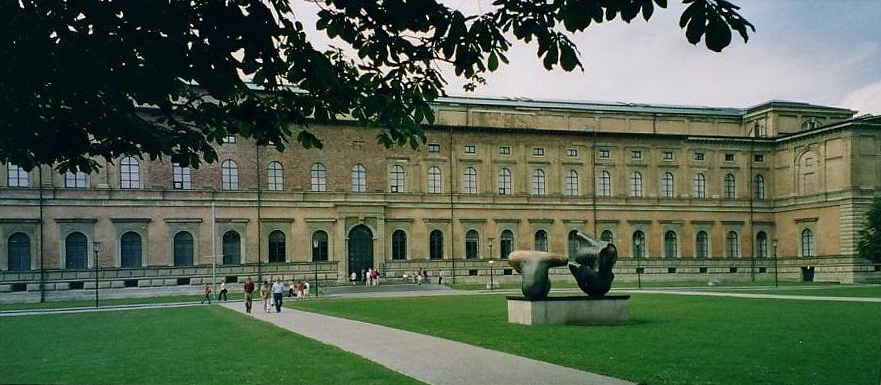
Photo: Burkhard Mücke · CC BY-SA 4.0 · Wikimedia Commons
Glyptothek is an archaeological museum in Munich. Commissioned by Crown Prince Ludwig, later King Ludwig the First. The free Lokali audio guide runs 7 minutes.
✓ Published October 2026 · how we write these guides
Visitor facts
| Lokali audio guide | 7 min · free |
|---|---|
| Type | Museum |
| Location | Munich, Germany |
| Coordinates | 48.1466, 11.5658 |
| Official website | antike-am-koenigsplatz.mwn.de |
| Languages | 50+, in the Lokali app |
The story
Start at the bottom of the steps. Feel how the pale stone of the portico stays cool, even on a warm Munich afternoon. Behind you, trams hum along the avenue. In front of you, eight tall columns rise in a quiet line, and the wide lawn of Königsplatz lies open on every side. The air here feels different from the old town. There is more sky and more space. The sounds of the city reach you softly, as if from far away.
The building in front of you is the Glyptothek, a museum made for one purpose: ancient sculpture. The name comes from two Greek words. One means to carve, and the other means a place where things are stored. So the name means, quite simply, a house for carved stone. The museum is often called the oldest public museum in Munich. It holds Greek and Roman sculpture, and it was designed to do nothing else.
The idea came from one man with a powerful obsession. Crown Prince Ludwig of Bavaria, who later became King Ludwig the First, loved ancient Greece. He wanted Munich to become a new Athens on the river Isar. He hired the architect Leo von Klenze, and building work began in 1816. The museum opened around 1830. For Ludwig, this was not only a gallery. It was a statement about what kind of city Munich could become.
Look at the front again. Klenze used the Ionic order here. That is the Greek style where each column ends in a scroll at the top, like a rolled sheet of paper. Above the columns sits a triangular pediment filled with sculpted figures. Along the side walls, statues stand in tall niches. Notice something unusual — the long side walls have no windows at all. The galleries take their light from the inner courtyard, so the outside stays calm and closed, like a temple.
Now, the first surprise. Ludwig bought many of his most famous pieces before this building even existed. In 1812, his agents bought a set of marble figures that had been found on the Greek island of Aegina. They came from the Temple of Aphaia, a goddess worshipped on that island. Ludwig won the sale against strong competition from other European collectors. The museum was, in a real sense, built around a collection he had already decided to own.
Inside, those Aegina figures are one of the main reasons to visit. They once filled the two pediments of the temple, the triangles at each end of the roof. They show warriors fighting in the Trojan War. Look closely at the faces. Some warriors wear a small, fixed smile, even while they fall wounded. Scholars call this the archaic smile, a style from early Greek art. Other figures look more natural and more serious. You can see Greek sculpture changing in a single group of stone.
The second surprise is about those statues and their repairs. When the Aegina figures arrived, many were broken. The Danish sculptor Bertel Thorvaldsen was asked to restore them, and he added new arms, legs and heads in marble. For many years, visitors saw his additions as part of the originals. In the twentieth century, the museum decided to remove most of these additions. So the figures you see today are more broken, but they are also more honest.
Then there is the statue many people come to see first: the Barberini Faun. A faun is a wild spirit of the woods from Greek myth, half human and full of appetite. This one lies back on a rock, asleep, one arm thrown over his head. He looks tired, maybe drunk, completely relaxed. The statue was found in Rome and owned for a long time by the powerful Barberini family. It is a Hellenistic work, from the later age of Greek art, when sculptors loved strong emotion and real bodies.
Walk around the faun if you can. From the front, he looks heavy and calm. From the side, you see the twist of his body and the strain in his legs. Many visitors find the statue surprisingly intimate. It does not show a god or a hero. It shows a body at rest, open and unguarded. That feeling is very modern, even though the stone is more than two thousand years old.
Now look at the walls themselves. You will see bare brick and plain surfaces, not painted decoration. This was not the original plan. The museum once had richly painted ceilings and walls. During the Second World War, bombing badly damaged the building, and the paintings were lost. When the Glyptothek reopened in the early 1970s, the decision was to leave much of the brick visible. Today the sculptures stand against simple, warm walls, and many visitors think this suits them better.
The square outside also carries a difficult past. In the 1930s, the Nazi regime used Königsplatz for mass rallies. The grass was replaced by large stone slabs, so crowds could march across it. Party buildings stood at the eastern edge of the square. After the war, the slabs stayed for decades. In the late 1980s, the city removed them and brought back the lawn. So the open green space you see today is also a quiet act of repair.
Königsplatz was planned as one complete design. Across the square stands another classical building, the State Collections of Antiquities, which holds smaller ancient objects like vases and jewellery. To the west rises the Propyläen, a huge stone gateway inspired by the entrance to the Acropolis in Athens. Together, the three buildings show Ludwig's dream at full scale. Stand in the middle of the lawn and you can see the whole plan at once.
Before you leave, find the inner courtyard if it is open. It is a calm space, surrounded by the museum walls, with tables where people sit with a coffee in summer. The noise of the city almost disappears. You are sitting in the middle of a building made for marble gods and sleeping fauns, and yet it feels ordinary and human. That is part of the pleasure here.
When you step back outside, look once more at the columns and the pale stone. Listen for the trams and the bicycles passing on the edge of the square. Then look at the green lawn, where people sit, read and talk. A king built this place to bring ancient Greece to Munich. Today it simply belongs to the city, and to anyone who stops here for a moment.
Key facts
What to look for
Practical tips
Common questions
Is there a free audio guide to Glyptothek?
Yes — the Lokali app narrates Glyptothek free of charge in 50+ languages. The guide runs about 7 minutes, covers the history, what to look for on site and practical tips, and works offline once downloaded.
Where is Glyptothek?
Glyptothek is in Munich, Germany, at 48.1466, 11.5658. Tap the map link on this page for directions from where you are.
What is Glyptothek known for?
Commissioned by Crown Prince Ludwig, later King Ludwig the First. Designed by architect Leo von Klenze.
What should you look for at Glyptothek?
Scroll-topped Ionic columns across the main portico. Windowless side walls with statues set in niches. Archaic smiles on the faces of fallen Aegina warriors.
What should you know before visiting Glyptothek?
Visit the Aegina figures early, before the galleries fill. Walk fully around the Barberini Faun to see its twist.
When is the best time to visit Glyptothek?
Visit the Aegina figures early, before the galleries fill.
On the map
Opens directions to Glyptothek from your location.
More to see in Munich



Hear Glyptothek in your language
The full story, narrated, in 50+ languages. Download it before you go and it plays offline, at your own pace, with no ticket and no tour group.