
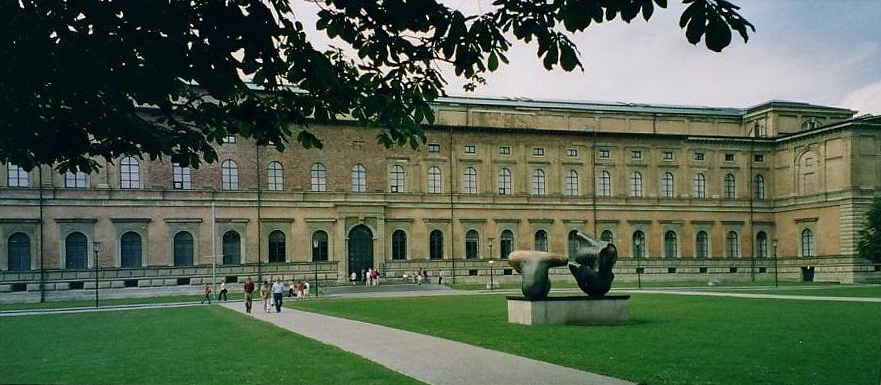
Photo: Burkhard Mücke · CC BY-SA 4.0 · Wikimedia Commons
Lenbachhaus is an art museum in Munich, Germany. Villa built for painter Franz von Lenbach in the late 1880s. The free Lokali audio guide runs 7 minutes.
✓ Published October 2026 · how we write these guides
Visitor facts
| Lokali audio guide | 7 min · free |
|---|---|
| Type | Museum |
| Location | Munich, Germany |
| Coordinates | 48.1469, 11.5636 |
| Official website | lenbachhaus.de |
| Languages | 50+, in the Lokali app |
The story
Listen first to the gravel. It crunches softly underfoot in the garden. Just beyond the trees, Munich's traffic hums around Königsplatz. In front of you stands a villa painted a warm ochre yellow, with shuttered windows, terraces and the calm lines of an Italian country house. Beside it rises something very different, a modern block wrapped in vertical metal tubes that catch the light like brushed gold. Two centuries of taste stand side by side here. Welcome to the Lenbachhaus.
The house began as a private dream. It was built for Franz von Lenbach, the most celebrated portrait painter in late nineteenth century Munich. Lenbach painted chancellors, kings, popes and the wealthy families of his age. Germans called him a painter prince, and he lived like one. In the late 1880s he commissioned the architect Gabriel von Seidl to design this villa. Seidl gave him an Italian Renaissance fantasy in the heart of Bavaria, with a studio, living quarters and a formal garden.
Stand back and look at the older building again. The proportions, the loggias and the warm plaster all point south, toward Florence and Rome. This was deliberate. Lenbach had copied old Italian masters early in his career, and he wanted his home to look like the world he admired. In his time, an artist's house was also a stage. Clients came here to sit for portraits. They walked through rooms full of antiques, and they left believing they had been painted by a modern Titian.
After Lenbach's death, the villa passed to his widow. In 1924 the City of Munich bought the property, and a few years later it opened as the municipal art gallery. Its full name is still the Städtische Galerie im Lenbachhaus, which simply means the City Gallery in the Lenbach House. For a while the museum focused on Munich painting. Then, in the 1950s, a single gift changed everything. It turned a local gallery into one of the most important collections of modern art in the world.
The gift came from Gabriele Münter, a painter who had been the partner of Wassily Kandinsky. Before the First World War, the two lived and worked together, partly in Munich and partly in the small market town of Murnau, south of the city. When war broke out in 1914, Kandinsky, a Russian citizen, had to leave Germany. He never came back to Münter. Many of his paintings, along with her own, stayed behind in her care.
Here is the first surprise most visitors miss. During the Nazi years, this kind of art was condemned as degenerate. Works like these were mocked, confiscated, sold off or destroyed. Münter kept hers hidden in her house in Murnau, out of sight. The paintings survived the war in the dark. In 1957, on her eightieth birthday, she gave this huge collection to the city. It included hundreds of works by Kandinsky, many of her own paintings, and pieces by their friends.
Those friends belonged to a circle called the Blue Rider, or Der Blaue Reiter in German. It was not a strict school. It was a loose group of artists who met in Munich before the First World War. In 1912 they published an almanac, a book of essays and images, under that name. Kandinsky and Franz Marc were its leaders. Around them stood August Macke, Alexej von Jawlensky, Marianne von Werefkin, Paul Klee and Münter herself.
What united them was a belief that colour could carry feeling directly, without needing to copy the world exactly. In these galleries you will see that idea unfold. Look at Münter's Murnau landscapes, with flat areas of colour and dark outlines. Then find Kandinsky's work and watch the hills, churches and riders slowly dissolve into pure colour and line. Within a few years he moved toward abstraction, painting that shows no recognisable object at all. Much of that journey hangs in these rooms.
Franz Marc deserves a slow look. He painted animals, and especially horses, as symbols of a purer, more spiritual world. His blue horses are among the best-loved images in the museum. Notice that the blue is not a decorative choice. For Marc, colours had meanings, and blue stood for something spiritual and calm. Here is a sad note. Both Marc and Macke died as soldiers in the First World War. The Blue Rider ended almost as soon as it had begun.
The Lenbachhaus does not stop in 1914. It also collects art from after 1945, and the museum is well known for its works by Joseph Beuys, the German artist who used felt, fat and everyday objects to talk about healing and memory. When the city bought one of his large installations around the end of the 1970s, it caused public debate. People argued about whether this was art at all, and whether a city should pay for it. Today it is part of the collection.
Now return to the building around you. In the early 2010s the museum was renovated and extended by the British practice Foster and Partners, and it reopened in 2013. That is the source of the metal-clad wing you saw outside. Inside, look up in the central atrium. A large hanging light sculpture by the artist Olafur Eliasson turns above the space, made of coloured glass and mirrored rings. Its reflections slide across the walls and change as you move beneath it.
Here is the second surprise. The museum has another exhibition space you might walk past without noticing. It is called the Kunstbau, which means art building, and it sits underground at the nearby Königsplatz underground station. It is a long, open hall built into the space above the platforms. Temporary exhibitions often appear there. So part of the Lenbachhaus lies beneath the square outside, above the trains that carry commuters across the city.
Before you leave, step into the villa rooms once more, or walk out into the garden. Notice the change in scale. The old house was made for one famous man and his guests. The new galleries were made for everyone. Listen again to the gravel and the city traffic. Look at the yellow walls beside the gold-coloured metal. A painter prince built this house to show the past, and today it holds the art that broke with the past. Both stories stay here, side by side.
Key facts
What to look for
Practical tips
Common questions
Is there a free audio guide to Lenbachhaus?
Yes — the Lokali app narrates Lenbachhaus free of charge in 50+ languages. The guide runs about 7 minutes, covers the history, what to look for on site and practical tips, and works offline once downloaded.
Where is Lenbachhaus?
Lenbachhaus is in Munich, Germany, at 48.1469, 11.5636. Tap the map link on this page for directions from where you are.
What is Lenbachhaus known for?
Villa built for painter Franz von Lenbach in the late 1880s. Architect Gabriel von Seidl designed the original Italianate villa.
What should you look for at Lenbachhaus?
Ochre-yellow villa walls beside gold-toned metal tube cladding. Olafur Eliasson's coloured glass light sculpture in the atrium. Franz Marc's blue horses in the Blue Rider galleries.
What should you know before visiting Lenbachhaus?
Start with the Blue Rider rooms before fatigue sets in. Visit the Kunstbau gallery at Königsplatz underground station too.
On the map
Opens directions to Lenbachhaus from your location.
More to see in Munich



Hear Lenbachhaus in your language
The full story, narrated, in 50+ languages. Download it before you go and it plays offline, at your own pace, with no ticket and no tour group.