
Photo: Bärwinkel,Klaus · CC BY 3.0 · Wikimedia Commons
Neue Pinakothek is an art museum in Munich, Germany. Founded by King Ludwig the First of Bavaria. The free Lokali audio guide runs 6 minutes.
✓ Published October 2026 · how we write these guides
Visitor facts
| Lokali audio guide | 6 min · free |
|---|---|
| Type | Museum |
| Location | Munich, Germany |
| Coordinates | 48.1499, 11.5711 |
| Official website | pinakothek.de |
| Languages | 50+, in the Lokali app |
The story
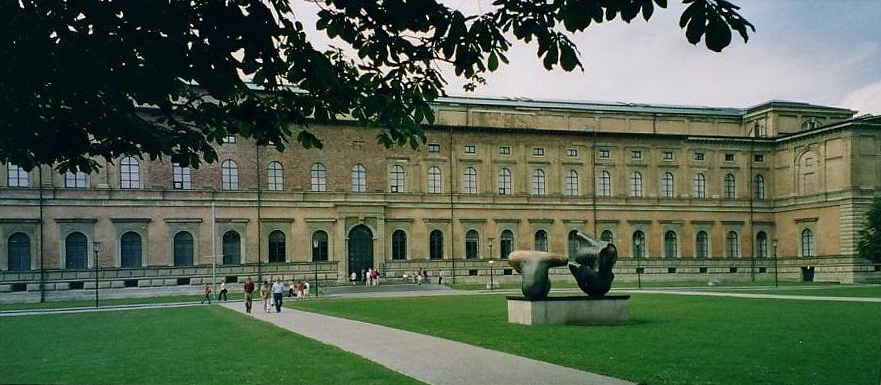
Stand on the lawn here for a moment and listen. The traffic of Maxvorstadt hums along the streets, bicycles tick past, and somewhere a tram bell rings. In front of you sits a long, low building of pale stone, with heavy arched forms and terraces stepping down toward the grass. It does not shout for attention. It feels more like a fortress built to protect something fragile... and in a sense, that is exactly what it is.
This is the Neue Pinakothek, the New Picture Gallery of Munich. Its name answers its neighbour across the lawn, the Alte Pinakothek, the Old Picture Gallery. Together with several other museums nearby, they form what Munich calls the Kunstareal, the art quarter. Within a few minutes' walk you can move from Renaissance altarpieces to modern design. This building was always meant to hold the middle chapter: European art of the eighteenth and nineteenth centuries.
The idea came from King Ludwig the First of Bavaria, a ruler who spent much of his energy and fortune on art and architecture. He had already given the city its gallery of Old Masters. Then he did something unusual for his time. He founded a museum for the art of his own century — paintings by living artists, or artists only recently gone. Today we take museums of contemporary art for granted. In the mid-nineteenth century, it was a bold idea.
The first building opened in the 1850s. Its outer walls carried large painted scenes by the artist Wilhelm von Kaulbach, which showed Ludwig's support for the arts of his day. It was a museum that told its own story on its façade. But painted walls do not survive Munich winters well, and the colours faded. Then the twentieth century brought something far worse than weather.
During the Second World War, bombing raids hit Munich hard, and the old gallery was badly damaged. The paintings themselves had been moved to safety, but the building was lost. After the war, the ruins were cleared. For years, the collection had no proper home of its own. Parts of it were shown in other buildings while the city decided what to do.
The answer is the building in front of you. It was designed by the architect Alexander von Branca and opened in 1981. Look at how it sits on the site. Instead of one grand palace front, the building breaks into smaller blocks, ramps and terraces. The arched shapes nod to traditional Munich architecture, but the overall form is clearly of its own era. Some people love it. Others find it heavy. Either way, it is worth a slow walk around.
Here is an important practical point. For several years now, this building has been closed for a major renovation. Much of the technical system inside needed renewal after decades of use. While the work continues, a selection of the most important paintings has been shown in the Alte Pinakothek across the lawn, and some works in the nearby Sammlung Schack. So before you plan your visit, check the current status. You may find these pictures next door.
So what is in this collection? Think of a journey from the late eighteenth century to the early twentieth. You meet English portraits and landscapes, with names like Gainsborough and Turner. You meet the Spanish painter Goya. You meet German Romantic painters, among them Caspar David Friedrich, famous for lonely figures and wide, quiet landscapes. These are pictures of mountains, mists and ruins, painted at a time when Europe was rethinking its relationship with nature.
Then the light changes. The collection holds major works of French Impressionism and the generation after it. Édouard Manet's painting known as Luncheon in the Studio is here — a young man leans against a table, looking out of the canvas as if he is bored with us. There are works by Claude Monet, and by Paul Cézanne. And there is one of Vincent van Gogh's famous paintings of sunflowers, one of several versions he made.
Here is a detail many visitors miss. Van Gogh did not paint just one sunflower picture. He painted a whole series, and today the versions are spread across several countries. The Munich canvas is one of the finest. If you have seen another version in London or Amsterdam, it is worth comparing them in your memory. The flowers, the background and the mood are all slightly different. He was experimenting, not repeating himself.
The collection also reaches toward Vienna around 1900. Gustav Klimt, the Austrian painter known for gold and ornament, is represented here too. That gives the collection a natural finishing line. It begins with powdered wigs and English parks, and it ends at the edge of modern art. Walk the lawn to the Pinakothek der Moderne nearby, and the story continues straight into the twentieth century.
There is a second surprise in the name itself. Pinakothek is not a German word at all. It comes from ancient Greek and means a place for keeping pictures. Ludwig the First loved classical Greece, and he filled Munich with Greek names and Greek forms. Just a short walk away is Königsplatz, a square lined with buildings in the style of ancient temples. Even this modern gallery carries that old Greek word on its doors.
Before you leave, look back at the building once more. Notice how the trees and the open lawn soften its weight, and how people use this space — students reading on the grass, children running between the museums, cyclists cutting across the paths. Whether the doors are open or the scaffolding is still up, this ground has held a gallery of living art for well over a century. As you walk on, the paintings are never far away... just across the grass, waiting in the next room.
Key facts
What to look for
Practical tips
Common questions
Is there a free audio guide to Neue Pinakothek?
Yes — the Lokali app narrates Neue Pinakothek free of charge in 50+ languages. The guide runs about 6 minutes, covers the history, what to look for on site and practical tips, and works offline once downloaded.
Where is Neue Pinakothek?
Neue Pinakothek is in Munich, Germany, at 48.1499, 11.5711. Tap the map link on this page for directions from where you are.
What is Neue Pinakothek known for?
Founded by King Ludwig the First of Bavaria. Original gallery opened in the 1850s.
What should you look for at Neue Pinakothek?
Heavy arched forms along the stone façade. Terraces stepping down toward the open lawn. Alte Pinakothek facing across the grass.
What should you know before visiting Neue Pinakothek?
Check renovation status before planning your visit. Look for key works in the Alte Pinakothek.
On the map
Opens directions to Neue Pinakothek from your location.
More to see in Munich


Hear Neue Pinakothek in your language
The full story, narrated, in 50+ languages. Download it before you go and it plays offline, at your own pace, with no ticket and no tour group.