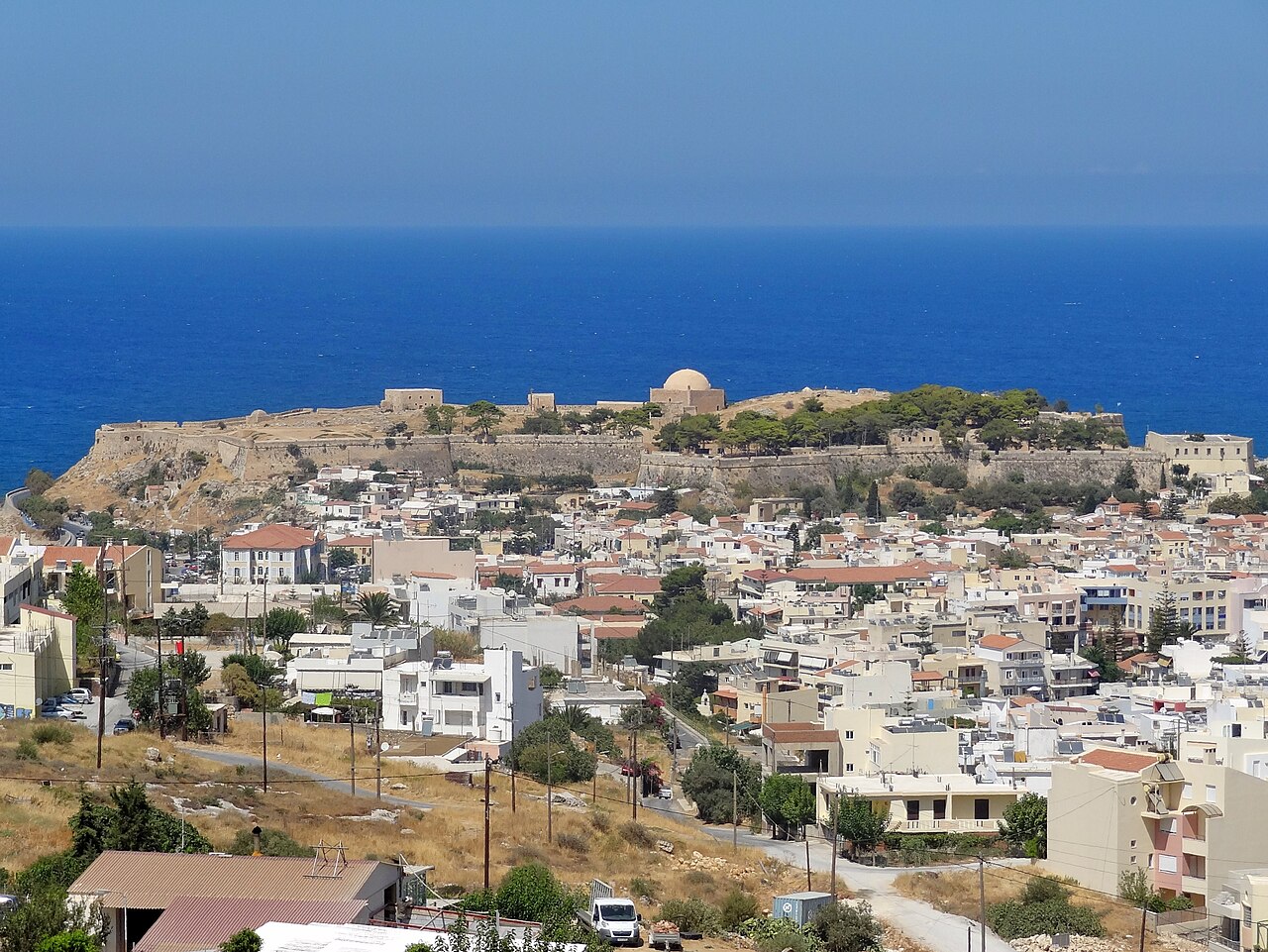
Fortezza of Rethymno
35.3722° N · 24.4711° E · Fortress
Fortezza of Rethymno is a fortress in Rethymno, Greece. Built by Venice between 1583 and 1588. Covers over 130,000 square meters. Most visitors spend 1-2 hours here. The free Lokali audio guide runs 6 minutes.
✓ Verified October 2026 · how we write these guides
Visitor facts
| Time needed | 1-2 hours |
|---|---|
| Lokali audio guide | 6 min · free |
| Type | Fortress |
| Best for | History |
| Location | Rethymno, Greece |
| Coordinates | 35.3722, 24.4711 |
| Languages | 45, in the Lokali app |
The story
The wind catches first — steady, salt-laced, pushing across this high plateau as it has for centuries. Beneath your feet, the limestone is worn smooth by half a million footsteps, and if you stand still for a moment, you can feel the fortress breathe — the old stone expanding in the midday heat, contracting as evening comes on. This is the Fortezza, Rethymno's star-shaped crown, perched above the harbor where Venetian engineers once scanned the horizon for Ottoman sails.
The fortress you are standing in was built between 1583 and 1588, a desperate project. Venice had ruled Crete for nearly four centuries, but the island's northern coast was under constant threat. Rethymno's old medieval walls had proven useless against cannon fire, so the Republic sent military architect Sforza Pallavicini to design something modern — a low, angular fortress built to deflect shot rather than absorb it. The result was this massive star, its bastions jutting out at sharp angles to create overlapping fields of fire. Every inch of the perimeter could be covered by artillery. On paper, it was impregnable.
Walk toward the seaward ramparts and you will see why the Venetians chose this hill. The drop to the water is steep, the rock face nearly sheer in places. From up here, lookouts could spot approaching ships hours before they reached the harbor. The fortifications stretch across nearly a hundred and thirty thousand square meters, making this one of the largest surviving Venetian fortresses in the Mediterranean. The walls are thick — some sections run more than four meters deep — and they are built from the same honey-colored limestone as the hill itself, so the whole structure seems to grow organically from the bedrock.
But the Fortezza never fulfilled its promise. In 1645, Ottoman forces landed on Crete and began a slow, grinding conquest of the island. Rethymno fell in 1646 after a brief siege — not because the walls failed, but because there were not enough soldiers to defend them. The fortress had been built to house a garrison of several thousand, but Venice, stretched thin across its empire, could spare only a few hundred. When the Ottomans arrived, the outcome was never in doubt.
The Ottomans kept the fortress and adapted it to their own needs. The Venetian church of Saint Nicholas, which once stood at the heart of the complex, was converted into a mosque — the Sultan Ibrahim Mosque, whose dome still rises above the parade ground. Step inside if the door is open. The interior is bare now, stripped of decoration, but the acoustics are remarkable. A whisper carries from one side of the dome to the other, a trick of geometry that Ottoman architects prized. The mihrab, the prayer niche facing Mecca, is still visible in the southern wall, a quiet reminder of the centuries when this was a place of Muslim worship.
Move through the fortress slowly and you will notice the layers. Venetian gun emplacements sit beside Ottoman powder magazines. A ruined barracks block shows both Christian and Islamic construction techniques — arched windows with Venetian proportions, doorways with Ottoman lintels. In some corners, you can still see graffiti scratched into the stone by soldiers who served here, names and dates in Greek, Italian, Turkish, layered one atop the other like sediment.
The fortress was never just a military installation. During the Ottoman period, it became a small town unto itself, with homes, shops, and workshops clustered inside the walls. Families lived here for generations, raising children in the shadow of the ramparts. By the nineteenth century, the military importance of the Fortezza had faded, and it became a quiet residential quarter. That ended during the Second World War, when German forces used the fortress as a base and cleared out the civilian population. After the war, the buildings inside the walls were left to decay, and for decades the Fortezza stood empty, visited only by goats and the occasional curious traveler.
Today, the fortress is open to the sky. Most of the interior structures are ruins — roofless barracks, collapsed cisterns, walls that stop abruptly mid-height. But this openness has a strange beauty. Wildflowers grow in the cracks between paving stones. Lizards dart across the sunbaked paths. In spring, the scent of wild thyme rises from the ground, and the whole plateau hums with bees. Walk the perimeter path and you will pass through light and shadow, the sun cutting sharp angles across the bastions, the sea glittering far below.
From the eastern ramparts, the view opens across the old town — a tight weave of Venetian and Ottoman houses, their rooftops climbing the hillside in uneven terraces. Beyond them, the modern city spreads along the coast, white apartment blocks and hotels giving way to the dark line of the Cretan mountains. On a clear day, you can see the peaks of Psiloritis, the island's highest range, snowcapped even in early summer.
The fortress does not shout. It does not need to. It simply stands, weathered and patient, holding its ground above the harbor. As you walk back toward the gate, notice the way the stone changes color in the shifting light — gold at noon, rose in the late afternoon, deep amber as the sun drops toward the sea. The Fortezza has seen empires rise and fall, has sheltered soldiers and families and goats and now you. When you leave, it will still be here, breathing with the wind.
Key facts
What to look for
Practical tips
Common questions
How long do you need at Fortezza of Rethymno?
Plan 1-2 hours. That is the time most visitors spend at Fortezza of Rethymno. The free Lokali audio guide runs 6 minutes and is made to listen to while you walk.
Is there a free audio guide to Fortezza of Rethymno?
Yes — the Lokali app narrates Fortezza of Rethymno free of charge in 50+ languages. No ticket, tour group or subscription, and it works offline once downloaded.
Where is Fortezza of Rethymno?
Fortezza of Rethymno is in Rethymno, Greece, at 35.3722, 24.4711. Tap the map link on this page for directions.
What should you know before visiting Fortezza of Rethymno?
Wear sturdy shoes — paths are uneven limestone
What is Fortezza of Rethymno known for?
Built by Venice between 1583 and 1588
What is the best time to visit Fortezza of Rethymno?
Visit late afternoon for softer light and cooler temperatures
On the map
Opens directions to Fortezza of Rethymno from your location.
More to see in Rethymno


Hear Fortezza of Rethymno in your language
The full story, narrated, in 50+ languages. Download it before you go and it plays offline, at your own pace, with no ticket and no tour group.