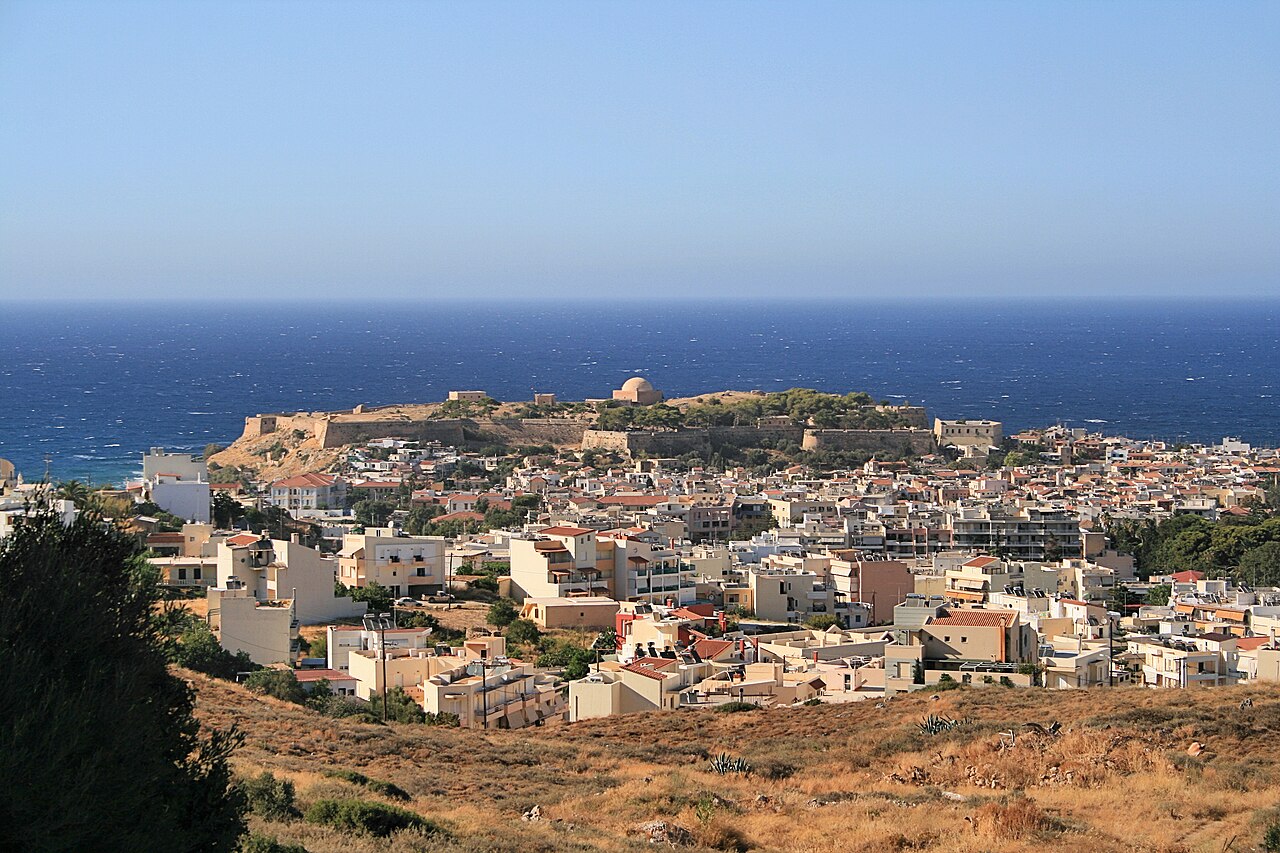
Rethymno Old Town
35.3715° N · 24.4734° E · Neighborhood
Rethymno Old Town is a neighborhood in Rethymno, Greece. Built primarily during Venetian rule, sixteenth and seventeenth centuries. One of Greece's best-preserved Renaissance settlements. Most visitors spend 1-2 hours here. The free Lokali audio guide runs 5 minutes.
✓ Verified October 2026 · how we write these guides
Visitor facts
| Time needed | 1-2 hours |
|---|---|
| Lokali audio guide | 5 min · free |
| Type | Neighborhood |
| Best for | Authentic finds |
| Location | Rethymno, Greece |
| Coordinates | 35.3715, 24.4734 |
| Languages | 45, in the Lokali app |
The story
The cobblestones beneath your feet are worn smooth by five centuries of footsteps — Venetian merchants, Ottoman officials, Greek rebels, tourists with cameras. The stone glows warm in the afternoon light, honey-coloured limestone that seems to hold the sun even after dark. Above you, wooden balconies lean close enough that neighbours could pass a cup of coffee across the narrow lane.
Rethymno's old town is one of the best-preserved Renaissance settlements in Greece, built almost entirely during Venetian rule between the late sixteenth and early seventeenth centuries. Unlike Chania or Heraklion, which suffered heavy bombing in the Second World War, Rethymno emerged largely intact. What you see around you — the arched doorways, the stone lintels carved with coats of arms, the fountains set into street corners — is remarkably close to what a traveller would have encountered in sixteen hundred.
The Venetians fortified this coast to protect their trade routes to the Levant. They built the massive Fortezza fortress on the hill above town, visible from almost every alley, and laid out a grid of streets below it. The architecture here is hybrid by necessity. Venetian Gothic arches frame doorways, but the overhanging wooden balconies are Ottoman additions from the seventeenth century, when Crete fell to the Turks. Many buildings served both empires — a Venetian loggia became a mosque, a Catholic chapel became Orthodox.
Walk slowly through the lanes and you will notice the layers. A Venetian lion carved above a doorway. A Turkish fountain with Arabic calligraphy. A neoclassical balcony added in the nineteenth century after independence. The stone itself tells the story — pale limestone quarried from the hills inland, darkened by centuries of smoke and rain, patched with brick where earthquake damage was repaired.
The harbour sits at the northern edge of the old town, a small crescent of water protected by a long stone breakwater. Venetian warehouses line the waterfront, their ground floors now converted to tavernas and cafes. In the early morning, before the crowds arrive, fishermen still mend nets on the quay, just as they did when galleys anchored here. The lighthouse at the end of the breakwater dates from the eighteen-thirties, built during the Egyptian occupation of Crete.
Rethymno never became a major port — it was always overshadowed by Heraklion to the east and Chania to the west. That secondary status may have saved it. There was less reason to demolish and rebuild, less pressure to modernize. The old town remained a residential neighbourhood well into the twentieth century, which meant the buildings were maintained rather than abandoned. Today, many of the stone houses are still lived in by local families, not just rented to tourists.
The Rimondi Fountain stands in a small square near the centre of the old town, built in sixteen-twenty-six by the Venetian governor Rimondi. Three stone lion heads spout water into basins below, and the carved columns on either side bear Latin inscriptions. For centuries, this was the main public water source for the neighbourhood. Women gathered here to fill jugs, children played in the overflow, and travellers watered their horses. The fountain still runs, fed by the same mountain springs.
As you wander, notice the textures underfoot. Some alleys are paved with smooth river stones set in geometric patterns, a technique the Ottomans brought from Anatolia. Others are simple cobblestone, irregular and uneven. A few lanes are still bare earth, packed hard by generations of use. The narrowest passages are barely wide enough for two people to pass — they were designed for donkeys and handcarts, not cars.
The old town feels quieter in the late afternoon, when the tour groups have moved on and the light turns golden. Locals emerge to sit on doorsteps, and the smell of baking bread drifts from bakeries tucked into ground-floor rooms. This is when the place feels least like a museum and most like a living neighbourhood. The stones are the same, but the life inside them continues.
Above the rooftops, the Fortezza rises on its hill, a massive star-shaped fortress that dominates the skyline. It was built in the fifteen-seventies, after a devastating pirate raid convinced the Venetians that Rethymno needed stronger defences. The walls are immense — thick enough to withstand cannon fire, high enough to command views across the entire coast. The fortress is worth a separate visit, but even from down here in the alleys, its presence shapes the town.
Rethymno's old town is not a single monument but a fabric — a weave of stone and wood and memory, patched and repaired over centuries. As you leave, glance back at the balconies leaning over the lane, the carved lintels, the worn steps. This place has outlasted empires. It will outlast us too.
Key facts
What to look for
Practical tips
Common questions
How long do you need at Rethymno Old Town?
Plan 1-2 hours. That is the time most visitors spend at Rethymno Old Town. The free Lokali audio guide runs 5 minutes and is made to listen to while you walk.
Is there a free audio guide to Rethymno Old Town?
Yes — the Lokali app narrates Rethymno Old Town free of charge in 50+ languages. No ticket, tour group or subscription, and it works offline once downloaded.
Where is Rethymno Old Town?
Rethymno Old Town is in Rethymno, Greece, at 35.3715, 24.4734. Tap the map link on this page for directions.
What should you know before visiting Rethymno Old Town?
Visit late afternoon when tour groups leave and locals emerge
What is Rethymno Old Town known for?
Built primarily during Venetian rule, sixteenth and seventeenth centuries
What is the best time to visit Rethymno Old Town?
Visit late afternoon when tour groups leave and locals emerge
On the map
Opens directions to Rethymno Old Town from your location.
More to see in Rethymno


Hear Rethymno Old Town in your language
The full story, narrated, in 50+ languages. Download it before you go and it plays offline, at your own pace, with no ticket and no tour group.