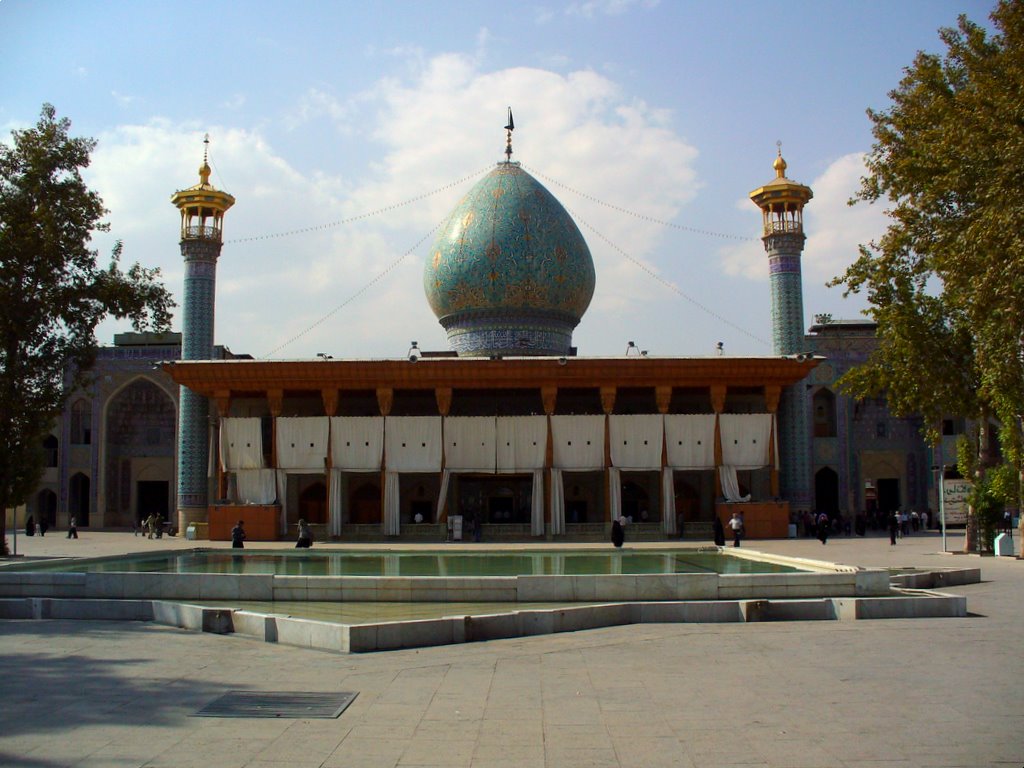
Photo: Roozbeh Taassob · CC BY-SA 3.0 · Wikimedia Commons
Shah Cheragh is a shrine complex in Shiraz, Iranian national heritage site. Shah Cheragh means King of the Light in Persian. The free Lokali audio guide runs 7 minutes.
✓ Published October 2026 · how we write these guides
Visitor facts
| Lokali audio guide | 7 min · free |
|---|---|
| Type | Memorial |
| Location | Shiraz County, Iran |
| Coordinates | 29.6096, 52.5433 |
| Official website | shahecheragh.ir |
| Languages | 50+, in the Lokali app |
The story
Take off your shoes, and the marble is cool beneath your feet. Ahead, through a tall doorway, the light changes. It breaks into thousands of small silver points that move as you move. Voices drop to a murmur. Somewhere a man is reciting prayers in a low, steady rhythm. This is Shah Cheragh, a shrine in the heart of Shiraz, and for many centuries people have come here for exactly this moment, the step from daylight into glass.
The name itself is a small story. In Persian, Shah Cheragh means "King of the Light." Before we explain where that name comes from, take a moment to look around the courtyard. Wide paving stretches out between the buildings. Pilgrims sit in small groups on the stone. Children run between them, and pigeons settle and lift again near the walls. This place has the busy, quiet feeling of a family home with many rooms.
At the centre of it all lies a grave. Shia Muslim tradition holds that this is the tomb of Ahmad ibn Musa, a son of the seventh Shia Imam, Musa al-Kazim. That makes him a brother of Imam Reza, whose great shrine stands in the city of Mashhad, far to the northeast. For Shia Muslims, the descendants of the Prophet's family carry deep spiritual weight. Their graves become places of prayer, comfort and pilgrimage.
How did a son of an Imam come to rest in southern Persia? According to tradition, Ahmad and other members of his family travelled into Persia during a time of conflict with the ruling Abbasid caliphs, the dynasty that ruled much of the Islamic world from Baghdad. The accounts say he was pursued and killed in this region. For a long time, his grave was simply lost to memory, hidden among the ordinary streets of a growing city.
Then comes the light. Legend has it that, centuries later, a local man noticed a glow rising from this spot at night. He watched it again and again. When people finally dug at the place, the story says, they found a grave and a body still at peace. From that glowing light, the shrine took its name. It is a tale told with affection, and it is best heard as faith and folklore rather than recorded history.
What is better documented is the building work that followed. Rulers and patrons of Shiraz added to the shrine over the medieval centuries. One name that often appears is a fourteenth century queen, Tashi Khatun, who is credited with major building and with founding a religious school here. Earthquakes struck Shiraz many times over the years, and the shrine was damaged, repaired and rebuilt again and again. Much of what you see today comes from later restorations, including work in the twentieth century.
Now look up at the dome. It has a bulging, onion-like shape, a form common in Iranian shrines. Its surface is covered in glazed tiles, and their colours change with the hour. In the morning the blue reads cool and pale. In the late afternoon it warms toward turquoise. Below it, slender minarets rise beside the entrance. The whole silhouette is designed to be seen from a distance, so that pilgrims know where to walk.
Here is the first surprise most visitors miss. The interior is not covered in glass by accident. This craft is called ayeneh-kari, which means mirror work. Craftsmen cut mirror into tiny pieces, often triangles, diamonds and thin strips. Then they set each piece by hand into plaster, in patterns that repeat across walls and ceilings. A single lamp becomes a field of stars. The goal is not decoration alone. It is to fill a holy space with light, the same light the shrine is named for.
Step closer to the tomb chamber, and you will see the grave enclosed by a decorated metal screen. Pilgrims touch it, press their foreheads against it, and tie small prayers into their thoughts. Some slip folded money or written requests through the gaps. Men and women usually enter through separate areas, and the mood can be intense. You may see people weeping openly. Try to stand to one side, move slowly, and let the space belong first to those who came to pray.
The second surprise concerns your own clothes. Women visiting the shrine are expected to wear a chador, the full, loose cloak worn by many Iranian women in religious places. If you do not have one, the shrine usually lends them near the entrance. Foreign visitors are often met by a volunteer guide from the shrine itself. These guides speak with you, explain customs, and answer questions. Many travellers say these conversations become the most human part of their visit.
This place also carries recent grief. In 2022 and again in 2023, the shrine was the target of deadly attacks on worshippers. You may notice careful security at the gates, with bag checks and attentive staff. For local families, these events are still close. The pilgrims returning to the courtyard each day are part of the answer. They keep coming, sitting on the same stones, praying in the same rooms.
Shah Cheragh is also tied closely to the old city around it. The shrine stands within walking distance of the old bazaar quarter of Shiraz, a city known across Iran for its poets, its gardens and its love of conversation. Shiraz is the city of Hafez and Saadi, two poets whose verses many Iranians can still quote from memory. Nearby, another shrine is associated with a second brother from the same family, so the neighbourhood has the feel of a sacred district rather than a single monument.
If you can, return at different times. In daylight, the courtyard feels open and social. After dark, the lights come on across the dome and the facade, and the mirror work inside seems to glow from within. Evening is also when many local families arrive after work. The crowd changes. The sound changes. A visit at night shows the shrine as something lived in, not only something admired.
Before you leave, stand once more at the edge of the courtyard. Feel the stone under your feet again. Look back through the doorway at the flicker of mirror light, and listen to the low voices of prayer. Then step out toward the streets of Shiraz, carrying the name with you... King of the Light. Notice, as you walk, how often you turn back to see the dome one more time.
Key facts
What to look for
Practical tips
Common questions
Is there a free audio guide to Shah Cheragh?
Yes — the Lokali app narrates Shah Cheragh free of charge in 50+ languages. The guide runs about 7 minutes, covers the history, what to look for on site and practical tips, and works offline once downloaded.
Where is Shah Cheragh?
Shah Cheragh is near Shiraz County, Iran, at 29.6096, 52.5433. Tap the map link on this page for directions from where you are.
What is Shah Cheragh known for?
Shah Cheragh means King of the Light in Persian. Shrine holds the tomb of Ahmad ibn Musa.
What should you look for at Shah Cheragh?
Thousands of tiny mirror pieces covering the inner ceilings. The onion-shaped dome covered in glazed blue tiles. The decorated metal screen surrounding the tomb.
What should you know before visiting Shah Cheragh?
Women should bring or borrow a chador at the entrance. Remove shoes before entering the inner sanctuary rooms.
On the map
Opens directions to Shah Cheragh from your location.
More to see near Shah Cheragh


Hear Shah Cheragh in your language
The full story, narrated, in 50+ languages. Download it before you go and it plays offline, at your own pace, with no ticket and no tour group.