
Arg of Karim Khan
29.6174° N · 52.5446° E · Fortification
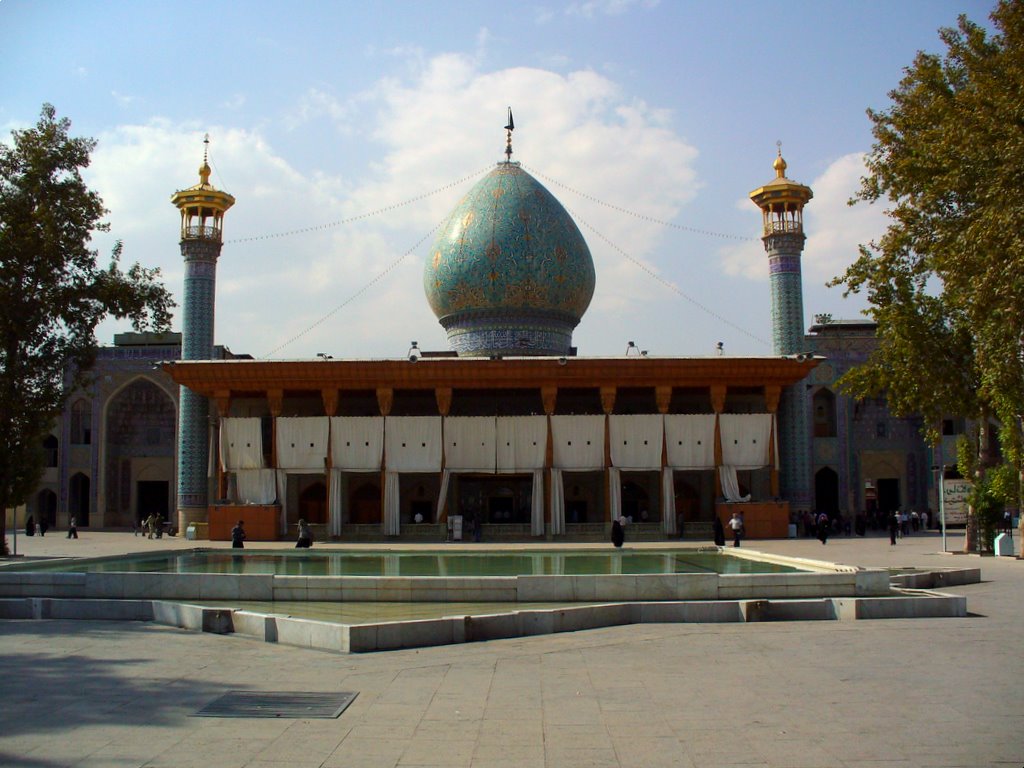
Photo: User:Hardscarf · CC BY-SA 3.0 · Wikimedia Commons
Arg of Karim Khan is a citadel in Shiraz, Iranian national heritage site. Built in the eighteenth century for Karim Khan Zand. The free Lokali audio guide runs 7 minutes.
✓ Published October 2026 · how we write these guides
Visitor facts
| Lokali audio guide | 7 min · free |
|---|---|
| Type | Fortification |
| Location | Shiraz, Iran |
| Coordinates | 29.6174, 52.5446 |
| Languages | 50+, in the Lokali app |
The story
Stand still for a moment and look up. A wall of warm brown brick rises in front of you, plain and heavy, almost without windows. At each corner, a round tower swells outward like the shoulder of a giant. Traffic hums behind you. Inside those walls, though, the noise drops away. There is water, the green of orange trees, and the soft echo of footsteps on stone. This is the Arg of Karim Khan, the citadel at the heart of Shiraz, the capital of Fars Province.
The word arg means citadel. It is a fortified compound where a ruler lived, worked, and kept his guard. This one was built in the second half of the eighteenth century for Karim Khan Zand. He was the founder of the Zand dynasty, a family that ruled much of Iran for a few decades in that century. Karim Khan made Shiraz his capital. He then set out to give the city buildings that matched its new importance. This fortress was the centre of that plan.
Here is the first detail that surprises many visitors. Karim Khan never called himself shah, the Persian word for king. He preferred the title Vakil, which can be translated as regent or representative. Popular tradition says he saw himself as the representative of the people. That is why you will hear his name on so many places in this neighbourhood. The Vakil Bazaar, the Vakil Mosque, and the Vakil Bathhouse all stand within a short walk of where you are now.
Now look carefully at the corner towers. The brick is not laid in flat, simple rows. It forms raised patterns of diamonds and zigzags that catch the light and throw small shadows. In the morning sun, the patterns look sharp. Late in the day, they soften into a texture like woven cloth. This decoration costs nothing in extra material. It is just the skill of the bricklayers, turning a defensive wall into something pleasant to look at.
And now the second surprise. Find the tower in the southeast corner and compare it with the others. It leans. The tilt is clear enough to see with your own eyes. The usual explanation is that the ground underneath settled over time. Many sources connect this to water below the tower, often described as a cistern or bath foundation. Locals sometimes call it the leaning tower of Shiraz. It has stood like this for generations, and it is now carefully watched by conservators.
Walk to the main entrance. Above the gate, there is a tiled panel in blues, yellows, and white. It shows a scene from the Shahnameh, the Book of Kings. This is the great Persian epic poem, written by the poet Ferdowsi about a thousand years ago. The panel shows the hero Rostam fighting the White Demon. Iranians grow up with these stories, much as other children grow up with fairy tales. Many sources date this tile panel to a later period than the citadel itself.
Step through into the courtyard. The change is immediate. The light becomes softer, and the air feels cooler. Orange trees stand in neat rows, and a long pool of water runs through the middle. In spring, when the trees blossom, the courtyard can fill with the scent of orange flowers. This garden plan follows a very old Persian idea. A walled garden with water at its centre was a picture of paradise. In fact, the English word paradise comes, through Greek, from an old Persian word for an enclosed garden.
Around the courtyard, look at the rooms behind the open arches. Some were living quarters. Others were reception spaces where the ruler and his family could sit in the shade and look over the water. Inside, parts of the walls and ceilings still carry painted decoration. You may see flowers, birds, and fine geometric frames. Some of these paintings are faded and patched, and some are clearly later additions. Together they show how many hands have worked on this building over two and a half centuries.
The compound also contains a private bathhouse. In eighteenth-century Iran, a bathhouse was more than a place to wash. It was a place to rest, to talk, and to warm the body in winter. The design used underground channels to carry heat and water. Even in a fortress, comfort mattered. If the bath area is open when you visit, notice how the rooms move from cooler spaces near the entrance to warmer chambers deeper inside.
The Zand dynasty did not last long. Karim Khan died in the late 1770s, and his successors fought each other for power. The Qajar dynasty soon took control of Iran and moved the capital to Tehran. A well-known historical account says that the first Qajar ruler, Agha Mohammad Khan, held a deep grudge against the Zand family. He ordered the destruction of many Zand buildings in Shiraz. This citadel survived, but its role changed.
Under the Qajars, the Arg became the seat of the provincial governor. Later, in the twentieth century, it served a much darker purpose. For a period, the fortress was used as a prison. Think about that as you stand in this calm garden. The same thick walls that protected a ruler were also used to hold people inside. Eventually the building was handed over to Iran's cultural heritage authorities. It was restored and opened to the public as a museum.
Today, the citadel works as a kind of doorway into old Shiraz. From here, you can walk to the vaulted lanes of the Vakil Bazaar, with its spices, carpets, and copper. Nearby is the Vakil Mosque, known for its carved stone columns. Seen together, these buildings show what Karim Khan wanted his capital to look like. They are practical, strong, and finished with careful decoration. The citadel is the anchor of that whole district.
Before you leave, find a quiet spot near the pool. Let your eyes travel from the water to the orange trees, then up to the brick walls and the open sky. Listen for small sounds... the birds in the branches, the low talk of families, the steps of other visitors on the stone. When you walk back out through the gate, turn once and look at the leaning tower. It has stood here, slightly tilted, through rulers, governors, prisoners, and now you.
Key facts
What to look for
Practical tips
Common questions
Is there a free audio guide to Arg of Karim Khan?
Yes — the Lokali app narrates Arg of Karim Khan free of charge in 50+ languages. The guide runs about 7 minutes, covers the history, what to look for on site and practical tips, and works offline once downloaded.
Where is Arg of Karim Khan?
Arg of Karim Khan is in Shiraz, Iran, at 29.6174, 52.5446. Tap the map link on this page for directions from where you are.
What is Arg of Karim Khan known for?
Built in the eighteenth century for Karim Khan Zand. Karim Khan used the title Vakil instead of shah.
What should you look for at Arg of Karim Khan?
The visibly leaning tower at the southeast corner. Diamond and zigzag brick patterns on the corner towers. Tiled panel of Rostam fighting the White Demon.
What should you know before visiting Arg of Karim Khan?
Visit in early morning for softer light and fewer crowds. Come in spring to smell the orange blossoms.
When is the best time to visit Arg of Karim Khan?
Visit in early morning for softer light and fewer crowds.
On the map
Opens directions to Arg of Karim Khan from your location.
More to see in Shiraz


Hear Arg of Karim Khan in your language
The full story, narrated, in 50+ languages. Download it before you go and it plays offline, at your own pace, with no ticket and no tour group.