
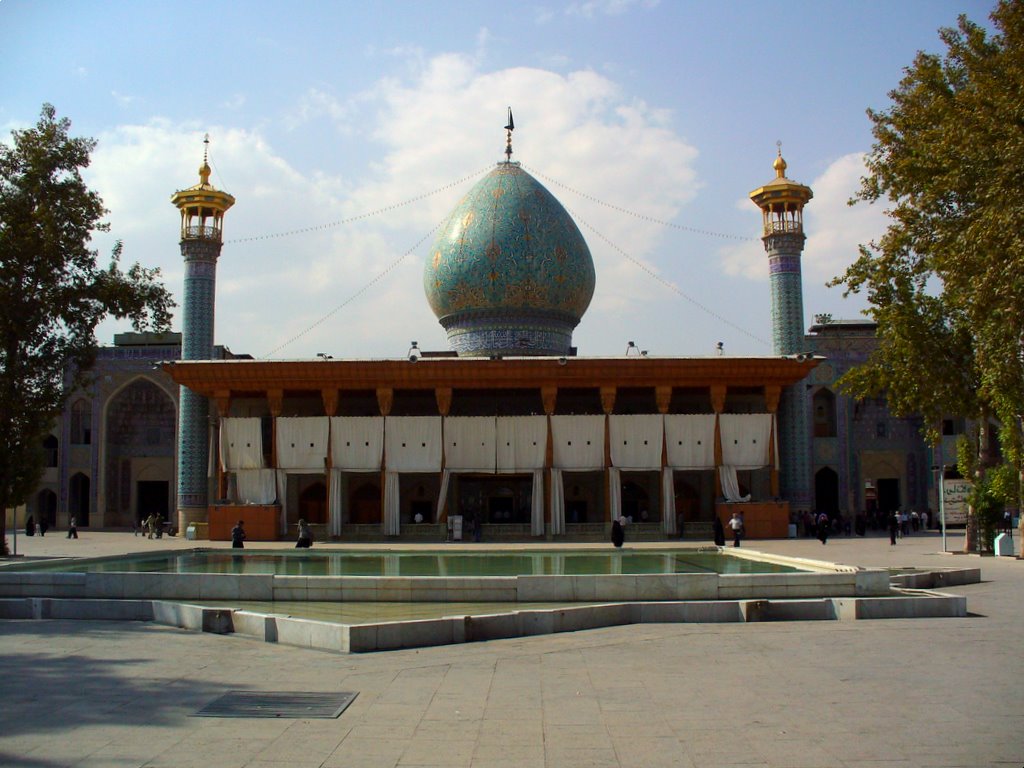
Photo: Ondřej Žváček · CC BY 2.5 · Wikimedia Commons
Tomb of Hafez is a tomb in Shiraz, Iranian national heritage site. Hafez was a fourteenth-century poet born in Shiraz. The free Lokali audio guide runs 7 minutes.
✓ Published October 2026 · how we write these guides
Visitor facts
| Lokali audio guide | 7 min · free |
|---|---|
| Type | Memorial |
| Location | Shiraz, Iran |
| Coordinates | 29.6258, 52.5584 |
| Languages | 50+, in the Lokali app |
The story
Listen first. Somewhere close by, someone is reciting poetry under their breath. Water moves softly in a long stone channel. Orange trees line the paths, and in spring the air here is heavy with the scent of their blossoms. You are standing in a garden in Shiraz, and the people around you are not only tourists. Many of them have come to visit an old friend, a poet who died more than six hundred years ago.
This is the Hafezieh, the tomb and memorial garden of Hafez. He is one of the most loved poets in the Persian language. His full name was Shams al-Din Muhammad, and he lived in the fourteenth century. He was born in Shiraz and died in Shiraz. He spent almost his whole life in this city of gardens, wine, and roses. He wrote about all three, and about God, longing, and the foolishness of hypocrites.
The name Hafez is a title, not a family name. It means someone who has memorised the Quran by heart, and tradition says the poet did exactly that. Later generations gave him another title as well: the Tongue of the Unseen. Readers felt that his verses carried a hidden wisdom. They believed the poems could speak directly to the person reading them, even centuries later. That belief is still alive in this garden today.
Look around at the people near the tomb. Some hold a small book, close their eyes, make a silent wish, and open it at a random page. This is called fal-e Hafez, the fortune of Hafez. The book is his Divan, his collected poems. The verse on the open page is read as an answer to the question in the reader's heart. Across Iran, families still do this at home, especially on Yalda, the longest night of the year.
Near the entrance, you may also see street vendors with a small bird, often a canary or a parakeet. For a small tip, the bird picks a folded card with its beak. On the card is a line of Hafez and its meaning for you. It is a gentle piece of street theatre. It is also a sign of how deeply this poet lives in everyday life, far beyond books and classrooms.
Now walk toward the centre of the garden. The structure you see is the open pavilion over the grave. It was built in the 1930s, and the French architect and archaeologist André Godard was closely involved in the design. Godard worked for many years in Iran on museums and historic monuments. His goal here was to honour older Persian building traditions in a modern, open form.
The pavilion has no walls. Eight slender stone columns hold up a dome, so the tomb stays open to the sky, the trees, and the people. Look up at the dome itself. Its shape is often compared to the hat of a dervish, a Sufi mystic. That is a fitting image. Sufism, the mystical tradition in Islam, runs through many of Hafez's poems. On the outside, the dome is covered in copper, and the light changes its colour through the day.
Now step under the dome and look up again. The inner surface is covered with tile mosaic in deep blues, turquoise, white, and touches of yellow. The patterns spread out like a flower or a starburst. In late afternoon, the colours glow softly. This is a good moment to pause. Very few visitors look up for long. Most of them look down, at the stone in the centre.
The tombstone is a long slab of pale alabaster, raised on a low platform. Look closely at its surface. Lines of graceful calligraphy cover the stone, and these are verses by Hafez himself. The stone dates from an earlier memorial that was built in the eighteenth century under Karim Khan Zand. He ruled much of Iran from Shiraz and filled the city with gardens and monuments. So the newer pavilion protects an older gift.
Watch what people do at the stone. Many touch it gently with their fingertips. Some rest a hand on it while they read a poem aloud. Others stand in silence for a long time. Here is something many foreign visitors do not expect: for many Iranians, this is not a museum visit. It is closer to a meeting. People come on happy days and sad days, before exams and after weddings, to share a moment with the poet.
Hafez also travelled far beyond Iran, through his words. In the nineteenth century, the German writer Goethe read Hafez in translation and admired him deeply. Goethe was inspired to write a whole collection of poems, the West-Eastern Divan, in conversation with the Persian master. Translators in English, French, and many other languages have tried to catch his music. Most of them say the same thing: the original is impossible to fully carry across.
Before you leave, walk along the paths away from the pavilion. Notice the tall dark cypress trees. In Persian poetry, the cypress is a classic image for a graceful, upright beloved. Look at the long pools and channels of water. They follow the old Persian idea of the garden as a small paradise on earth. Hafez wrote often of the gardens of Shiraz. Here, the city has given him one of his own.
If you can, stay until evening. As the light fades, the garden fills with families, students, and couples. The pavilion is lit, and the tiles glow against the dark sky. Voices rise and fall as people read verses to each other. Some evenings, you may hear someone singing a poem softly. It is a reminder that this is a living place, not a frozen one.
So, take one last look at the alabaster stone and the open dome above it. Breathe in the scent of the trees. If someone near you is reading aloud, listen for the rhythm, even if you do not understand the words. As you walk back toward the gate and the traffic of Shiraz, you carry a little of that rhythm with you... which is exactly what Hafez's readers have done for six centuries.
Key facts
What to look for
Practical tips
Common questions
Is there a free audio guide to Tomb of Hafez?
Yes — the Lokali app narrates Tomb of Hafez free of charge in 50+ languages. The guide runs about 7 minutes, covers the history, what to look for on site and practical tips, and works offline once downloaded.
Where is Tomb of Hafez?
Tomb of Hafez is in Shiraz, Iran, at 29.6258, 52.5584. Tap the map link on this page for directions from where you are.
What is Tomb of Hafez known for?
Hafez was a fourteenth-century poet born in Shiraz. The name Hafez means one who memorised the Quran.
What should you look for at Tomb of Hafez?
Calligraphy of Hafez's verses carved into the alabaster stone. Blue and turquoise tile mosaic inside the dome. Copper dome shaped like a dervish's hat.
What should you know before visiting Tomb of Hafez?
Visit in the evening when locals gather and the pavilion is lit. Try a fal-e Hafez by opening the Divan at random.
When is the best time to visit Tomb of Hafez?
Come in spring to smell the orange blossoms.
On the map
Opens directions to Tomb of Hafez from your location.
More to see in Shiraz



Hear Tomb of Hafez in your language
The full story, narrated, in 50+ languages. Download it before you go and it plays offline, at your own pace, with no ticket and no tour group.